 Live Science Plus





You are now subscribed
Your newsletter sign-up was successful
Want to add more newsletters?

Delivered Daily
Daily Newsletter
Sign up for the latest discoveries, groundbreaking research and fascinating breakthroughs that impact you and the wider world direct to your inbox.

Once a week
Life's Little Mysteries
Feed your curiosity with an exclusive mystery every week, solved with science and delivered direct to your inbox before it's seen anywhere else.

Once a week
How It Works
Sign up to our free science & technology newsletter for your weekly fix of fascinating articles, quick quizzes, amazing images, and more

Delivered daily
Space.com Newsletter
Breaking space news, the latest updates on rocket launches, skywatching events and more!
Once a month
Watch This Space
Sign up to our monthly entertainment newsletter to keep up with all our coverage of the latest sci-fi and space movies, tv shows, games and books.

Once a week
Night Sky This Week
Discover this week's must-see night sky events, moon phases, and stunning astrophotos. Sign up for our skywatching newsletter and explore the universe with us!
Join the club
Get full access to premium articles, exclusive features and a growing list of member rewards.
The fossil of an ancient amphibious reptile with a crocodile's body and a fish's tail has been unearthed in Oregon. Scientists believe the creature's remains were transported by geologic processes nearly 5,000 miles away from where it originally died more than 100 million years ago.
The new fossil is the oldest crocodilian ever unearthed in Oregon and one of the few to be unearthed on this side of the Pacific. The “hybrid” animal is thought to be a new species within the genus Thalattosuchia, a group of crocodilians living during the age of dinosaurs.
Rocky ride
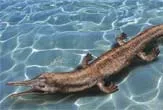
Scientists uncovered the remains [image] of the six- to eight-foot-long reptile in Jurassic rock on private property in the Snowshoe Formation of the Izee Terrane, a rock formation in Oregon. They knew the croc came from Asia due to distinct anatomical features, such as the way its ribs were connected to the rest of its body.
The rock-entombed animal migrated eastward from perhaps Japan via continental drift, a theory of land movement in geological time, suggests William Orr, part of the fossil-discovery team and director of the Thomas Condon State Museum of Fossils at the University of Oregon.
During ancient times, the Pacific Ocean was much wider than it is today, and Orr suggests the rocky ride could have taken as long as 100 million years before reaching North America.
“This idea is kind of profound, that you can move pieces of the Earth’s real estate about the globe,” Orr told LiveScience.
Into the ocean
Like modern-day crocodilians, the creature sported both land-lubbing and ocean-faring equipment. It had short, stubby legs, which the scientists say would have allowed it to creep easily along the ground and lay eggs.
But the amphibious Thalattosuchia was also at home in the water. With webbed feet and a fish’s tail, the reptile was likely a swift swimmer that could pulse through the water in search of aquatic prey.
“The thing that makes this creature unique is its tail,” Orr said. Unlike today’s reptiles, the creature had a shark-like tail, an indication of its ability to maintain itself in a marine environment.
“[The animal] was awfully close to being purely aquatic,” Orr said.
- Images: Dinosaur Fossils
- Vote: Avian Ancestors: Dinosaurs That Learned to Fly
- Top 10 Amazing Things You Didn’t Know About Animals
- Fins of Ancient Marine Reptile Like Fiberglass
- All About Dinosaurs
