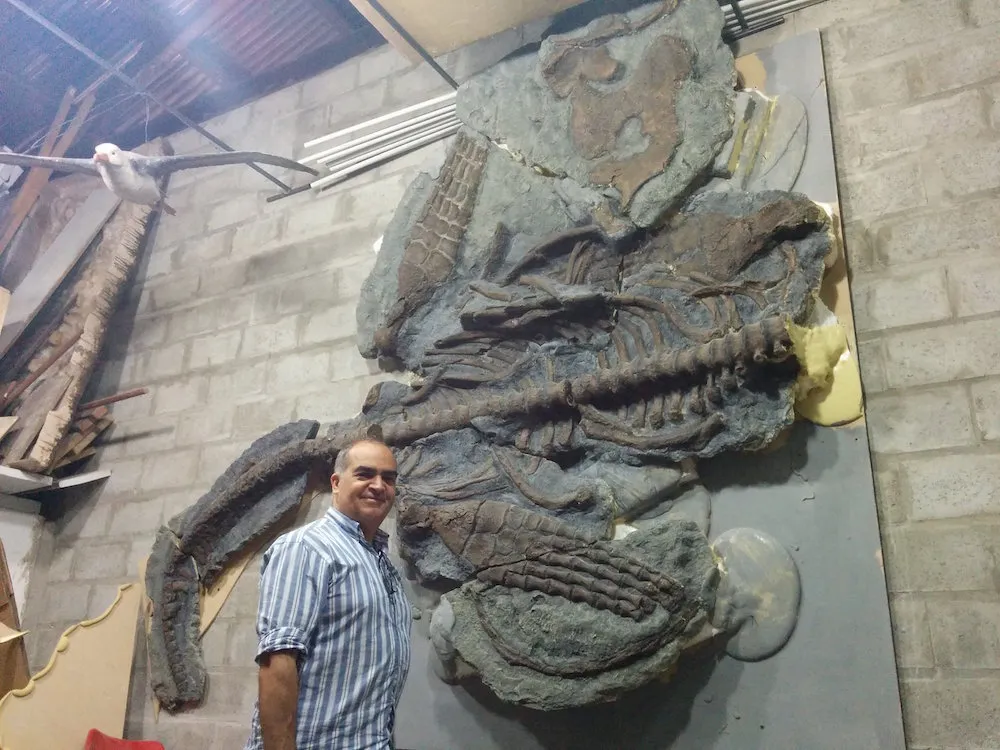
Plesiosaurs aren't dinosaurs, but they're just as enormous as some of their Cretaceous-age pals. A plesiosaur measuring about 23 feet (7 meters) long and dating back to about 65 million years ago was uncovered in Patagonia. Researchers suspect it represents a new genus and species, but they have yet to fully examine and name the creature, which is one of the largest plesiosaurs on record. [Read the full story on the Patagonian plesiosaur]
Full-size replica
Fernando Novas, a paleontologist at the Bernardino Rivadavia Natural Sciences Museum in Buenos Aires, stands next to a full-size cast of the plesiosaur he and his colleagues excavated in Patagonia.
The head and part of the neck are missing, but the reptile's long flippers, ribs and spine are in excellent condition. (Photo credit: Hernán Seoane)
Argentino Lake
A view of Argentino Lake, where the researchers found the plesiosaur fossil. (Photo credit: Fernando Novas)
Fossils at their feet
Sign up for the Live Science daily newsletter now
Get the world’s most fascinating discoveries delivered straight to your inbox.
People stand on the fossils embedded in rock (notice the large flipper on the right) at Argentino Lake. (Photo credit: Fernando Novas)
Underwater tail
People could see part of the plesiosaur's tail even before the excavation began. (Photo credit: Fernando Novas)
Sandbags
The researchers created a fort around the fossil using sandbags. (Photo credit: Fernando Novas)
Draining the pool
With the help of a generator, the researchers pumped the water out of the sandbag fort so that they could excavate the plesiosaur skeleton. (Photo credit: Fernando Novas)
Excavation in progress
Fernando Novas (right) helps his colleagues put plaster jackets on the stones containing the fossils.
Water continued to flood the enclosure, so the paleontologists had to almost continuously bail it out with buckets (left). (Photo credit: Courtesy of Fernando Novas)
Plasterwork
The paleontologists isolated the rock containing the fossil, including the plesiosaur's tail (seen here), and covered it in plaster to help protect it. (Photo credit: Fernando Novas)
Dry relief
On the last day of the excavation, the water subsided, and the researchers were able to work without it disrupting their dig.
"There were no waves," Novas said. "It was the perfect condition to work." (Photo credit: Courtesy of Fernando Novas)
Hot wheels
The landowner, Gerardo Povazsán, provided the researchers with a bulldozer so they could move the heavy fossils from the lake to a truck. (Photo credit: Courtesy of Fernando Novas)
Moving day
The researchers moved the nine blocks containing the heavy fossils into a truck. Once it was loaded, they drove it roughly 1,700 miles (2,745 kilometers) to Buenos Aires. (Photo credit: Fernando Novas)
Plesiosaur vertebrae
Novas and his colleagues are now excavating the plesiosaur fossils from the sandstone at a lab located at the Bernardino Rivadavia Natural Sciences Museum in Buenos Aires. (Photo credit: Hernán Seoane)
Laura is the managing editor at Live Science. She also runs the archaeology section and the Life's Little Mysteries series. Her work has appeared in The New York Times, Scholastic, Popular Science and Spectrum, a site on autism research. She has won multiple awards from the Society of Professional Journalists and the Washington Newspaper Publishers Association for her reporting at a weekly newspaper near Seattle. Laura holds a bachelor's degree in English literature and psychology from Washington University in St. Louis and a master's degree in science writing from NYU.