Get the world’s most fascinating discoveries delivered straight to your inbox.
You are now subscribed
Your newsletter sign-up was successful
Want to add more newsletters?
Join the club
Get full access to premium articles, exclusive features and a growing list of member rewards.
An account already exists for this email address, please log in.
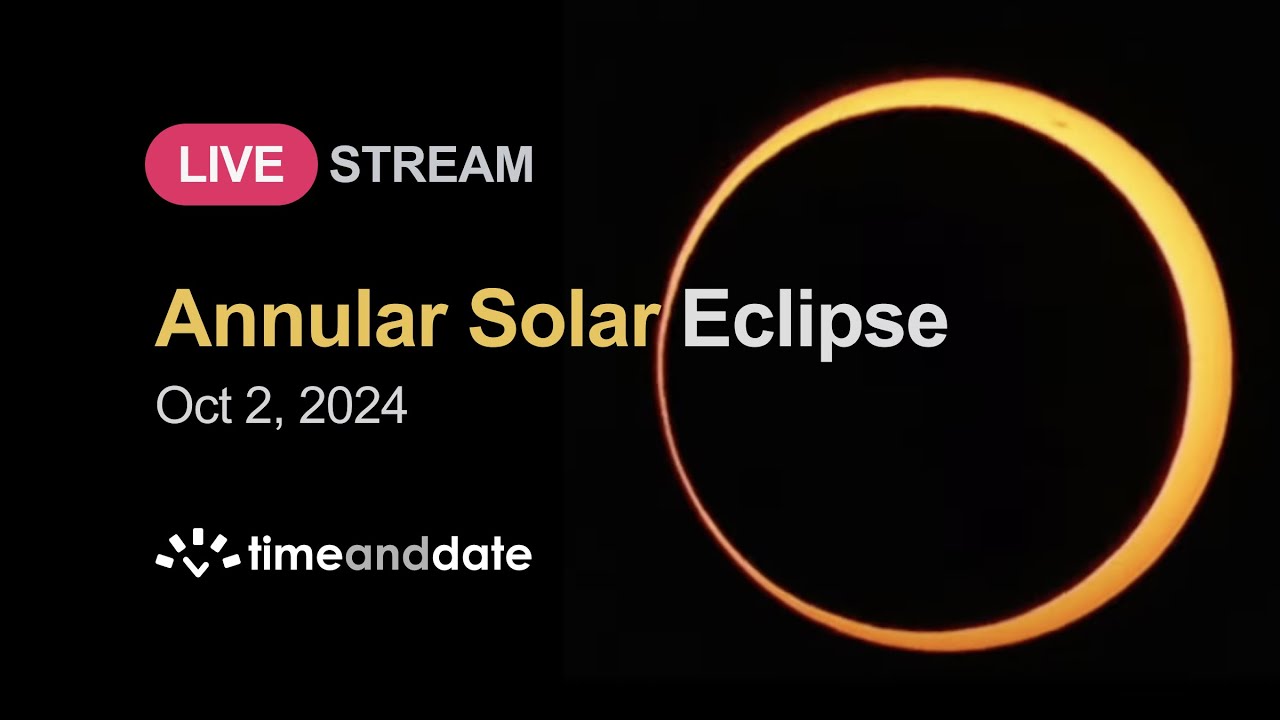
Watch live: A 'ring of fire' solar eclipse has begun over Easter Island
The Oct. 2 partial solar eclipse, known as an annular or "ring of fire" eclipse, is about to begin over Easter Island and South America. Watch it for free right here.
Right now, the moon's shadow is racing across the Pacific Ocean, creating a spectacular "ring of fire" eclipse that will soon be visible to skywatchers on Easter Island and the tip of South America.
If you're not located within the path of the eclipse — also called the path of annularity — don't fret. You can watch the whole thing unfold for free via the livestream below, courtesy of timeanddate.com. The partial phase of the eclipse has already begun, and the peak phase will last from 3:03 to 3:09 p.m. EDT (1903 to 1909 GMT), as seen from the Pacific island of Rapa Nui — a tourist destination better known as Easter Island.
The Oct. 2 event is a type of partial eclipse known as an annular solar eclipse. All solar eclipses occur when the moon is positioned precisely between Earth and the sun, always coming two weeks after a full moon. (The last one was September's Harvest Moon, which also featured a partial lunar eclipse.)
However, unlike the April 8 total solar eclipse that dazzled millions of skywatchers across North America, the moon is a bit further from Earth now and will never completely block out our view of the sun today, only covering about 93% of the sun's center.
The moon's path of annularity on Oct. 2 crosses Easter Island (Rapa Nui) and parts of Chile and Argentina.
(Image credit: Michael Zeiler GreatAmericanEclipse.com)
This will result in a brilliant "ring of fire" encircling the dark moon for several minutes during the peak phase of the eclipse. It also means viewers on the ground MUST ALWAYS view the eclipse through solar eclipse glasses or solar-filtered telescopes, as the brightest part of the sun will never be fully blocked like it was in April.
Today's annular eclipse will also follow a much less populated path than April's total eclipse did, with only an estimated 175,000 people living in the path of annularity, according to spaceweather.com. The eclipse will pass over Rapa Nui at roughly 3 p.m. EDT, then will cross the Pacific for several hours before reaching southern Chile and Argentina around 4:20 p.m. EDT. The "ring of fire" phase will last a maximum of 6 and a half minutes over Rapa Nui, and between 3 and 6 minutes over South America.
Sign up for the Live Science daily newsletter now
Get the world’s most fascinating discoveries delivered straight to your inbox.
Following today's partial eclipse, the next total solar eclipse will be visible on Aug. 12, 2026, from Greenland, Iceland and Spain. For more immediate skywatching opportunities, try looking for the bright comet C/2023 A3 (Tsuchinshan-ATLAS) as it makes a close approach to Earth on Oct. 13 (a nice backyard telescope will help), or catching the Draconid meteor shower on Oct. 8 and 9 as dozens of "shooting stars" tumble over the Northern Hemisphere.
Brandon is the space / physics editor at Live Science. With more than 20 years of editorial experience, his writing has appeared in The Washington Post, Reader's Digest, CBS.com, the Richard Dawkins Foundation website and other outlets. He holds a bachelor's degree in creative writing from the University of Arizona, with minors in journalism and media arts. His interests include black holes, asteroids and comets, and the search for extraterrestrial life.