Get the world’s most fascinating discoveries delivered straight to your inbox.
You are now subscribed
Your newsletter sign-up was successful
Want to add more newsletters?
Join the club
Get full access to premium articles, exclusive features and a growing list of member rewards.
An account already exists for this email address, please log in.
Sample of 'potentially hazardous' asteroid Bennu, which may contain the seeds of life, arrives in UK for analysis
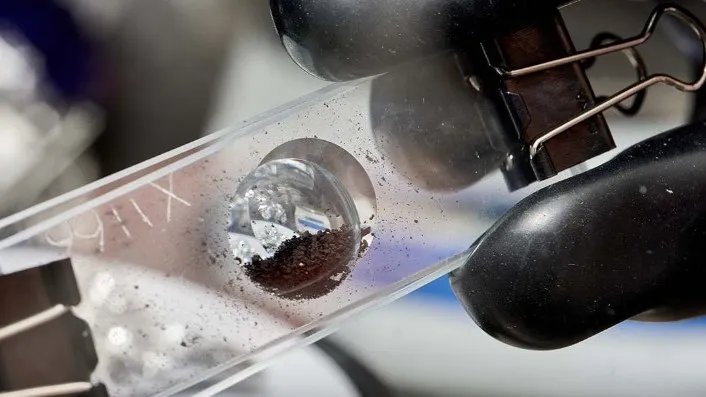
A sample from the asteroid Bennu, collected by the OSIRIS-REx mission, has arrived at London's Natural History Museum for analysis. Scientists are optimistic that it could contain the seeds of life.
The fragment — a millimeter-size (0.04 inch) slice from the roughly 6-ounce (170 grams) sample that was collected from the asteroid Bennu and may contain the precursors to life — arrived at the Natural History Museum in London Tuesday (Nov. 28).
NASA scientists first revealed the sample on Oct. 11 after it hurtled back to Earth aboard the OSIRIS-REx capsule at speeds of up to 27,000 mph (43,000 km/h). After a seven-year, 4 billion-mile (6.4 billion kilometers) round trip, the capsule deployed its parachute and safely landed in the Utah desert before being transported to Johnson Space Center in Houston. Now, bits of it are being sent around the world for analysis.
"It's almost unbelievably exciting," Sara Russell, a professor of cosmic mineralogy and planetary science at the Natural History Museum, said in a statement. "It's almost like a dream to have the sample back, because we've been thinking about it for so long."
OSIRIS-REx's view of asteroid Bennu
(Image credit: NASA/Goddard/University of Arizona)
Bennu is a potentially hazardous asteroid that has a 1-in-2,700 chance of striking Earth in the year 2182 — the highest odds of any known space object. But the scientists are more interested in what's trapped inside the space rock: the possible extraterrestrial precursors of life on Earth.
"This is the biggest carbon-rich asteroid sample ever returned to Earth," NASA Administrator Bill Nelson said at a news conference upon the sample's return. "Carbon and water molecules are exactly the elements we wanted to find. They're crucial elements in the formation of our own planet, and they're going to help us determine the origins of elements that could have led to life."
Sign up for the Live Science daily newsletter now
Get the world’s most fascinating discoveries delivered straight to your inbox.
Earth's water is older than the planet itself and was probably brought here by asteroid and comet impacts. But water likely wasn't the only material asteroids brought to Earth; the building blocks of life likely hitched a ride on a space rock, too. Bennu is a B-type asteroid, which means it contains high amounts of carbon and, potentially, many of the primordial molecules present when life emerged on Earth.
Some of these building blocks — including uracil, one of the nucleobases for RNA — were recently found on the asteroid Ryugu by the Japan Aerospace Exploration Agency's Hayabusa2 spacecraft, which returned to Earth with its rock sample in 2020. OSIRIS-REx mission scientists are hoping to find other potential precursors for Earth's biology inside the Bennu sample.
The sample was collected after nearly two years of searching for a landing site on Bennu's craggy surface. Upon making contact with the asteroid, OSIRIS-REx fired a burst of nitrogen from its Touch-and-Go Sample-Acquisition Mechanism to both stick the landing and prevent the craft from sinking through the asteroid.
The blast sent rocks and dust careening around the craft, and some of that rocky debris landed in a canister aboard OSIRIS-REx. A follow-up blast of OSIRIS-REx's thrusters later lifted it from Bennu, and the spacecraft completed a number of flyovers before leaving the asteroid for Earth in May 2021.
Now that the sample has arrived, scientists around the world will begin analyzing it for clues about how our solar system, and the life on our planet, came to be.
"It's kind of like the leftover building block of our solar system," Ashley King, a meteorite researcher at the Natural History Museum, said in the statement. "When we think about how planet Earth formed, all the ingredients are also locked up within Bennu. So we want to disentangle the story of Bennu and learn about the origin of the solar system and then the history of Earth."
Ben Turner is a U.K. based writer and editor at Live Science. He covers physics and astronomy, tech and climate change. He graduated from University College London with a degree in particle physics before training as a journalist. When he's not writing, Ben enjoys reading literature, playing the guitar and embarrassing himself with chess.