It's quick and easy to access Live Science Plus, simply enter your email below. We'll send you a confirmation and sign you up for our daily newsletter, keeping you up to date with the latest science news.
Get the world’s most fascinating discoveries delivered straight to your inbox.
You are now subscribed
Your newsletter sign-up was successful
Want to add more newsletters?
Join the club
Get full access to premium articles, exclusive features and a growing list of member rewards.
An account already exists for this email address, please log in.
James Webb Space Telescope sees an ancient black hole dance with colliding galaxies
Using the James Webb Space Telescope, astronomers have witnessed the dramatic dance between a supermassive black hole-powered quasar and merging galaxies less than a billion years after the Big Bang.
An illustration of a supermassive black hole powered quasar. The inset shows a map of line emissions of hydrogen (in red and blue) and oxygen (in green), in the PJ308-21 system, shown after masking the light from the central quasar (QSO).
(Image credit: NASA, ESA, CSA, Joseph Olmsted (STScI)/ Decarli et. at / INAF / A&A 2024)
Using the James Webb Space Telescope (JWST), astronomers have observed the dramatic "dance" between a supermassive black hole and two satellite galaxies. The observations could help scientists better understand how galaxies and supermassive black holes grew in the early universe.
This particular supermassive black hole is feeding on surrounding matter and powering a bright quasar that is so distant that JWST sees it as it was less than a billion years after the Big Bang. The quasar, designated PJ308-21, is localized to an active galactic nucleus (AGN) in a galaxy that is in the process of merging with two massive satellite galaxies.
Not only did the team determine that the black hole has a mass equivalent to two billion suns, but they also found that both the quasar and the galaxies involved in this merger are highly evolved, a surprise considering they existed when the 13.8-year-old cosmos was just an infant.
The merger of these three galaxies is likely to deliver to the supermassive black hole vast amounts of gas and dust, which will facilitate its growth and allow it to keep powering PJ308-21.
"Our study reveals that both the black holes at the center of high-redshift [early and distant] quasars and the galaxies that host them undergo extremely efficient and tumultuous growth already in the first billion years of cosmic history, aided by the rich galactic environment in which these sources are formed," team leader Roberto Decarli, a researcher at Italy's National Institute for Astrophysics (INAF), said in a statement.
The data was collected in September 2022 by JWST's Near InfraRed Spectrograph (NIRSpec) instrument as part of the 1554 Program, which aims to observe the merger between the galaxy hosting PJ308-21 and two of its satellite galaxies.
Sign up for the Live Science daily newsletter now
Get the world’s most fascinating discoveries delivered straight to your inbox.
Decarli added that the work represented a real "emotional rollercoaster" for the team, which developed innovative solutions to overcome the initial difficulties in data reduction and produce images with an uncertainty of less than 1% per pixel.
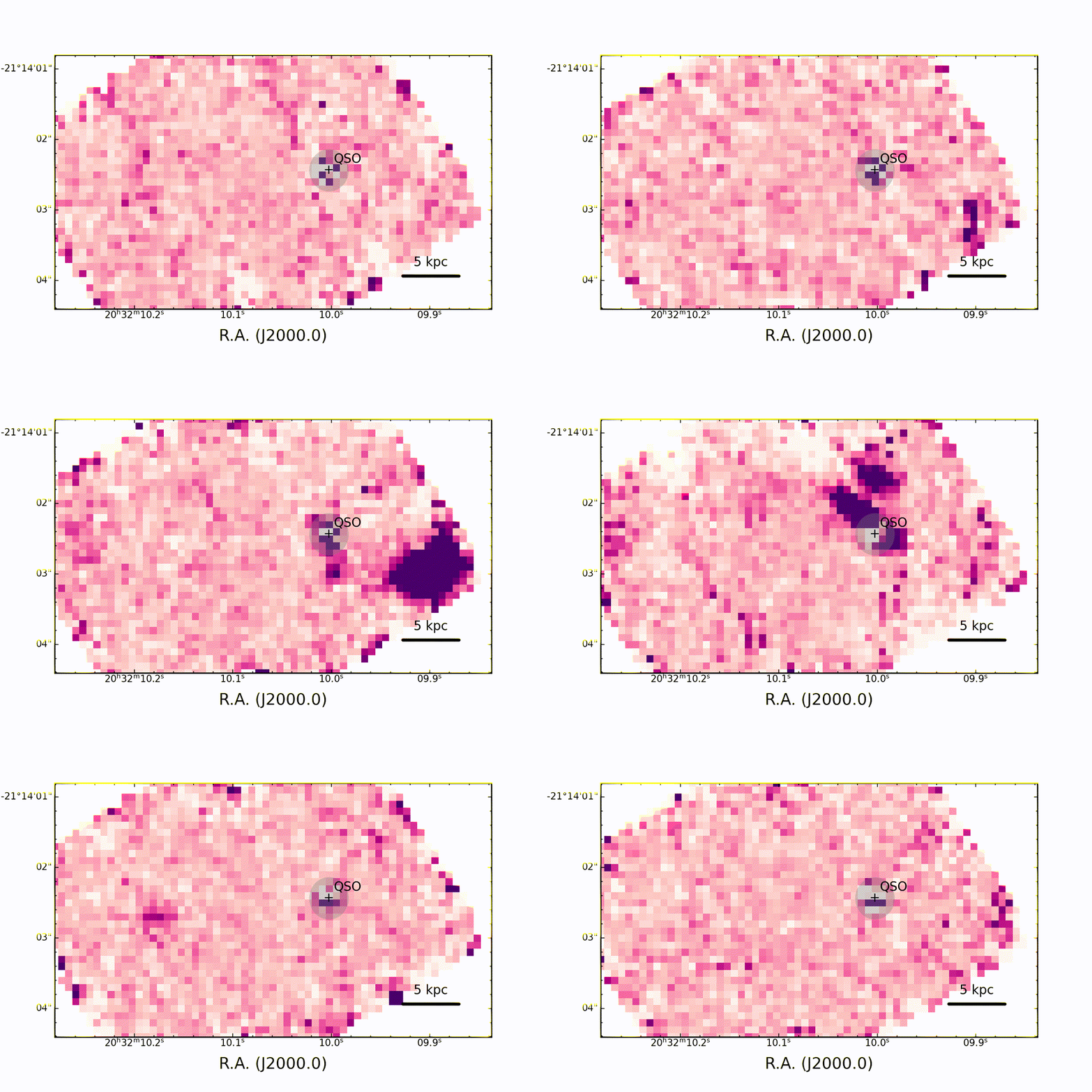
Map of ionizing oxygen emission in the PJ308-21 system, observed with the JWST showing a complex three-dimensional structure of the system and the "cosmic dance" of the satellite galaxies around the quasar.
(Image credit: Decarli et. at / INAF / A&A 2024)
A very metal quasar
Quasars are born when supermassive black holes with masses millions or billions of times that of the sun that sit at the heart of galaxies are surrounded by a wealth of gas and dust. This matter forms a flattened cloud called an accretion disk that swirls around the black hole and gradually feeds it.
The immense gravitational forces of the black hole generate powerful tidal forces in this accretion disk, which heat this gas and dust temperatures as great as 120,000 degrees Fahrenheit (67,000 degrees Celsius). This causes the accretion disk to emit light across the electromagnetic spectrum. This emission can often be brighter than the combined light of every star in the surrounding galaxy, making quasars like PJ308-21 some of the brightest objects in the cosmos.
While black holes don't have characteristics that can be used to determine how evolved they are, their accretion disks (and thus quasars) do. In fact, galaxies can be "aged" in the same way.
An artist's impression of a supermassive black hole and its accretion disk.
(Image credit: S. Dagnello (NRAO/AUI/NSF))
The early universe was filled with hydrogen, the lightest and simplest element, and a little helium. This formed the basis of the first stars and galaxies, but during the life of these stellar bodies, they forged elements heavier than hydrogen and helium, which astronomers call "metals."
When these stars ended their lives in massive supernova explosions, these metals were dispersed throughout their galaxies and went on to be the building blocks of the next generation of stars. This process saw stars, and through them galaxies, becoming progressively "metal rich."
The team found that, like most AGNs, the active heart of PJ308-21 is metal-rich, and the gas and dust around it are being "photoionized. " This is the process by which particles of light, called photons, provide the energy that electrons need to escape atoms, creating electrically charged ions.
Map of line emissions of hydrogen (in red and blue) and oxygen (in green), in the PJ308-21 system, shown after masking the light from the central quasar (QSO). The different colors of the quasar's host galaxy and companion galaxies in this map reveal conditions and physical properties of the gas within them.
(Image credit: Decarli et. at / INAF / A&A 2024)
One of the galaxies that's merging with the host galaxy PJ308-21 is also metal-rich, and its matter is also being partially photoionized by electromagnetic radiation from the quasar.
Photoionization is also happening in the second satellite galaxy, but in that case, it is being caused by a bout of rapid star formation. This second galaxy also differs from the first and the AGN, as it appears to be metal-poor.
"Thanks to NIRSpec, for the first time, we can study, in the PJ308-21 system, the optical band rich in precious diagnostic data on the properties of the gas near the black hole in the galaxy hosting the quasar and in the surrounding galaxies," said team member and INAF astrophysicist Federica Loiacono. "We can see, for example, the emission of hydrogen atoms and compare it with that of the chemical elements produced by the stars to establish how rich the gas is in metals."
Though light leaves this early-universe quasar across the broad range of the electromagnetic spectrum, including optical light and X-rays, the only way to observe it is in infrared.
That's because, as the light has traveled for over 12 billion years to reach JWST, the expansion of the universe has "stretched" its wavelengths considerably. That "shifts" the light in the direction of the "red end" of the electromagnetic spectrum, a phenomenon understandably called "redshift," which is denoted as "z" by astronomers.
JWST is adept at seeing "high red-shift" or "high-z" objects and events like PJ308-21 because of its sensitivity to infrared light.
"Thanks to the sensitivity of the JWST in the near and mid-infrared, it was possible to study the spectrum of the quasar and companion galaxies with unprecedented precision in the distant universe," Loiacono concluded. "Only the excellent 'view' offered by JWST is able to ensure these observations."
The team's research was accepted for publication in June 2024 in the journal Astronomy & Astrophysics.
Robert Lea is a science journalist in the U.K. who specializes in science, space, physics, astronomy, astrophysics, cosmology, quantum mechanics and technology. Rob's articles have been published in Physics World, New Scientist, Astronomy Magazine, All About Space and ZME Science. He also writes about science communication for Elsevier and the European Journal of Physics. Rob holds a bachelor of science degree in physics and astronomy from the U.K.’s Open University

 Live Science Plus