














Black hole 'morsels' could finally prove Stephen Hawking's famous theory right
Stephen Hawking suggested nothing lasts forever, including black holes. Scientists may have a way to prove it at last.

One of the most profound messages Stephen Hawking left humanity with is that nothing lasts forever — and, at last, scientists could be ready to prove it.
This idea was conveyed by what was arguably Hawking's most important work: the hypothesis that black holes "leak" thermal radiation, evaporating in the process and ending their existence with a final explosion. This radiation would eventually come to be known as "Hawking radiation" after the great scientist. To this day, however, it's a concept that remains undetected and purely hypothetical. But now, some scientists think they may have found a way to finally change that; perhaps we'll soon be on our way toward cementing Hawking radiation as fact.
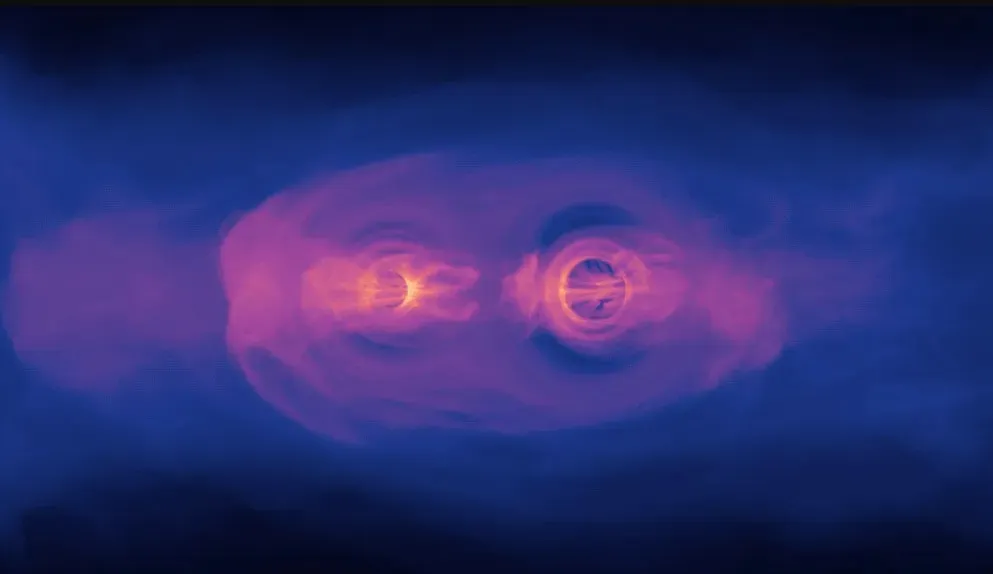
The team suggests that, when larger black holes catastrophically collide and merge, tiny and hot "morsel" black holes may be launched into space — and that could be the key.
Importantly, Hawking had said that the smaller the black hole is, the faster it would leak Hawking radiation. So, supermassive black holes with masses millions or billions of time that of the sun would theoretically take longer than the predicted lifetime of the cosmos to fully "leak." In other words, how would we even detect such immensely long-term leakage? Well, maybe we can't — but when it comes to these asteroid-mass black hole morsels, dubbed "Bocconcini di Buchi Neri" in Italian, we may be in luck.
Tiny black holes like these could evaporate and explode on a time scale that is indeed observable to humans. Plus, the end of these black holes' lifetimes should be marked by a characteristic signal, the team says, that indicates their deflation and death via the leaking of Hawking radiation.
Related: Stephen Hawking wanted scientists to 'make black holes' on Earth. Physics says it's possible.
"Hawking predicted that black holes evaporate by emitting particles," Francesco Sannino, a scientist behind this proposal and a theoretical physicist at the University of Southern Denmark, told Space.com. "We set out to study this and the observational impact of the production of many black hole morsels, or 'Bocconcini di Buchi Neri,' that we imagined forming during a catastrophic event such as the merger of two astrophysical black holes."
Get the world’s most fascinating discoveries delivered straight to your inbox.
Morsel black holes can't keep their cool
The origin of Hawking radiation dates back to a 1974 letter written by Stephen Hawking called "Black hole explosions?" that was published in Nature. The letter came about when Hawking considered the implications of quantum physics on the formalism of black holes, phenomena that arise from Albert Einstein's theory of general relativity. This was interesting because quantum theory and general relativity are two theories that notoriously resist unification, even today.
Hawking radiation has remained troubling and undetected for 50 years now for two possible reasons — first of all, most black holes might not emit this thermal radiation at all, and second, if they do, it may not be detectable. Plus, in general, black holes are very strange objects to begin with and therefore complex to study.
"What is mind-bending is that black holes have temperatures that are inversely proportional to their masses. This means the more massive they are, the colder they are, and the less massive they are, the hotter they are," Sannino said.
Even in the emptiest regions of space, you'll find temperatures of around minus 454 degrees Fahrenheit (minus 270 degrees Celsius). That's because of a uniform field of radiation left over from just after the Big Bang, called the "cosmic microwave background" or "CMB." This field if often called a "cosmic fossil," too, because of how utterly old it is. Furthermore, according to the second law of thermodynamics, heat should be unable to flow from a colder body to a hotter body.
"Black holes heavier than a few solar masses are stable because they are colder than the CMB," Sannino said. "Therefore, only smaller black holes are expected to emit Hawking radiation that could potentially be observed."

Simulated view of a black hole in front of the Large Magellanic Cloud.
Research author Giacomo Cacciapaglia of the French National Centre for Scientific Research told Space.com that, because the vast majority of black holes in today's universe are of astrophysical origin, with masses exceeding a few times that of the sun, they cannot emit observable Hawking radiation.
"Only black holes lighter than the moon can emit Hawking radiation. We propose that this type of black hole may be produced and ejected during a black hole merger and start radiating right after its production," Cacciapaglia added. "Black hole morsels would produced in large numbers in the vicinity of a black hole merger."
However, these black holes are too small to create effects that allow them to be imaged directly, like the Event Horizon Telescope has been doing for supermassive black holes by focusing on the glowing material that surrounds them.
The team suggests there is a unique signature that could be used to indicate the existence of these morsel black holes. This would come in the form of a powerful blast of high-energy radiation called a gamma-ray burst occurring in the same region of the sky where a black hole merger has been detected.

An unusually bright gamma-ray burst erupts from the region around a black hole merger.
The researchers said these Bocconcini di Buchi Neri black holes would radiate Hawking radiation faster and faster as they lose mass, hastening their explosive demises. Those possessing masses of around 20,000 tons would take an estimated 16 years to evaporate, while examples of morsel black holes with masses of at least 100,000 kilotons would potentially last as long as hundreds of years.
The morsels' evaporation and destruction would produce photons exceeding the trillion electron volts (TeV) energy range. To get an idea of how energetic that is, Sannino said that CERN's Large Hadron Collider (LHC) in Europe, the largest particle accelerator on the planet, collides protons head-on with a total energy of 13.6 TeV.
RELATED STORIES
The researchers do have an idea of how to detect these morsel black holes as they evaporate, however. First, black hole mergers could be detected via the emission of gravitational waves, which are tiny ripples in spacetime predicted by Einstein, emitted as the objects collide.
Astronomers could then follow up on those mergers with gamma-ray telescopes, such as the High-Altitude Water Cherenkov gamma-ray Observatory, which can spot photons with energies between 100 Gigaelectron volts (GeV) and 100 TeV.
The team acknowledges there is a long way to go before the existence of morsel black holes can be confirmed, and therefore a long way to go before we can validate Hawking radiation once and for all.
"As this is a new idea, there is a lot of work to do. We plan to better model the Hawking radiation emission at high energies beyond the TeV scale, where our knowledge of particle physics becomes less certain, and this will involve experimental collaborations in searching for these unique signatures within their dataset," Cacciapaglia concluded. "On a longer timeline, we plan to investigate in detail the production of morsels during catastrophic astrophysical events like black hole mergers."
The team's research is available as a pre-print paper on the repository arXiv.
Originally posted on Space.com.

Robert Lea is a science journalist in the U.K. who specializes in science, space, physics, astronomy, astrophysics, cosmology, quantum mechanics and technology. Rob's articles have been published in Physics World, New Scientist, Astronomy Magazine, All About Space and ZME Science. He also writes about science communication for Elsevier and the European Journal of Physics. Rob holds a bachelor of science degree in physics and astronomy from the U.K.’s Open University