













What was the Deepwater Horizon disaster?
The 2010 event killed 11 people and smothered the Gulf of Mexico in the largest marine oil spill in history.


On April 20, 2010, the Deepwater Horizon oil rig in the Gulf of Mexico exploded, killing 11 people. Two days later, the rig capsized, and the damaged pipe below the rig began spewing oil into the surrounding water. Oil continued to spill from the pipe for 87 days, releasing an estimated 377,514 metric tonnes into the Gulf, according to court findings. The fallout of the spill included economic hardship for people living on the Gulf Coast and environmental damage that persists today.
Drilling for oil and gas in the Gulf of Mexico
Oil and gas companies have been drilling in the Gulf of Mexico for fuel since the 1930s, according to a 2018 Consensus Report published by the National Academy of Sciences, Engineering, and Medicine. Today, the region provides more than a fifth of U.S. oil and gas production, the U.S. Energy Information Administration estimates.
Related: Why is there so much oil in the Gulf of Mexico?
The oil below the ocean floor formed from organic materials, such as the remains of plants and animals, trapped below ground millions of years ago. Over time, pressure and heat transformed the molecules of those organic materials into hydrocarbons — compounds made of hydrogen and carbon, which form the building blocks of oil and natural gas. The oil and gas accumulates underground into cracks and pockets between layers of rock tens to hundreds of feet thick called "pay zones" by the oil and gas industry. Energy companies have drilled more than 2,000 oil wells in the Gulf of Mexico.
BP (formerly known as The British Petroleum Company ltd.) is one of the world's largest oil companies, with headquarters in London. The company leased the Deepwater Horizon rig from the world's biggest oil rig contractor, TransOcean, beginning in 2001, to search for oil in an area of the Gulf that BP named the Macondo Prospect. BP hired Halliburton, an oil field services company, to help operate the rig and carry out the exploration.

Oil rigs like this free-floating structure drill at wells in the Gulf of Mexico to extract fossil fuels from deep water. The platforms usually host drilling machinery but also desalination, generation and life support equipment for the crew.
What caused the Deepwater Horizon disaster?
The ultimate cause of the Deepwater Horizon disaster was a series of preventable missteps by engineers and workers designing and carrying out a drill plan in the weeks and hours preceding the event. The errors were later described in detail in a January 2011 report to the president created by the National Commission on the BP Deepwater Horizon Oil Spill and Offshore Drilling — a team of engineers, politicians and scientists tasked by President Barack Obama with investigating what caused the explosion and oil spill.
Crew members on Deepwater Horizon stood 4,992 feet (1,521 meters) above the sea bed and had to rely on data from underwater instruments to make decisions. The crew worked with large, heavy steel materials and flammable oil in a natural system that can be unpredictable. On top of that, the operation was managed by a slew of contractors and subcontractors, which meant the opportunity for miscommunication was great.
Get the world’s most fascinating discoveries delivered straight to your inbox.
The Deepwater Horizon oil rig left its previous post in the Gulf of Mexico and arrived at the Macondo well in January 2010. By early April 2011, the rig's crew was assembled and prepared to complete the three tasks required before oil could be regularly pulled from the Macondo Prospect: First, they had to drill into the bedrock and fit a metal tube into the tunnel; next, they had to pour cement down the tube to seal it in place; and finally, they would carefully remove the Deepwater Horizon rig from the well and replace it with a smaller, less expensive production rig to extract oil regularly.
Related: Gallery: Exploring the Gulf of Mexico
Problems began during drilling. BP had to stop drilling into the seabed about 2,000 feet (610 m) higher than expected because the pressure was too high. Next, they had to line the hole with a casing — a concrete pipe that prevents the hole from caving in. A shorter casing would be easier to cement into place and was deemed safer by computer models, but the company ultimately decided to use a longer casing, which would be less prone to leaks. In order to hold the casing in place, concrete would be pumped into the space between the casing and the surrounding Earth. For this to work, the concrete must surround the casing evenly, otherwise it could be unstable and vulnerable to oil leaking in from the sides. To ensure an even, snug fit, engineers fit the casing with centralizers, which are metal tubes with strips of metal sticking out on each side. Computer models recommended that the casing be fit with 21 centralizers, but BP engineers chose to insert only six centralizers because of a supply shortage. This increased the risk that the cement would surround the casing unevenly.
With the casing and centralizers in place, it was time to pour the concrete. BP engineers made several choices during this step that further increased the risk of error. First, they cut pre-cementing tests short, which prevented technicians from checking for leaked oil at the bottom of the well; they pumped the cement slower than recommended, further increasing the risk that the cement would not fill the space around the casing evenly; and they limited the amount of cement used, which can cut the risk of lost oil but increases the risk of contamination by leaving more casing exposed.
In the months leading up to the disaster, Halliburton had conducted several tests showing that the type of cement used wasn't stable, meaning that it might form pores that allow liquids and gasses to pass through it. Halliburton shared some of these test results with BP, but the company decided to proceed.
The crew, made of Transocean and Haliburton employees, finished cementing just after midnight on April 20. At that point, BP and Halliburton representatives checked a valve to be sure that the pressure from the cement was not pushing too much liquid up out of it. After a couple of hours, the BP and Halliburton representatives emailed members of their respective teams to confirm that the cementing job had been a success.
The operation went awry during the final step, when the crew planned to follow a set of precarious procedures to detach Deepwater Horizon from the well to make room for a smaller rig, the report describes. During the process, crew members conducted positive and negative pressure tests to ensure no gas had leaked into the well. The negative pressure test should have alerted them that there was a leak, but they misinterpreted the results. At 8:00 p.m. local time, the crew concluded that everything was fine. But that was a mistake — gaseous hydrocarbons had leaked into the well.

A boat works to collect oil that has leaked from the Deepwater Horizon wellhead in the Gulf of Mexico on April 28, 2010 near New Orleans, Louisiana. An estimated leak of 1,000 barrels of oil a day were still leaking into the gulf at the time.
When gaseous hydrocarbons enter a well, they expand to fill up the space, shooting up the pipe in what is called a "kick," and this is what happened at Deepwater Horizon. The crew closed the blowout preventer — a seal that is designed to stop the expanding molecules from climbing up the well to the rig — but it was too late.
The molecules climbed with increasing speed up the pipe until, at around 9:40 p.m., the force of the rising gases in the pipe pushed mud out onto the rig's floor. A few minutes later, the gaseous hydrocarbons enveloped large areas of the rig and met at least one ignition source (could have been heat or sparks from on-board equipment), which then erupted in an explosion that could be seen from miles away.
Eleven workers went missing during the explosion and were presumed dead three days later. The entire Deepwater Horizon rig capsized 36 hours after the explosion, on the morning of April 22, which is coincidentally Earth Day, a globally recognized day promoting environmental protection.
As the rig sank, it damaged the pipe leading down to the well. Oil began spilling from the well and did not stop for 87 days.
How bad was the Deepwater Horizon disaster?
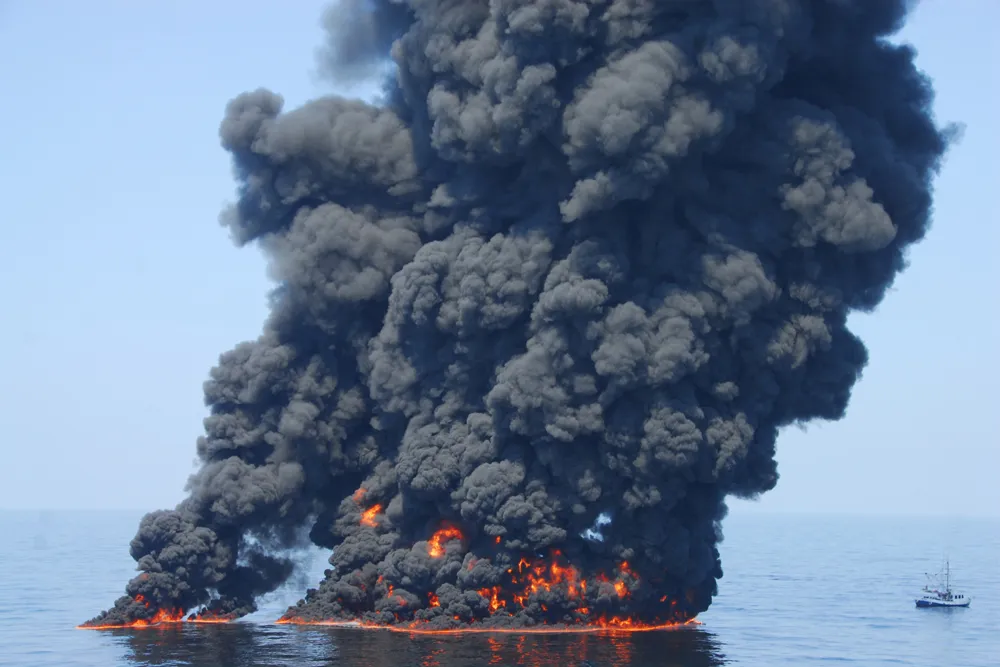
One cleanup method used in the gulf after the Deepwater Horizon spill was to burn surface oil.
The Deepwater Horizon spill is considered the largest marine oil spill in history, according to the U.S. Environmental Protection Agency. Court proceedings following the spill estimated that 3.19 million barrels of oil were poured into the Gulf of Mexico — that's about half the total amount of oil the U.S. was producing per day in the Gulf of Mexico at the time of the disaster.
People in the United States watched the entire disaster unfold on the news. By June, a Pew Research Center survey showed that more people opposed the government allowing more offshore oil and gas drilling in U.S. waters than favored it — a sharp flip in public opinion that lasted only a couple of months.
Related: BP oil spill changed some minds on environmental issues.
In the weeks following the explosion and spill, environmental first responders and scientists tried several ways to reduce the harm to the environment, according to the U.S. National Oceanic and Atmospheric Administration (NOAA). They sprayed dispersants, liquids that help microbes break down oil; they set surface oil on fire to burn it up quickly, and surrounded oil with floating booms to prevent its spread; and they dispatched underwater chambers to contain leaking oil. Meanwhile, BP made three attempts to cap the well before it was finally closed on Sept. 19, 2010.

How did the Deepwater Horizon spill hurt wildlife?
Related stories from Live Science
Experts are still researching the extent of the damage, but all contend that it is extensive and long-lasting. After the spill, images of oil-slicked birds and turtles filled the news, according to a 2012 analysis in The Journal of American History. Oiled animals may die because they can't fly or swim well, which can exhaust them and make them vulnerable to predators, according to NOAA. NOAA researchers found that at least 14,000 sea turtles and hatchlings died because of the spill. Every species of crustacean in the Gulf was exposed to the oil, and many dolphins and whales suffered injuries, the researchers found.
Oil can enter animals through their skin or orifices. This can be harmful and even deadly because hydrocarbons, in particular a type called polycyclic aromatic hydrocarbons, are toxic to animals, according to Isabel Romero, an organic geochemist and research assistant at the University of South Florida in St. Petersburg, Florida.
Romero has found these compounds in deepwater fish species that live in the Gulf. "People are used to looking for evidence [of the spill] on the surface of the ocean," Romero said, which seems logical, because oil floats. But much of the oil from the Deepwater Horizon spill mixed with microalgae and marine debris and then sunk to the seafloor, Romero explained, and chemicals from the oil can still be found in the sediments and animals at the bottom of the ocean.

BP cleanup crews shoveled some oil off of beaches in May 2010 in Louisiana, but hundreds of miles of coastal wetlands and islands were smothered in the spill.
How did the Deepwater Horizon spill hurt the economy?
The effects of the spill also rippled through the economy, particularly on the Gulf Coast. The U.S. Department of the Interior temporarily halted offshore deepwater drilling for about 5 months after the spill. The halt caused some wage and job losses, especially in Florida, according to a 2014 policy brief from a researcher at Harvard's Taubman Center for State and Local Government. However, jobs and wages increased in oil-intensive portions of Louisiana, which was the state closest to the spill.
Concerns over seafood safety caused fisheries to close in the months after the spill — at one point, 36% of federal waters in the Gulf were closed, according to the nonprofit ocean conservation organization Oceana. A 2019 study in the journal Deep Oil Spills found that the commercial and recreational fishing industry lost 25,000 jobs and $2.3 billion in industry output.
Hotels, restaurants and fishing charters along the Gulf Coast lost business as tourists cancelled their trips, according to a 2014 study by the U.S. Department of the Interior. But tourism rebounded by 2011, possibly because of the marketing money BP gave the affected communities, The Times-Picayune reported.
What were the consequences for the BP oil spill?
The explosion and spill launched a tangled web of legal lawsuits against BP, TransOcean, Halliburton and Anadarko, an oil company BP partnered with on the well. In 2011, before all of the damage had been assessed, NOAA reached an agreement with BP that the company would pay $1 billion for early restoration projects, like cleaning up beaches, marshes and wetlands. Eventually, the majority of lawsuits against BP were settled in 2016 for $20.8 billion, which is the largest environmental damage settlement in U.S. history, according to NOAA.
The settlement covered a civil penalty, natural resource damages and economic claims, among other charges, according to the U.S. Department of Justice. Most of the money was allocated to projects for economic and ecological restoration. Five hundred million dollars were given to the National Academy of Sciences to create the Gulf Research Program, a 30-year program meant to support the Gulf environment and community and explore the safety of the offshore energy industry.
Drilling for oil out at sea is an inherently risky business, said Richard Sears, the chief scientist for the National Commission on the BP Deepwater Horizon Oil Spill and Offshore Drilling, and member of one of the Gulf Research Program's committees studying how to decrease risk in offshore energy operations.

But oil and gas production in the Gulf of Mexico doesn't appear to be going away anytime soon, despite the Deepwater Horizon disaster. In fact, oil production continues to climb, according to data from the U.S. Bureau of Safety and Environmental Enforcement.
"There are a lot of reasons to say things have probably improved since Deepwater Horizon," Sears told Live Science. For one thing, negative pressure tests are now required and must be reported to the U.S. Bureau of Safety and Environmental Enforcement (BSEE). This forces operators to think more carefully about the test results and it gives BSEE regulators the chance to ask questions and seek explanations if they aren't satisfied, Sears said.
Nonetheless, he said, the systemic problems that led to the disaster persist today. "The rigs are operated by a contractor, and they're staffed by people from different companies doing all these specialist jobs. There may be nobody on the rig that really understands in great detail what each specialty is doing."
Companies like BP that lease drilling sites from the Federal government deploy onboard representatives who talk to contractors and onshore specialists to make sure work is being carried out safely. But how effectively these representatives interact with contractors and specialists is determined by the company, and according to Sears, that's "not easy to regulate."
Additional resources
- Learn more about the National Commission on the BP Deepwater Horizon Oil Spill and Offshore Drilling at their archived website.
- Find real-time location data for oil and gas platforms in the Gulf of Mexico and surrounding states on this interactive map from the U.S. Energy Information Administration.
- Read more about the various aspects of the oil spill and its effects on the environment from the Smithsonian Institute.

Jen Monnier is a journalist in Seattle covering the environment and public health. Her work has appeared in Scientific American, CityLab, the Los Angeles Times, Hakai Magazine and Ensia. She earned her master's degree in science, health, and environmental reporting at New York University and a bachelor's degree in philosophy from Western Washington University.