













Gallery: Exploring the Gulf of Mexico

Okeanos Explorer Expedition

The NOAA research vessel Okeanos Explorer explored unknown areas in the Gulf of Mexico in March and April of 2012. Here, Bobby Mohr, Tom Kok, and Jeff Williams discuss plans on the back deck of the ship.
Mussels and Bubbles

Researchers explored the seafloor of the Gulf with a remotely operated vehicle, capturing images such as these methane bubbles rising up through a bed of mussels.
Salty Seafloor

At diapirs or salt domes, sometimes the salt itself actually reaches the seafloor where it dissolves, occasionally filling lows in the seafloor with super-saturated, very dense salty waters known as brines.
Copper-Plated Shipwreck
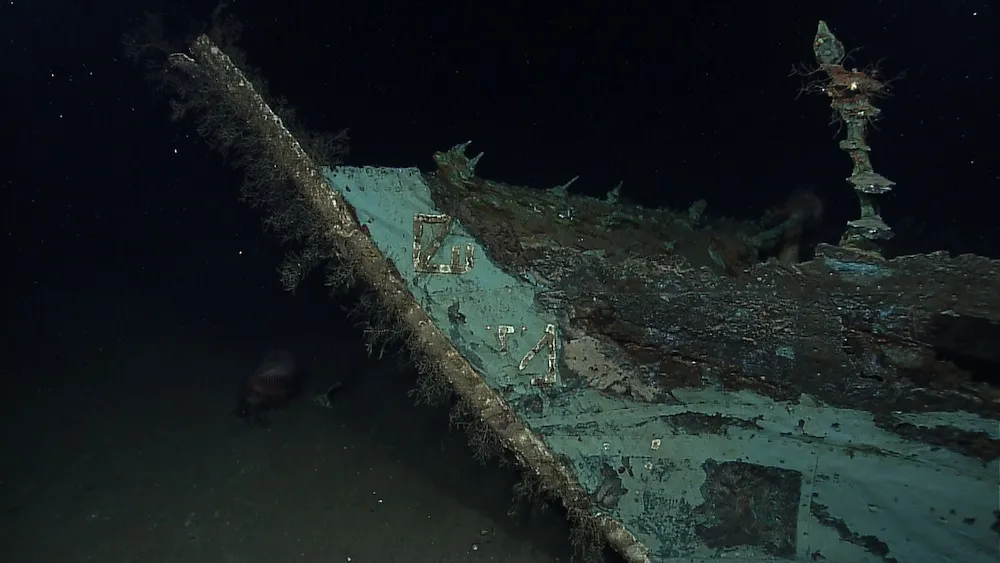
The remains of a ship, perhaps dating back to the early 1800s, found in the Gulf of Mexico by NOAA's Okeanos Explorer.
Gulf Coral

Deep-sea corals flourish in the dark depths of the Gulf of Mexico, providing foundations that attract lush communities of other animals, including brittle stars, anemones, crabs, and fish.
"Pregnant" Coral

This coral may be expecting! The white dots in the translucent body may be developing embryos that will later form their own coral organisms.
The Lobster and the Crinoid

A squat lobster (right) sitting next to a crinoid (left). Despite their plant-like appearance, crinoids are animals capable of pulling up roots and "walking" along the seafloor.
Get the world’s most fascinating discoveries delivered straight to your inbox.
Red Fish

One fish, two fish, red fish ... okay, no blue fish here, but the Okeanos Explorer's ROV turned up gorgeous images of deep-sea fish.
Shipwreck

One of the four shipwrecks explored during the Okeanos Explorer mission. This is a ship's steering geer under 7,000 feet of water.
Lost U-Boat

U-166, the only German submarine lost in the Gulf of Mexico. The wreck of U-166 was first found in 2001.
Black Coral

A Leiopathes black coral colony at 425 meters depth on the West Florida escarpment in the Gulf of Mexico.

Stephanie Pappas is a contributing writer for Live Science, covering topics ranging from geoscience to archaeology to the human brain and behavior. She was previously a senior writer for Live Science but is now a freelancer based in Denver, Colorado, and regularly contributes to Scientific American and The Monitor, the monthly magazine of the American Psychological Association. Stephanie received a bachelor's degree in psychology from the University of South Carolina and a graduate certificate in science communication from the University of California, Santa Cruz.