


-
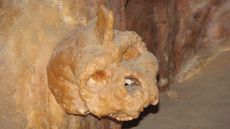 Mysterious 300,000-year-old Greek cave skull was neither human nor Neanderthal, study finds
Researchers have dated the mysterious skull from Petralona Cave in Greece to 300,000 years ago and concluded that the fossil belonged to an ancient human group that lived alongside Neanderthals.
2 Commentsneanderthals -
 Gene that differs between humans and Neanderthals could shed light on the species' disappearance, mouse study suggests
A gene called ADSL, which helps synthesize DNA, differs between modern humans and our extinct human relatives. The findings could shed light on why Neanderthals vanished.
2 Commentsneanderthals -
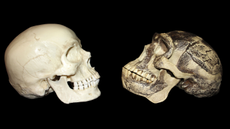 'It makes no sense to say there was only one origin of Homo sapiens': How the evolutionary record of Asia is complicating what we know about our species
As experts study the human fossil record of Asia, many have come to see it as telling a different story than what happened in Europe and Africa.
neanderthals -
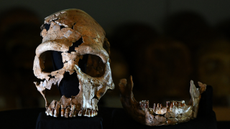 Neanderthal genes may explain disorder where brain bulges out of the skull
Neanderthal genes may explain why some people have Chiari malformation type I, a condition in which the brain bulges out of the back of the skull.
2 Commentsneanderthals -
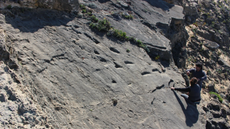 78,000-year-old footprints from Neanderthal man, child and toddler discovered on beach in Portugal
A Neanderthal trackway discovered in Portugal shows how an adult male and two children hunted for food 78,000 years ago.
10 Commentsneanderthals -
 Endurance athletes that carry Neanderthal genes could be held back from reaching their peak
A Neanderthal variant in an enzyme involved in energy production has been linked to a 50% lower probability of achieving elite athletic performance.
5 Commentsneanderthals -
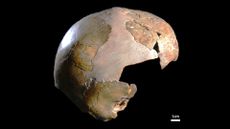 140,000-year-old child's skull may have been part modern human, part Neanderthal — but not everyone is convinced
A child buried in the world's oldest human cemetery had both modern human (Homo sapiens) and Neanderthal characteristics, suggesting she was a hybrid, according to a new study. However, not everyone is convinced the study's findings are definitive.
2 Commentsneanderthals -
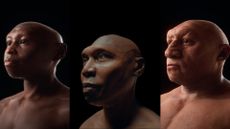 Stunning facial reconstructions of 'hobbit,' Neanderthal and Homo erectus bring human relatives to life
A new documentary brings early human history to life with a "scientifically accurate" collection of hyper-real 3D models.
neanderthals -
 125,000-year-old 'fat factory' run by Neanderthals discovered in Germany
An analysis of ancient animal bones found in Germany suggests that Neanderthals extracted grease from them to gobble up 125,000 years ago.
5 Commentsneanderthals


