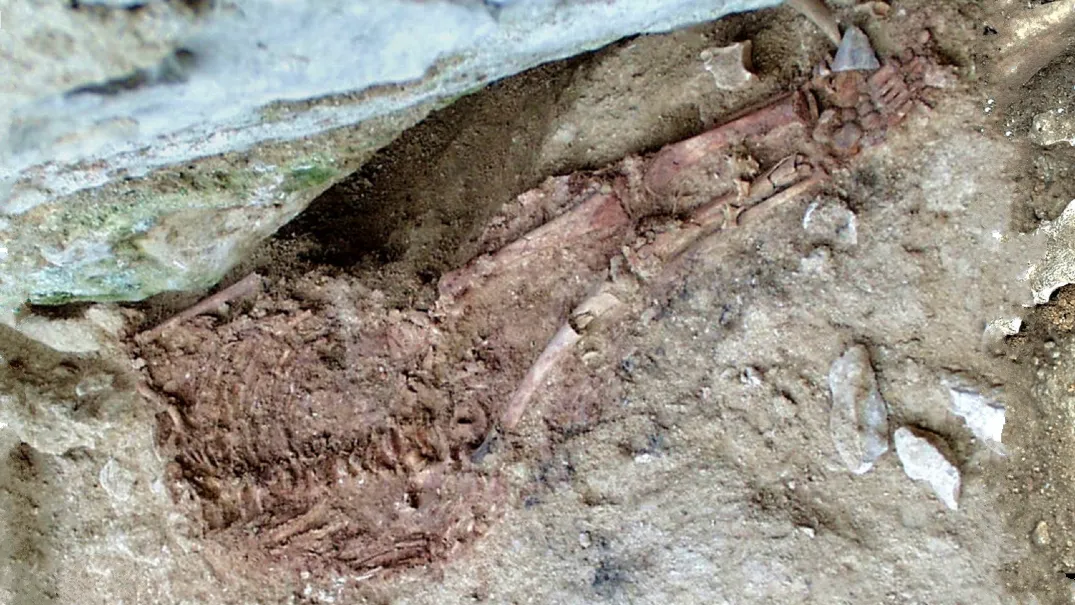
The skeleton of a child with both Neanderthal and modern-human features has been dated to around 28,000 years ago, according to new research that used a new chemical method to pull off the feat.
The new dates, which range from 25,830 to 26,600 B.C., change what archaeologists initially thought about the burial rituals surrounding the "Lapedo child" in what is now Portugal.
"The death of the child may have triggered a declaration of the place as taboo or as unsuitable for mundane hunting activities, leading to people avoiding it until such time as the event faded from social memory," João Zilhão, an archaeologist at the University of Barcelona, told Live Science in an email. Zilhão and colleagues published the new dates Friday (March 7) in the journal Science Advances.
The child's skeleton was discovered in 1998 in the Lagar Velho rock-shelter in the Lapedo Valley of central Portugal. When paleoanthropologists removed the bones from the dirt, they immediately noticed that the child's skeleton had a "mosaic" of Neanderthal and human features, suggesting it was a hybrid individual. For example, the child had a prominent chin like humans' but short, stocky legs like Neanderthals'.
In the late 1990s, the discovery of a hybrid child and associated burial ritual was not immediately accepted as a valid interpretation of the Lapedo site. The Lapedo child was found a decade before the first Neanderthal genome was sequenced — a feat that paved the way for a better understanding of interbreeding between humans and our extinct cousins. We now know from ancient DNA that Neanderthals and humans interbred multiple times over thousands of years.
One issue that has plagued researchers' study of the Lapedo child is the difficulty of dating it. Four previous attempts were made using traditional radiocarbon-dating methods to narrow down the time frame of the burial, but problems with poor preservation and methodology could produce only a broad range of 20,000 to 26,000 years before present — much more recent than expected based on dates from nearby animal bones.
Sign up for the Live Science daily newsletter now
Get the world’s most fascinating discoveries delivered straight to your inbox.
But using a novel method called compound-specific radiocarbon analysis (CSRA), researchers have determined that the Lapedo child lived thousands of years earlier than initially thought.
Study first author Bethan Linscott, a geochemist at the University of Miami, told Live Science in an email that, although the CSRA method has been around awhile, it's only recently been used to redate Neanderthal sites where modern carbon has contaminated the ancient samples.
"The key benefit of compound-specific radiocarbon dating is that it is extremely efficient at removing contamination from archaeological bones," Linscott said. "This is especially important when dealing with poorly preserved bones because even trace amounts of contamination present in such samples can seriously impact the accuracy of the date."
An illustration of the Lapedo child's skeleton showing the location of samples and items buried with the youngster.
(Image credit: G. Casella)
Bunny bones
The team then took their research a step further by redating three things that excavators assumed were part of the Lapedo child's burial ritual: a young rabbit whose bones were found on top of the child, red deer bones discovered near the child's shoulder, and charcoal underneath the child's legs that was assumed to have been a ritual fire.
The researchers discovered, however, that only the rabbit bones were contemporaneous with the Lapedo child, while the charcoal and red deer bones were much older, suggesting they were already present at the site when the child was buried.
As a result of the new dating technique, the researchers hypothesized that the bunny was placed on top of the shrouded body of the Lapedo child as an offering before the grave was filled roughly 28,000 years ago. The site was then abandoned for at least two millennia.
"While we do not have any genetic evidence from Lagar Velho, providing additional confirmation on the age of the site allows us to better understand, on the basis of morphology, how the process of replacement of Neanderthals by Homo sapiens may have played out," Adam Van Arsdale, a paleoanthropologist at Wellesley College who was not involved in the study, told Live Science by email.
Researchers are figuring out the exact amount of overlap in time between the two groups and whether specific features shared from one group to the other were advantageous, especially given that Neanderthals went extinct around 40,000 years ago but modern humans persisted.
Neanderthal quiz: How much do you know about our closest relatives?
Kristina Killgrove is a staff writer at Live Science with a focus on archaeology and paleoanthropology news. Her articles have also appeared in venues such as Forbes, Smithsonian, and Mental Floss. Kristina holds a Ph.D. in biological anthropology and an M.A. in classical archaeology from the University of North Carolina, as well as a B.A. in Latin from the University of Virginia, and she was formerly a university professor and researcher. She has received awards from the Society for American Archaeology and the American Anthropological Association for her science writing.
You must confirm your public display name before commenting
Please logout and then login again, you will then be prompted to enter your display name.