













Largest European Dinosaur Found

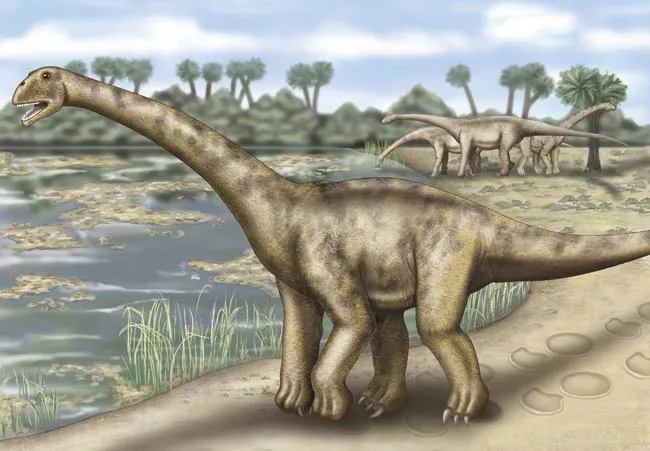
The fossils of a dinosaur measuring as long as an NBA basketball court were recently recovered in Spain, establishing that Europe was home to giant dinosaurs millions of years ago.
The biggest dinosaurs, called Sauropods [image], were previously thought to have roamed only the New World and Africa. But the discovered fossils of a Sauropod [image] point to what may have been the largest terrestrial animal in Europe and one of the most massive in the world, scientists write in the Dec. 22 issue of the journal Science.
This dinosaur, called Turiasaurus riodevensis for the Teruel area and Riodeva—the village where the fossil site [image] is located—is estimated to have weighed between 40 to 48 tons.
"The humerus—the long bone in the foreleg that runs from the shoulder to the elbow—was as large as an adult," said Brooks Hanson, Science's deputy editor, physical sciences. The claw of the first digit of its pes, or hoof, is the size of an NFL football.
The fossils allowed scientists to group the Sauropods found in Europe into a previously unrecognized branch with more primitive features than those found elsewhere from the Jurassic period, about 150 to 200 million years ago.
This dinosaur is more evolutionary primitive than other known giant Sauropods, Hanson said.
- Images: Drawing Dinosaurs
- A Brief History of Dinosaurs
- Animations Reveal How Dinosaurs Might Have Walked
- Mating Game: The Really Wild Kingdom
- The Weirdest Science Stories of 2006
- Amazing Animal Abilities
Get the world’s most fascinating discoveries delivered straight to your inbox.
