















A star's crown
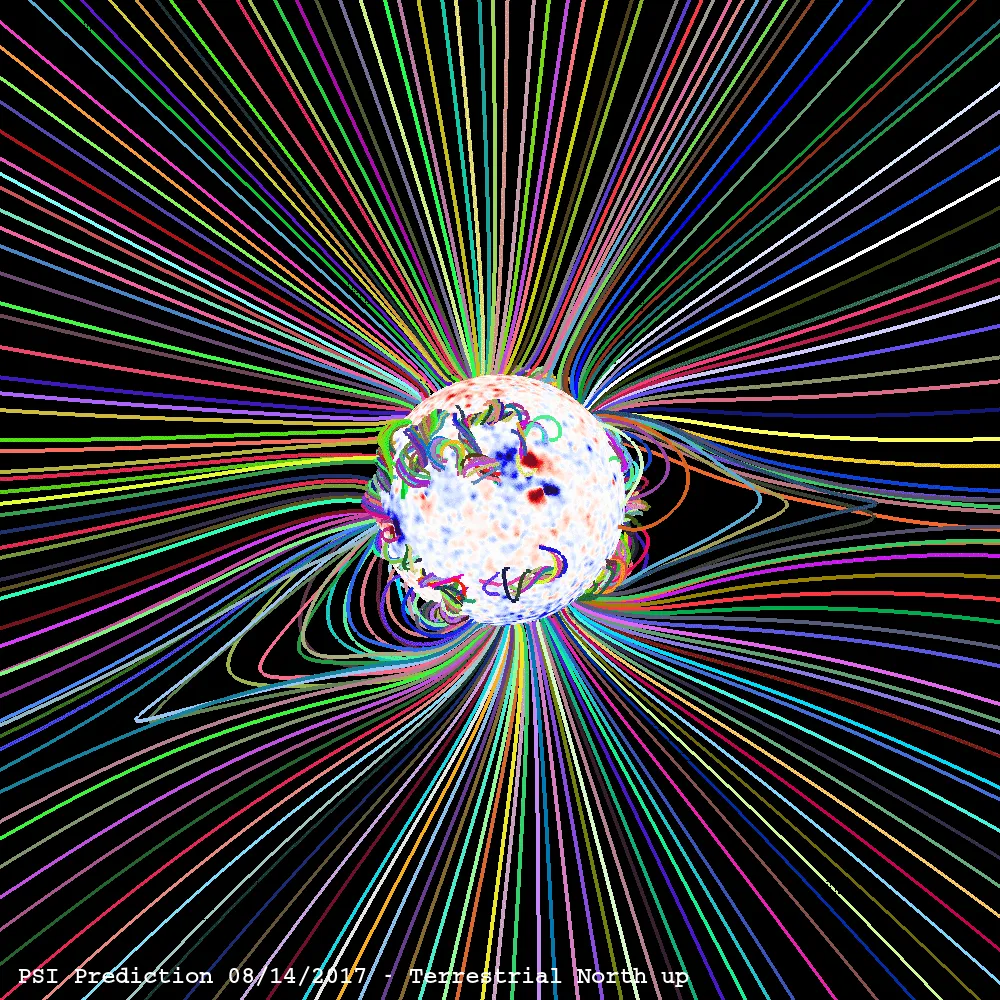
Prior to the famous total solar eclipse on Aug. 21, 2017, researchers produced this stunning schematic of what the sun's corona would look like, showing magnetic field lines emanating from its surface.
Total eclipse

During that same solar eclipse, observers weren't just treated to the rare sight of the moon's disk entirely enveloping the sun. Amateur photographers, such as John Mitchell, were also able to capture an array of activity, ranging from sunspots to solar flares, on Earth's closest star in the stages leading up to the eclipse.
Spiral star farts

A telltale spiral pattern of gas and dust can be seen emanating from a dying star in this image, made using the Atacama Large Millimeter/submillimeter Array telescope in Chile. Normally, stars in this state produce shell-shaped emissions, suggesting that this oddball has a companion circling around and altering its stellar wind.
Airglow

An astronaut aboard the International Space Station snapped this gorgeous photo of an orange glow above our planet, with a beautiful background of stars. Known as airglow, the striking phenomenon is created by chemical reactions high in Earth's atmosphere, though it is not always quite so pumpkin-colored.
Get the world’s most fascinating discoveries delivered straight to your inbox.

Adam Mann is a freelance journalist with over a decade of experience, specializing in astronomy and physics stories. He has a bachelor's degree in astrophysics from UC Berkeley. His work has appeared in the New Yorker, New York Times, National Geographic, Wall Street Journal, Wired, Nature, Science, and many other places. He lives in Oakland, California, where he enjoys riding his bike.