It's hard to find your place when you're the new kid in town — especially when you're the only kid with a tusk the size of a baguette jutting out of the center of your forehead.
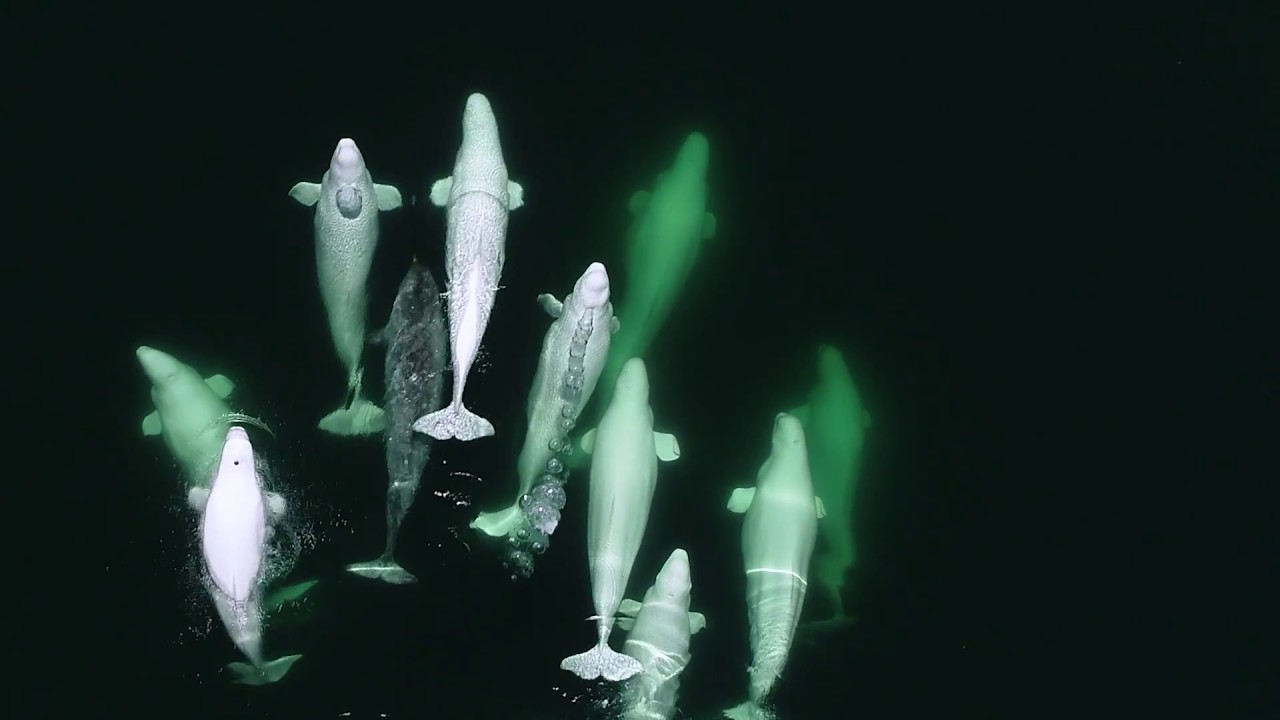
That didn't stop one young, orphaned male narwhal from making fast friends with a gang of 10 male beluga whales in eastern Canada. For three years in a row, the gray-speckled narwhal has been spotted cavorting with the same band of snow-white belugas in Canada's St. Lawrence River — a body of water that flows from Lake Ontario to the Atlantic Ocean, located about 620 miles (1,000 kilometers) south of the Arctic habitat where narwhals are typically found.
How did the toothy young narwhal get so far south? He probably fled there after his Arctic habitat lost too much ground to climate-related ice melt, according to biologists at the Group for Research and Education on Marine Mammals (GREMM) — a nonprofit whale-conservation group based in Quebec, Canada.
Latest Videos FromLive Science
And what's he doing there? Just bro-ing out, by the looks of things.
"[The narwhal] behaves like it was one of the boys," Robert Michaud, the president and scientific director of GREMM, told the CBC. "They are in constant contact with each other. … It's like a big social ball of young juveniles that are playing some social, sexual games."
Aerial footage shot by GREMM shows just how close-knit this nonconventional pod has become.The young narwhal travels where his beluga bros travel. He surfaces when they surface, blows bubbles when they blow bubbles and doesn't shy away from playful rubbings when that's what the pervading mood calls for. He is, according to GREMM scientists, part of the fraternity.
While any news involving narwhals is automatically noteworthy and delightful, blended families like this might not be so unusual, Michaud told the CBC. As ever more Artic ice is lost to climate change, Arctic creatures are forced to swim south in search of new hunting grounds. Some stray Arctic beluga whales, for example, have wandered as far south as New Jersey while in pursuit of a friendly face to cozy up to. (Sometimes, these wayward whales mistake boats for fellow whales, resulting in serious propeller-related injuries.)
"Due to the climate change being observed in the Arctic, there is a chance that these two related species (the beluga and narwhal belong to the same family: Monodontidae) might find themselves in one another's company more and more frequently in the decades to come," GREMM researchers wrote on the website Whales online. "We already see this phenomenon in other species, such as the polar bear and the grizzly, which have even been observed to interbreed."
These polar-grizzly hybrids have sometimes been called "pizzly" or "grolar" bears. And if those polar portmanteaus tickle your fancy, here's another one: "narluga." According to one 1993 paper, it's possible that previous generations of narwhals and beluga whales got up to some inter-cetacean hanky-panky to create a hybrid species of their own (nicknamed "narluga"). The resulting creature, which left behind a massive, toothy skull in Greenland, had physical features that looked analogous to those of both belugas and narwhals — but even bigger.
What fate awaits the lone narwhal bro of St. Lawrence River? Time — and more epic drone footage — will tell. For now, take heart that if a blubbery, tusk-faced orphan can forge lasting friendships with a seemingly homogenous clique, you can too!
Originally published on Live Science.