













Eclipse Overload: What If the Sun Were Blocked for Years?

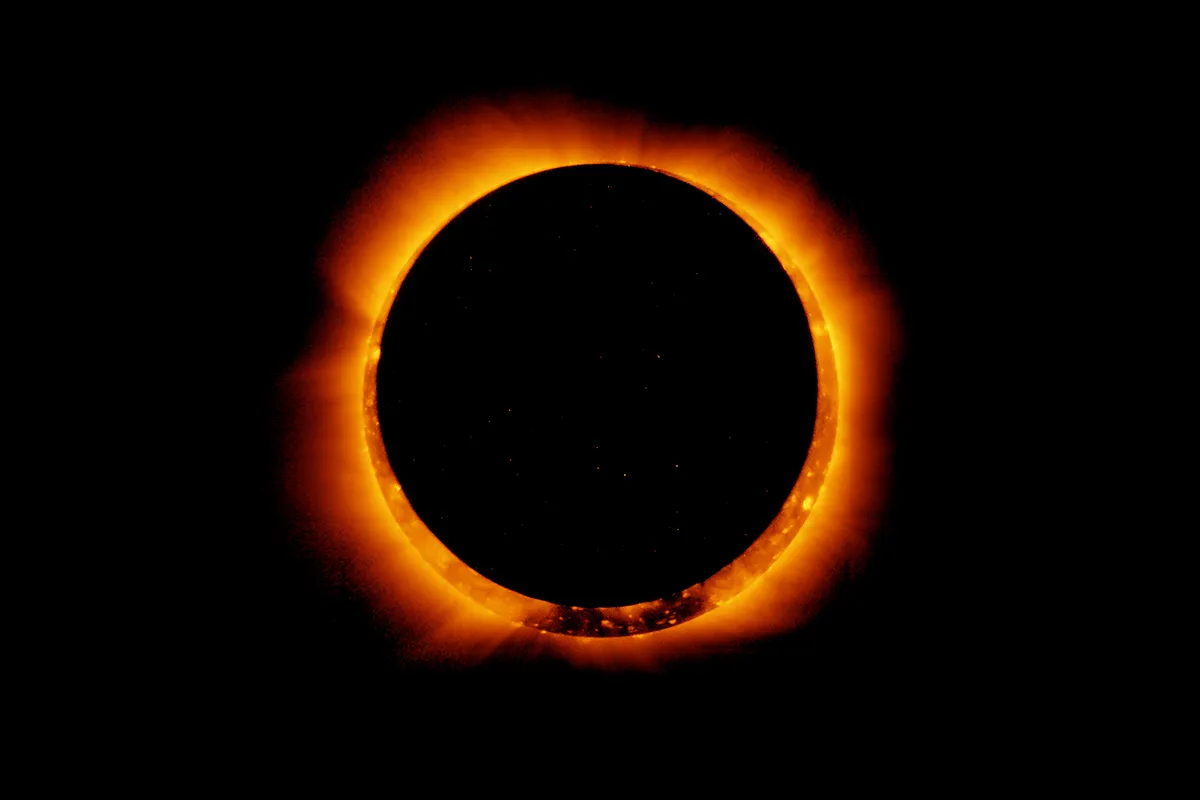
Total solar eclipses are astonishing events to witness, and preparations for them — particularly for eclipses with paths that are visible to large numbers of people, such as the Aug. 21 eclipse — can generate widespread "eclipse fever" that lasts for months.
However, the eclipse itself speeds by all too quickly, with the total eclipse visible for about 2 minutes. The length of totality for the upcoming Great American Solar Eclipse will vary across locations; Earth's rotational speed and the curvature of its surface — together with the orbital speed of the Earth and moon — determine how long a total eclipse is visible at any given point, Space.com reported. People in Carbondale, Illinois, will enjoy the longest period of total darkness during the eclipse, beginning at 1:20 p.m. local time and lasting 2 minutes and 40 seconds, according to NASA.
The fleeting nature of eclipses is a good thing. While the moon doesn't block the sun's light for long, other events in Earth's past did significantly obstruct the sun for weeks, months or even years at a time, which can have devastating consequences for life on the planet. [Top 10 Ways to Destroy Earth]
Around 66 million years ago, a mass extinction event known as the Cretaceous-Tertiary (K-T) extinction wiped out up to 80 percent of Earth's species. Many researchers link this die-off to a momentous event preserved in the geologic record — a giant comet or asteroid slammed into Earth and left an enormous crater measuring 112 miles (180 kilometers) across, under what is now the Yucatan Peninsula in Mexico.
Debris that "blasted into the upper atmosphere and beyond" would have been capable of quickly encircling the globe — or at least one hemisphere — and blocking the sun, paleoclimate expert Linda Ivany, a professor in the Department of Earth Sciences at Syracuse University, told Live Science in an email.
Dimmed, not darkened
The fragments of the asteroid and pulverized surface rock were probably soon joined in the atmosphere by quantities of ash from wildfires, caused by the heat pulse that scorched vegetation following the impact, Ivany said.
"Those particles can stay in the atmosphere much longer and were likely generated more or less continually for a period of years after the event," she said.
Get the world’s most fascinating discoveries delivered straight to your inbox.
As this ashy cover extended across Earth's atmosphere, it wouldn't have blocked the sun completely, as a total eclipse does. But it would have dimmed the sun's light enough to sound a death knell for photosynthesizing plants and the animals that ate them, Ivany told Live Science.
"The reduced solar input for months or years would have hurt the ability of these organisms to grow and reproduce, like a house plant you put in too dark a corner. Sooner or later, it just fades and dies, even though it's not 'dark' in your house," she said.
Reduced sunlight would have meant cooler surface temperatures, as well, Ivany said.
"There are data from the Cretaceous extinction that suggest short-term cooling immediately following the extinction, and that's likely due to the change in the opacity of the atmosphere," she said.
Terrestrial vertebrates that either ate plants or preyed on herbivores — such as the non-avian dinosaurs — were also snuffed out. But animals inhabiting ecosystems fueled by dead organic matter had a better chance of surviving periods where vegetation was scarce or unable to grow, Ivany explained.
Ashes to ashes
Asteroid impacts aren't the only events capable of partially blocking the sun — volcanos can also darken skies on a global scale. On April 5, 1815, when Indonesia's Mount Tambora erupted, it spewed approximately 36 cubic miles (150 cubic kilometers) of rock and ash to heights of 18 miles (29 km), in what was the biggest eruption in recorded history. [History's Most Destructive Volcanoes]
Shortly after the explosion, the ash cloud over the region expanded to cover an area approximately the size of Australia, and air temperatures there dropped as much as 20 degrees Fahrenheit (11 degrees Celsius), Scientific American reported. The ash lingered in Earth's atmosphere, teased into filaments that spread over the planet. The ash obscured sunlight and lowered temperatures around the world for the next three years, leading people to dub 1816 the "Year Without a Summer," according to the New York Times.
And Earth is capable of generating even bigger eruptions, from so-called "supervolcanoes" — massive calderas that can measure up to 31 miles (50 km) in diameter and can produce nearly 1,100 cubic miles (more than 450 cubic km) of magma, the journal Science reported. (For comparison, the famous 1980 Mount St. Helens eruption released just 0.1 cubic km of magma, according to Oregon State University.)
Luckily, supervolcanoes typically erupt only about once every 100,000 years, according to Science. The most recent supervolcano eruption was Mount Toba in Indonesia about 74,000 years ago, which produced an estimated 700 cubic miles (2,800 cubic km) of magma. Geologists have identified seven active supervolcano zones on Earth, though none of them currently poses a threat, Science reported.
By comparison, the few minutes of darkness during the Aug. 21 solar eclipse won't lead to any long-term changes affecting global temperatures. However, there will likely be a noticeable impact on solar energy grids in parts of the U.S. Utility workers in California are anticipating solar energy production to be reduced by up to 75 percent during the eclipse, potentially affecting up to 6 million homes, a representative for California Independent System Operator, a nonprofit that oversees and operates electrical power grids, told Live Science in June.
Original article on Live Science.

Mindy Weisberger is a science journalist and author of "Rise of the Zombie Bugs: The Surprising Science of Parasitic Mind-Control" (Hopkins Press). She formerly edited for Scholastic and was a channel editor and senior writer for Live Science. She has reported on general science, covering climate change, paleontology, biology and space. Mindy studied film at Columbia University; prior to LS, she produced, wrote and directed media for the American Museum of Natural History in NYC. Her videos about dinosaurs, astrophysics, biodiversity and evolution appear in museums and science centers worldwide, earning awards such as the CINE Golden Eagle and the Communicator Award of Excellence. Her writing has also appeared in Scientific American, The Washington Post, How It Works Magazine and CNN.