The most powerful and destructive volcanic eruptions — called super-eruptions — can take millions of years to form because magma doesn't gush, but rather slowly trickles into the system, a new study finds.
Researchers found that super-eruptions are triggered by an incredibly slow but steady drip of magma from large reservoirs deep within Earth's crust into smaller reservoirs closer to the surface, they said.
In turn, the large reservoirs draw in the hot magma from the layer beneath them, which is Earth's mantle, the researchers said. The reservoirs keep the magma in a state of partially molten rock, and store it like a sponge, they added. [Big Blasts: History's 10 Most Destructive Volcanoes]
Because the researchers couldn't physically travel to these large reservoirs, they ran a series of numerical simulations to better understand the process. The results show that the large reservoirs are essential for generating the largest volcanic eruptions known to Earth, they said.
However, because the drip of magma is so slow, it can take millions of years before a supervolcano erupts, they said.
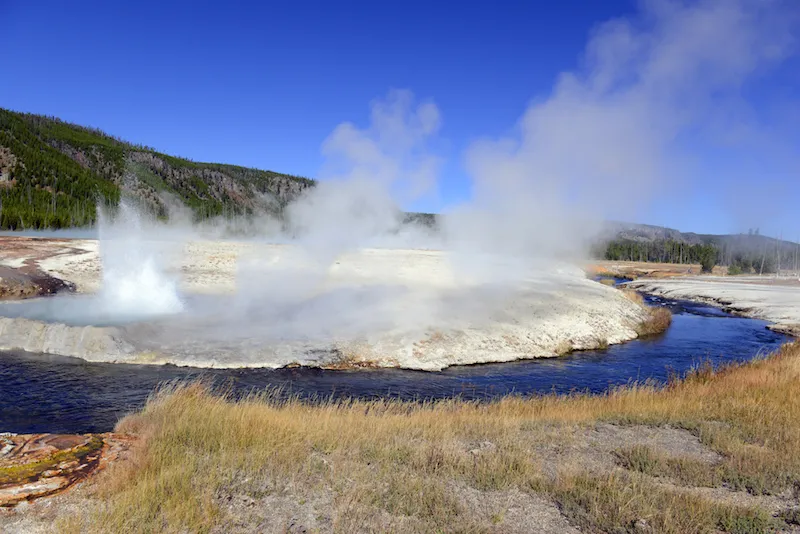
The finding explains why supervolcano eruptions are few and far between — for instance, Yellowstone, one of the world's largest supervolcanoes, erupted about 2 million, 1.2 million and 640,000 years ago.
The four main layers within Earth.
(Image credit: Jakinnboaz/Shutterstock)
The discovery may also shed light on why other volcanoes erupt with greater frequency and at specific magnitudes, the researchers said. That's because the amount of magma stored in Earth's upper crust determines the frequency and magnitude of volcanic eruptions.
Sign up for the Live Science daily newsletter now
Get the world’s most fascinating discoveries delivered straight to your inbox.
Small eruptions that emit less than 0.2 cubic miles (1 cubic kilometer) of material happen regularly — yearly, if not daily, the researchers said. But super-eruptions, which erupt hundreds of cubic miles of material — are rare, occurring hundreds of thousands of years apart.
"Our current understanding tells us that hot magma can be injected from the Earth's lower crust into colder surroundings near the surface," study co-author Wim Degruyter, a lecturer of geodynamics at Cardiff University in the United Kingdom, said in a statement. "At this point, the magma can either erupt or cool down to such a point that the magma solidifies and an eruption does not occur."
Until now, researchers haven't been able to figure out how the magma can stay hot in a near-surface reservoir, which is cooler than the larger reservoirs in the deep crust.
"Our study has shown that the key to this is much larger reservoirs deeper below the surface that are able to slowly increase the temperature in the upper part of the crust such that it becomes more amenable to the storage of magma," Degruyter said. " When the crust has become fully mature, giant reservoirs are able to form in the upper crust and thus we see extremely powerful eruptions."
For instance, earlier research has shown that a reservoir in the upper part of the crust beneath Yellowstone is connected to a deeper magma pool, the researchers said. The deeper magma reservoir is about 12 miles to 28 miles (19 to 45 milometers) beneath Earth's surface, and likely holds enough magma to fill the Grand Canyon more than 11 times, the researchers said.
"Our calculations appear to agree with the observations that have been made at Yellowstone," Degruyter added.
Laura is the managing editor at Live Science. She also runs the archaeology section and the Life's Little Mysteries series. Her work has appeared in The New York Times, Scholastic, Popular Science and Spectrum, a site on autism research. She has won multiple awards from the Society of Professional Journalists and the Washington Newspaper Publishers Association for her reporting at a weekly newspaper near Seattle. Laura holds a bachelor's degree in English literature and psychology from Washington University in St. Louis and a master's degree in science writing from NYU.