













Facts About Venus Flytraps

Unlike most plants, Venus flytraps are carnivorous, which means they eat meat. Charles Darwin wrote in his 1875 publication, "Insectivorous Plants," that the Venus flytrap is "one of the most wonderful [plants] in the world." There's no doubt that this opinion was formed after watching the jaws of this plant snap around an insect, capturing it for a meal.
Size
Venus flytraps grow to around 5 inches (13 centimeters) in diameter. Each plant usually has about six stems with hinged leaves. The edges of the leaves are lined with "teeth," and the leaves fit together like a clamshell. When the leaves snap shut, they form a trap. An individual trap grows to around 1 inch (3 cm), according to The International Carnivorous Plant Society.
Habitat
Venus flytraps are native to North Carolina and South Carolina, but they have been introduced to other states, including Florida and New Jersey. They like the moist, acidic soil found in the understories of forests, according to the National Wildlife Federation. They also need high humidity and a lot of sunlight to flourish.
Habits & Diet
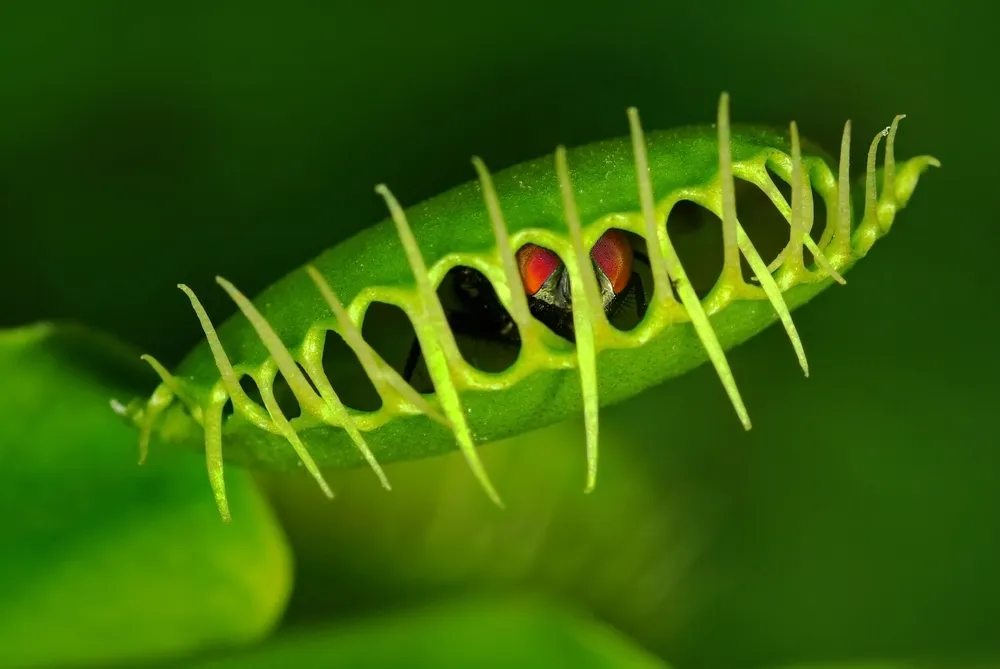
The most interesting thing about this plant is how it eats. Flytraps lure insects by the reddish lining in the leaves and by secreting a fragrant nectar. When bugs land in the jaws of the flytrap, it doesn't clamp down right away. Sensory hairs, called trichomes, on the inside of the petals essentially count the movements from the insect. There must be at least two movements in 20 seconds or the petals won't close. This prevents it from trapping debris or other items that wouldn't make a good meal.
On the second movement, the plant closes its jaws in under a second by snapping from a convex shape to concave shape. The bristles on the edges of the leaves work like jail bars to prevent the insect from making an escape. [Related: Deadly Math: Venus Flytraps Calculate When Killing Prey]
On the third movement, it starts to digest the insect. Digestive juices are introduced to the mouth area and they break down the insect. After five to 12 days, the plant will reopen and the parts of the bug that couldn't be digested fall out.
The Venus flytrap's primary prey is ants, but it will also eat flies, beetles, slugs, spiders and even tiny frogs. Flytraps don't just eat bugs for nutrition, though. Like other plants, they also need water, gases and sunlight. Insects simply supplement their diet, according to the Botanical Society of America.
Get the world’s most fascinating discoveries delivered straight to your inbox.
Reproduction
Venus flytraps reproduce like many other plants. When their flowers are pollinated, they create seeds. The seed mature after four to six weeks and become black and pear-shaped. These seeds are then spread and grow into new plants.
These flytraps can also reproduce asexually. The roots of the Venus flytrap will extend in the soil and create a bulb root. The new flytrap will grow from the bulb. A gardener can then separate the new plant and bulb from the parent plant by cutting the connecting roots.
Classification/taxonomy
Here is the taxonomy of the Venus flytrap, according to the Integrated Taxonomic Information System:
Kingdom: Plantae Subkingdom: Viridiplantae Infrakingdom: Streptophyta Superdivision: Embryophyta Division: Tracheophyta Subdivision: Spermatophytina Class: Magnoliopsida Superorder: Caryophyllanae Order: Caryophyllales Family: Droseraceae Genus: Dionaea Species: Dionaea muscipula
Conservation status
The Venus flytrap is listed as vulnerable by the International Union for Conservation of Nature's Red List of Threatened Species. These plants are vulnerable from over-harvesting and habitat destruction.
Another problem for flytraps is proper soil. Forest fires are sometimes beneficial to the understory of a forest. It can clear brush and allow more sunlight through to the understory. Since forest fires are often contained and put out by humans, the trees and brush become overgrown and the Venus flytraps don't get the light they need.

Other facts
When the flytrap's "mouth" is closed, it is sealed air tight. That helps keep out bacteria.
These are perennial plants, which means they bloom year after year. Their flowers are white with green veins running from the base of the petal toward the edges, according to the National Wildlife Federation.
It is estimated that Venus flytraps can live up to 20 years or longer, according to the National Wildlife Federation.
Additional resources
