In winter, an icy freshwater lake can appear frozen in time. Though lakes are typically teeming with life — visible and microscopic — it's not hard to imagine that when temperatures drop and ice solidifies on a lake's surface, plant and animal activity in its depths would also "freeze."
But frozen freshwater lake ecosystems don't take a winter break after all. A new study finds that under the ice, certain forms of life are far more active than scientists thought.
In fact, cyclical winter activity of tiny aquatic organisms, like zooplankton and photosynthesizing algae, could play critical roles in the lake ecosystems' overall health, infusing the water with nutrients to fuel other organisms' spring and summer growth. [Yuck! Photos of 'Rock Snot' Algae Infestations]
About half of the world's lakes — approximately 50 million — freeze seasonally, but little is known about what goes on underneath their ice cover, the study authors wrote. Sea-ice studies, which are more numerous, show that ice cover drives algae production, a vital part of ocean food webs. Scientists suspected that ice-covered lakes could be similarly active.
Previous studies focused primarily on how lake ecosystems behaved in summer, "when most of the data on lakes have been collected," study lead author Stephanie Hampton, director of the Center for Environmental Research, Education and Outreach at Washington State University, told Live Science in an email.
So Hampton led an effort to collect and analyze data sets that represented winter conditions in lakes. Those data sets could then be compared to data sets of summer conditions.
Milla Rautio of the University of Québec at Chicoutimi fetches a water sample through the winter ice at Lake Saanajärvi in Finland. She and other researchers have found that life under the ice in freshwater is vibrant, complex and surprisingly active.
(Image credit: Heather Mariash)
Hampton and her colleagues first reviewed existing research, investigating 14 studies with data for 17 lakes. They then reached out directly to the scientific community for more data, gathering both under-ice and summer observations conducted between 1940 and 2015 from 101 lakes.
Sign up for the Live Science daily newsletter now
Get the world’s most fascinating discoveries delivered straight to your inbox.
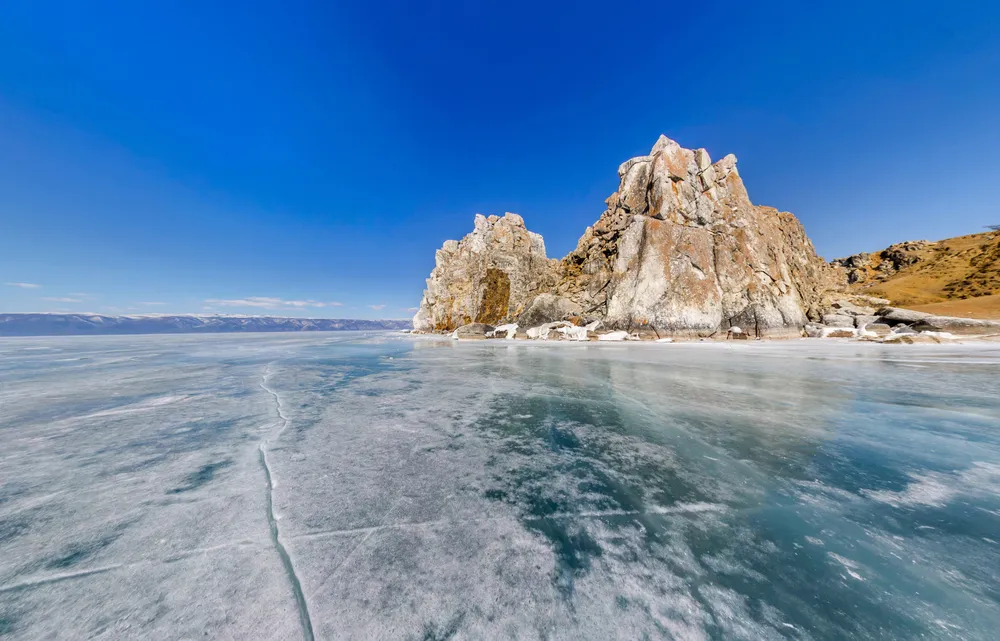
Scientists' findings varied widely from lake to lake, largely depending on the type of ice cover and how easily sunlight could penetrate it. When lakes are covered by clear ice, sunlight can reach the algae and zooplankton beneath and fuel their growth. At Lake Baikal in Siberia, winter algae blooms — under ice — are often larger than summer algae blooms.
"Some hypothesize that clear ice in winter provides ready access to light for the relatively large filamentous algae that dominate those big winter blooms," Hampton told Live Science in an email, explaining that those filaments attach to the ice or become suspended near it. The ice provides a stable environment with access to plenty of light, enabling the algae to thrive.
"The lake is naturally nutrient poor, so these offshore algal blooms are not at levels that are a nuisance — they are important for feeding the food web," Hampton said. "And the algal blooms are largest when the ice is clear — a factor that is determined by the weather at the time of freezing."
The findings provide a first glimpse of how winter activity in lakes — even those that have frozen over — could be necessary for a healthy environment year-round. But as little as scientists know about life under freshwater lakes' ice, even less is known about how this balance will shift in a warming world, Hampton added.
Higher temperatures could lead to reduced ice cover or shorter periods of coverage, which could spell trouble for winter growth of algae and zooplankton, she said. Investigating lakes where winter ice cover is inconsistent could provide researchers with some insight into how lake ecosystems adapt to this variability. For instance, they may observe changes in the algal communities' composition, which could affect the lake's entire food web, Hampton said.
"There is a lot we do not know about how these dynamics will play out," Hampton told Live Science.
The findings were published online today (Nov. 28) in the journal Ecology Letters.
Mindy Weisberger is a science journalist and author of "Rise of the Zombie Bugs: The Surprising Science of Parasitic Mind-Control" (Hopkins Press). She formerly edited for Scholastic and was a channel editor and senior writer for Live Science. She has reported on general science, covering climate change, paleontology, biology and space. Mindy studied film at Columbia University; prior to LS, she produced, wrote and directed media for the American Museum of Natural History in NYC. Her videos about dinosaurs, astrophysics, biodiversity and evolution appear in museums and science centers worldwide, earning awards such as the CINE Golden Eagle and the Communicator Award of Excellence. Her writing has also appeared in Scientific American, The Washington Post, How It Works Magazine and CNN.