













Photos: Ancient Tully Monster's Identity Revealed

One odd-looking creature

Since the so-called Tully monster's discovery in 1958, fossils of the odd-looking creature have mystified scientists. Now, two 2016 studies using cutting-edge technologies and a team of collaborative experts have announced that the approximately 307-million-year-old fossils — which, incidentally, are the state fossil of Illinois — are vertebrates. one study found that they were are jawless fish, similar to modern lampreys.
The other found that they were vertebrates, and likely "a type of very weird fish."
Tully monster, envisioned
An illustrator's interpretation of the Tully monster (Tullimonstrum gregarium). Notice its hammerheadlike eyes and its toothy mouth at the end of its proboscis.
Fishy swimmer
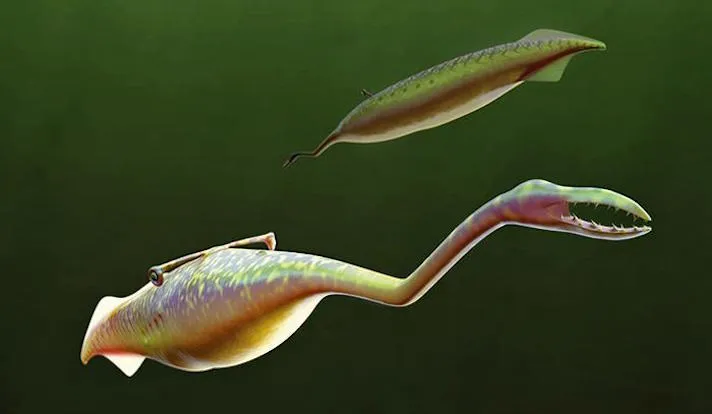
The Tully monster likely used its tail to propel it forward in the water.
First Tully monster fossil

The first fossil ever found of the Tully monster. Notice its proboscis folded over its head at the top.
Open wide

The toothy mouth at the end of the long proboscis. The dark spot on the right might be the remnants of an organ, the researchers said.
Eye bar

A sideways view of a Tully monster specimen. Notice its long eye bar pointing diagonally on the right side of the fossil.
Get the world’s most fascinating discoveries delivered straight to your inbox.
Folded tail

A fossil with a folded tail, with the dorsal fin extending from the fifth skeletal muscle in the middle of the specimen.
Oh, that face!

This specimen shows a clear view of the Tully monster's eyes (right), proboscis (middle) and mouth (left).
Follow Laura Geggel on Twitter @LauraGeggel. Follow Live Science @livescience, Facebook & Google+.
It's all in the eyes

An microscopic image of Tully monster's peculiar eyes.
Tully Hunt

Thomas Clements and Sarah Gabbott search for the Tully monster in Illinois, where Tully is the state fossil.
A star is born

The Tully Monster is so famous in Illinois, that it's even featured on U-Haul trucks.

Laura is the managing editor at Live Science. She also runs the archaeology section and the Life's Little Mysteries series. Her work has appeared in The New York Times, Scholastic, Popular Science and Spectrum, a site on autism research. She has won multiple awards from the Society of Professional Journalists and the Washington Newspaper Publishers Association for her reporting at a weekly newspaper near Seattle. Laura holds a bachelor's degree in English literature and psychology from Washington University in St. Louis and a master's degree in science writing from NYU.