How Scientists Created a Semi-Artificial Life Form (Infographic)
By
Karl Tate
published
in Infographics
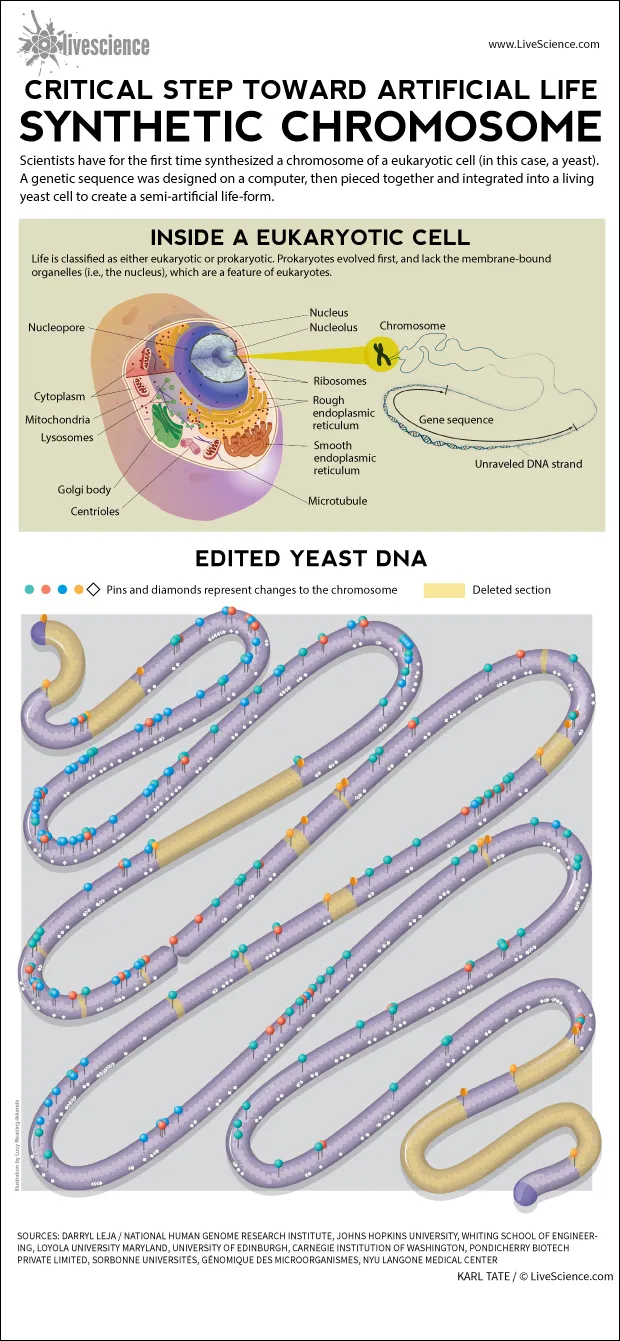
By editing its DNA sequence on a computer, scientists modified a eukaryotic yeast cell.
(Image credit: By Karl Tate, Infographics Artist)
Add us as a preferred source on Google
Subscribe to our newsletter
Scientists have for the first time synthesized a chromosome of a eukaryotic cell (in this case, a yeast). A genetic sequence was designed on a computer, then pieced together and integrated into a living yeast cell to create a semi-artificial life-form.
Life is classified as either eukaryotic or prokaryotic. Prokaryotes evolved first, and lack the membrane-bound organelles (i.e., the nucleus), which are a feature of eukaryotes.
Sign up for the Live Science daily newsletter now
Get the world’s most fascinating discoveries delivered straight to your inbox.

Karl has been Purch's infographics specialist across all editorial properties since 2010. Before joining Purch, Karl spent 11 years at the New York headquarters of The Associated Press, creating news graphics for use around the world in newspapers and on the web. He has a degree in graphic design from Louisiana State University.