Kilauea Eruption Triggered Unusually Strong Earthquakes

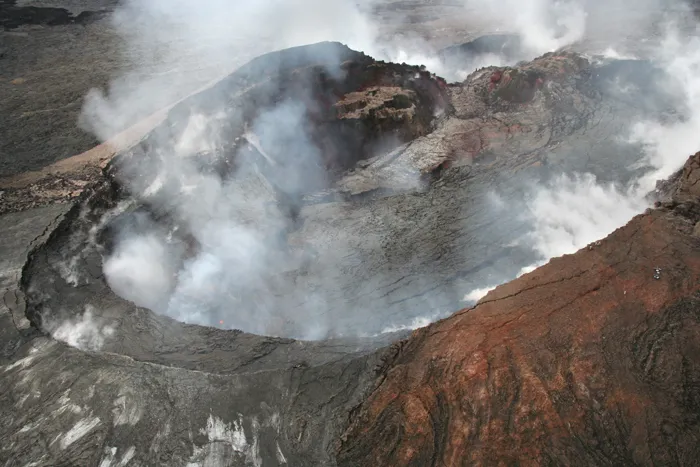
Strong earthquakes can occur when molten-hot magma rapidly pressurizes volcanoes, researchers found after studying activity at Hawaii's Kilauea volcano during 2007.
Such quakes could help researchers forecast volcanic activity, the scientists said.
The researchers found that Hawaii's Kilauea volcano, located on Hawaii's Big Island, has been erupting since 1983. By the end of 2012, the years of lava flows had covered 48.4 square miles (125.5 square kilometers) with about 1 cubic mile (4 cubic km) of molten rock, and added about 500 acres (202 hectares) of new land to the volcano's southeastern shore. The flows also destroyed more than 200 structures and buried about 9 miles (14.5 km) of highway with as much as 115 feet (35 meters) of lava.
Starting in 2003, researchers noticed the magma chamber within the volcano was inflating — activity that accelerated in 2006. In 2007, the volcano's eruption peaked with a burst of activity known as the Father's Day event (for the time of year it occurred). [In Images: Hawaii's Mount Kilauea Erupts]
New research suggests that in the buildup to the Father's Day event, a pair of strong earthquakes struck beneath the upper part of Kilauea's east rift zone, the part most clearly linked with the network of magma underlying the volcano. Earthquakes are common around Kilauea, but the two 2007 earthquakes were among the most powerful recorded in that region since record keeping began in 1959, with magnitudes of 4.7 and 4.1.
Most quakes linked with the movement of magma in volcanoes — so-called volcano-tectonic earthquakes — have very small magnitudes. To learn more about the mysterious Kilauea quakes, scientists analyzed a range of data from the events, including details from satellite radar and seismic and GPS sensors.
The researchers suggested that the powerful quakes were caused when the magma chamber beneath Kilauea inflated with molten rock. This magma deformed the Earth, causing pre-existing faults in the crust near the volcano to slip, resulting in volcano-tectonic earthquakes that are more powerful than usual.
Get the world’s most fascinating discoveries delivered straight to your inbox.
"To the best of our knowledge, for the first time, we have found a realistic explanation for the occurrence of larger-than-expected volcano-tectonic earthquakes at Kilauea volcano, Hawaii, and possibly at other volcanoes," said study lead author Christelle Wauthier, a volcanologist at the Carnegie Institution of Washington.
The scientists propose that similarly larger-than-expected quakes could occur at other volcanoes worldwide. In addition, they think that "such earthquakes provide an indicator of the potential for future volcanic activity," Wauthier told LiveScience's OurAmazingPlanet. Moderate-magnitude earthquakes in volcano summit areas "might indicate that magma pressure is reaching critical levels," she said.
Wauthier and her colleagues Diana Roman and Michael Poland detailed their findings in the Oct. 28 issue of the journal Geophysical Research Letters.
Follow OurAmazingPlanet @OAPlanet, Facebook and Google+. Original article at LiveScience's OurAmazingPlanet.