













Tiny Robot Flies Like a Jellyfish

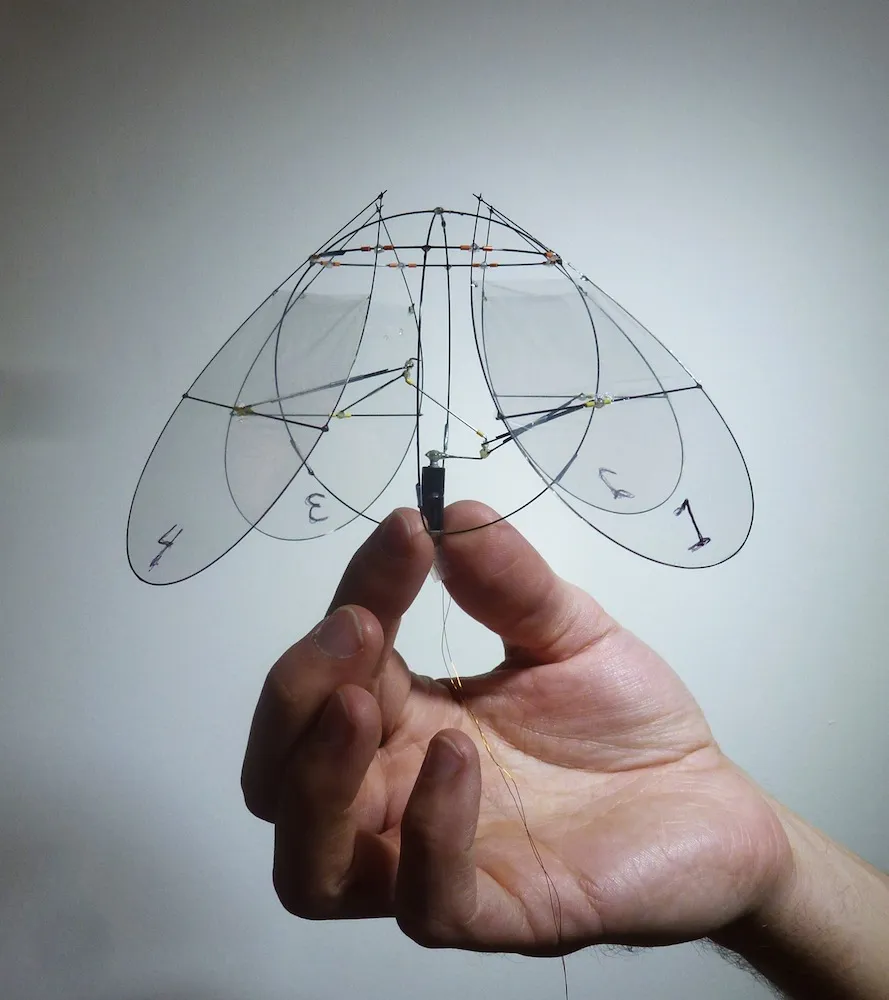
A new teeny-tiny robot flies through the air like a jellyfish swims.
The jellyfish flier is a strange sight — it looks a little bit like a Chinese lantern that's developed a hankering for the open skies — but its unique design keeps it from tipping over without the use of sensors or external controls. That talent could make it handy for maneuvering in small spaces, said its inventor Leif Ristroph, a postdoctoral researcher at New York University.
"What's cool is you can actually build these flying things yourself," Ristroph told LiveScience. "All the components I used to make this, they cost about $15 and they're available on hobby airplane websites." [See Video of the Flying Jellyfish Robot]
Searching for stability
Many small robots take insects as their inspiration, such as the dragonfly-like DelFly, a Dutch drone that weights only 0.7 ounces (20 grams). But insect flight is notoriously unstable, Ristroph said. Instability is no big deal for bugs — they have nervous systems that can correct their wing motions when they begin to tip. Insect-inspired robots need sophisticated sensor systems to do the same.
"The real number-one issue in flying is stability," Ristroph said. "How do I keep upright the whole time?"
Ristroph wanted to know if he could invent a winged flying machine that was inherently stable, no sensors or artificial nervous system needed. He tinkered with five or 10 designs, he said, including one inspired by an umbrella. In principle, he said, opening and closing an umbrella rapidly should generate lift and send the object flying.
Get the world’s most fascinating discoveries delivered straight to your inbox.
The flying jellyfish
He ended up creating a conelike machine made of four wings approximately 3 inches (8 centimeters) long, surrounding a small motor. The wings flap up and down not-quite-simultaneously. In practice, Ristroph said, the motion is very similar to what a jellyfish does to propel itself through water.
"It has a bell that contracts and squirts water downwards," Ristroph said. The jellyfish flier does the same with air.
The magic of the new robot is that it is automatically stable. If it begins to tip, the motion of the flapping wings naturally corrects its course, keeping it upright as it ascends, hovers and moves horizontally.
The prototype does not include a battery, so the robot still requires a wire for power. More engineering work will be necessary to get power and a radio receiver onboard so that an operator can control the flying bot from afar, Ristroph said.
"Part of what we're trying to do is get people excited about this design so that we can work with them and improve upon it," he said. He and his colleagues detail their invention today (Jan. 14) in the Journal of the Royal Society Interface. They also presented the robot at a fluid dynamics meeting in November.
The robot also highlights the need to keep an open mind when devising new robots, Ristroph said. The next big breakthrough may come from a tinkerer messing around in their garage or dorm room, he said.
"There are lots of ways to fly, and we've barely scratched the surface," he said. "It's a cool problem to think about. Can we dream up new ways to fly?"
Follow Stephanie Pappas on Twitter and Google+. Follow us @livescience, Facebook & Google+. Original article on LiveScience.

Stephanie Pappas is a contributing writer for Live Science, covering topics ranging from geoscience to archaeology to the human brain and behavior. She was previously a senior writer for Live Science but is now a freelancer based in Denver, Colorado, and regularly contributes to Scientific American and The Monitor, the monthly magazine of the American Psychological Association. Stephanie received a bachelor's degree in psychology from the University of South Carolina and a graduate certificate in science communication from the University of California, Santa Cruz.