













Facts About Roentgenium

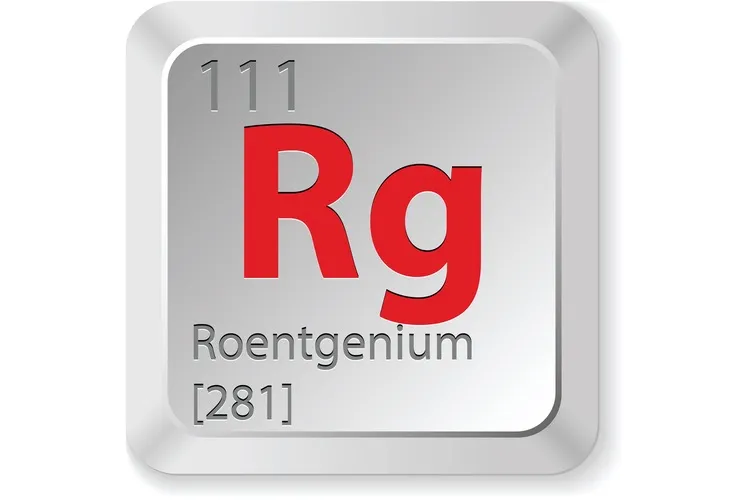
Atomic Number: 111 Atomic Symbol: Rg Atomic Weight: [281] Melting Point: Unknown Boiling Point: Unknown
Word origin: Roentgenium is named for scientist Wilhelm Conrad Röentgen, who discovered X-rays.
Discovery: Element 111 was discovered by the Gesellschaft fur Schwerionenforschung team led by Peter Armbruster and Gottfried Münzenber in late 1994. They produced three atoms of 272Rg.
Properties of roentgenium
Roentgenium is a radioactive, synthetic element about which little is known. It is classified as a metal and is expected to be solid at room temperature.
Roentgenium has seven isotopes whose half-lives are known. The most stable isotope is 281Rg, with a half-life of about 26 seconds. It decays through spontaneous fission.
Sources of roentgenium
Get the world’s most fascinating discoveries delivered straight to your inbox.
Roentgenium is produced artificially. The team that discovered it bombarded atoms of bismuth with ions of nickel in a linear accelerator to produce element 111.
The atomic weight for manmade transuranium elements is based on the longest-lived isotope in the periodic table. These atomic weights should be considered provisional since a new isotope with a longer half-life could be produced in the future. [See Periodic Table of the Elements]
Uses of roentgenium
Only a few atoms of roentgenium have ever been made, and they have no current application outside of scientific study.
(Sources: Los Alamos National Laboratory, Jefferson Lab)
