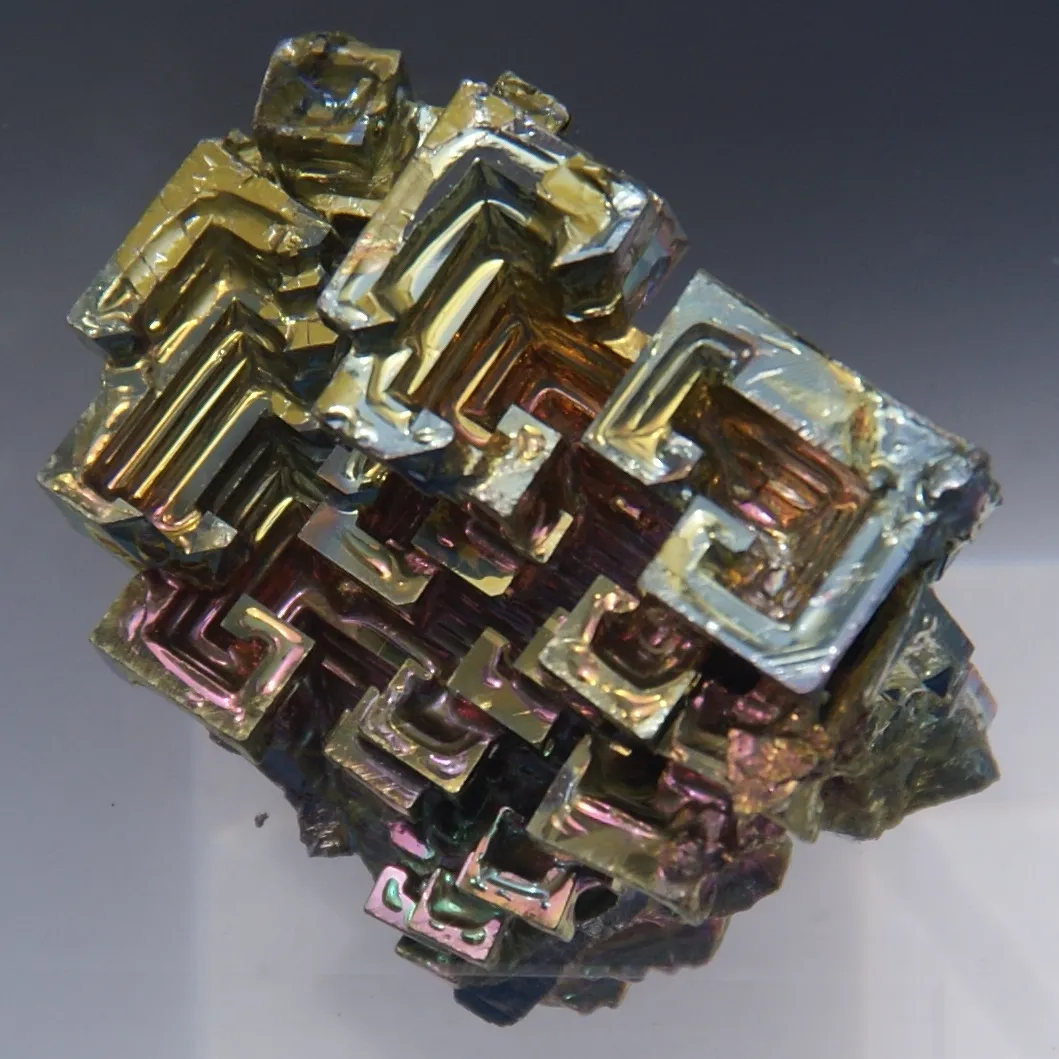
Bismuth is a brittle, crystalline, white metal with a slight pink tinge. It has a variety of uses, including cosmetics, alloys, fire extinguishers and ammunition. It is probably best known as the main ingredient in stomach ache remedies such as Pepto-Bismol.
Bismuth, element 83 on the periodic table of elements, is a post-transition metal, according to Los Alamos National Laboratory. (Different versions of the periodic table represent it as a transition metal.) Transition metals — the largest group of elements, which includes copper, lead, iron, zinc and gold — are very hard, with high melting points and boiling points. Post-transition metals share some characteristics of transition metals but are softer and conduct more poorly. In fact, bismuth's electric and thermal conductivity is unusually low for a metal. It also has a particularly low melting point, which enables it to form alloys that can be used for molds, fire detectors and fire extinguishers.
Until recently, bismuth was considered the heaviest element that still had a stable nucleus. However, in 2003, researchers at the Institut d'Astrophysique Spatiale in Orsay, France, found that bismuth does decay into thallium, but it has an extremely long half-life: about 20 billion billion years (That's 20 followed by 18 zeroes). Put another way, if 100 grams of bismuth-209 (the natural isotope) had been present at the beginning of the universe more than 14 billion years ago, about 99.9999999 grams of it would still be around today, according to Chemicool. (Lead is now the heaviest stable element, according to Science magazine.)
Though bismuth had been known as early as 1400, it was frequently confused with lead because it was similarly a heavy metal with a low melting point, according to the Royal Society of Chemistry. French chemist Claude Geoffroy the Younger was the first to prove that bismuth was distinct from lead in 1753.
The word "bismuth" is a Latinized version of an Old German word, "weissmuth" or "white substance," possibly named after the element's white oxide, according to Chemicool.
Sources of bismuth
Naturally occurring bismuth is found in small quantities throughout Earth's crust both as a pure metal and combined with other elements in various compounds. The largest source of bismuth is found in the mineral bismuthinite, or bismuth sulfide (Bi2S3), according to John Emsley in his book, "Nature’s Building Blocks: An A-Z Guide to the Elements" (Oxford University Press, 1999). Bismuth is typically obtained as a by-product in refining lead, copper, tin, silver, and gold ores found in Bolivia, Peru, Japan, Mexico, and Canada.
Properties of bismuth
Compared to other metals, bismuth is the most diamagnetic; that is, it resists being magnetized and is repelled by a magnetic field, according to Chemicool. It also has low electric conductivity and the greatest electrical resistance when placed in a magnetic field, a trait called the Hall effect.
Sign up for the Live Science daily newsletter now
Get the world’s most fascinating discoveries delivered straight to your inbox.
It has a very low thermal conductivity — lower than any other metal except mercury, according to Chemicool. It also has a relatively low melting point, especially when alloyed with tin and lead. Bismuth burns with a blue flame and clouds of yellow oxide when heated in air, according to Robert E. Krebs in his book, "The History and Use of Our Earth’s Chemical Elements: A Reference Guide" (Greenwood Publishing Group, 2006).
When liquid bismuth freezes, it expands rather than contracts because it forms a crystalline structure similar to water. Four other elements expand when they freeze: silicon, gallium, antimony and germanium, according to Chemicool. Bismuth crystals are easy to make at home. There are several how-to guides online, including this one at ScienceAlert and this one at ThoughCo.
Bismuth in your medicine cabinet
Bismuth subsalicylate (C7H5BiO4), sold under the brand names Pepto-Bismol and Kaopectate, is a well-known remedy for stomach aches and diarrhea. It works by decreasing the flow of fluids and electrolytes into the bowel, reduces inflammation within the intestine, and may kill the organisms that can cause diarrhea, according to the U.S. National Library of Medicine.
Many cosmetics including lipsticks, eyeshadow and nail polish contain bismuth oxychloride (BiOCl), a pearly powder that makes the products shine, according to Emsley.
Industrial and military uses of bismuth
According to Los Alamos:
Bismuth compounds are used as catalysts in the manufacturing process of synthetic fiber and rubber.
When bismuth is combined with other metals such as lead, tin, iron and cadmium, it forms alloys with low melting points that can be used in fire detectors and extinguishers.
Alloys of bismuth are also used in making sharp castings of objects subject to damage by high temperatures because the liquid metal expands 3.32 percent when it becomes solid.
Bismanol, an alloy of bismuth and manganese, is a permanent magnet of high coercive force (a measure of magnetization) developed in the 1950s by the U.S. Naval Ordinance Laboratory in White Oak, Md. It was used in small motors.
The bismuth metal is used as replacement for lead in shot and bullets.
Bismuth can also be used in nuclear reactors and to make transuranium elements using a process called cold fusion.
Carol Stoll is a contributing writer for Live Science. She previously taught high school science in Newark, N.J., and Riverdale, N.Y. She has a master’s degree in science education from Harvard Graduate School of Education and a bachelor’s degree in biology from Washington University in St. Louis.