













Monkey Avatars: Primates Move Virtual Arms with Their Mind

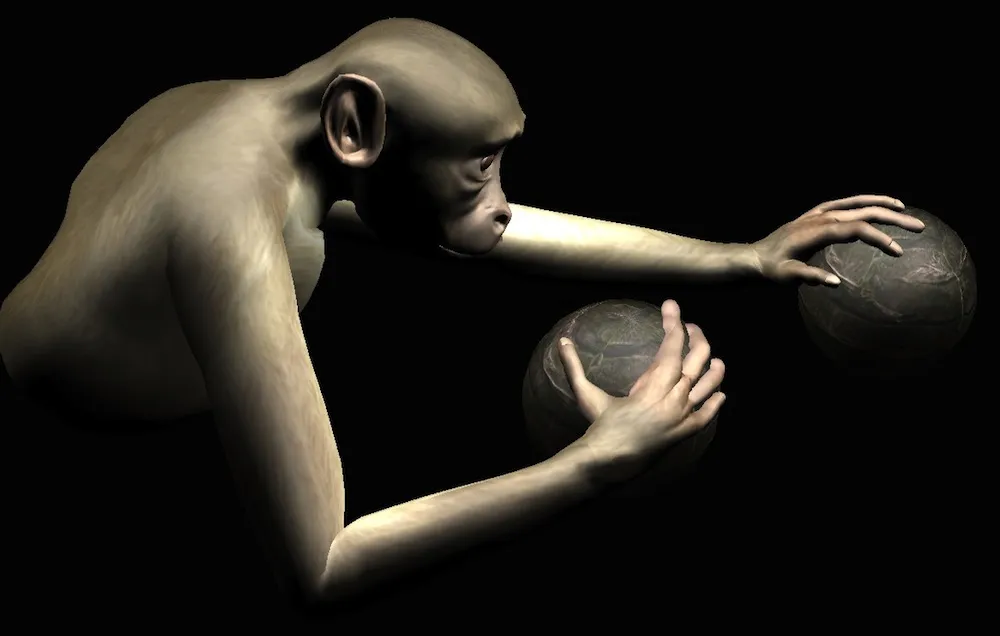
Sci-fi authors take note: Monkeys have learned to move a pair of virtual arms directly using their brain.
The finding, which comes from the same group that recently linked two rat brains together, is the latest demonstration of efforts to record signals from the brain and use them to operate computers or prosthetic limbs. The ultimate goal of this research is to restore physical control to people who are paralyzed.
From typing on a keyboard to opening a can, life is full of movements that require two arms, neurobiologist Miguel Nicolelis, who led the research, said in a statement.
"Future brain-machine interfaces aimed at restoring mobility in humans will have to incorporate multiple limbs to greatly benefit severely paralyzed patients," said Nicolelis, of Duke University School of Medicine. [Watch video of monkeys controlling avatars]
Spinal cord injuries, stroke and neurodegenerative diseases cause millions of cases of paralysis worldwide. Although these conditions lead to damage to the connections between the brain and the muscles, the brain areas responsible for muscle movements often remain intact.
Over the past decade, researchers have made great strides in developing brain-machine interfaces to connect the mind to prosthetic devices. But until now, these systems only sought to control a single limb, the researchers said.
Monkey arm avatars
Get the world’s most fascinating discoveries delivered straight to your inbox.
In the study, Nicolelis and his colleagues recorded signals from nearly 500 neurons in both hemispheres of monkey brains, using arrays of tiny electrodes implanted in movement-related areas of the cortex — the largest number of neurons recorded and reported to date, the team said.
They trained monkeys to operate a pair of avatar arms in a virtual environment, first with joysticks, and later, using their minds alone. The animals performed a virtual task requiring both arms.
Over time, the monkeys improved their ability to control the avatar arms with their brain, performing better at the two-armed task. Furthermore, the animals' brains showed notable reorganization, or plasticity, over time in the brain areas from which the researchers recorded.
The findings, detailed today (Nov. 6) in the journal Science Translational Medicine, suggest the monkey brains are incorporating the avatar arms into their internal body image.
The results also suggest that ensembles of neurons, rather than individual neurons, form the basic unit of normal movement control. Simply summing up the neural activity associated with right or left arm movements alone did not predict the brain activity involved in moving both arms in concert, Nicolelis said.
Mind-machine connection
In previous studies, researchers from the University of Pittsburgh showed in 2005 that a monkey could feed itself using a prosthetic arm controlled by its brain. And in 2012, using a system developed by researchers at Brown University, a person with four paralyzed limbs operated a brain-controlled prosthetic arm to grasp a cup and drink from it.
The new study's findings are part of the Walk Again Project, an international collaboration that aims to build a brain-controlled exoskeleton for paralyzed individuals. The group plans to demonstrate the exoskeleton at the opening ceremony of the 2014 FIFA World Cup.
Follow Tanya Lewis on Twitter and Google+. Follow us @livescience, Facebook & Google+. Original article on LiveScience.
