













Facts About Bohrium

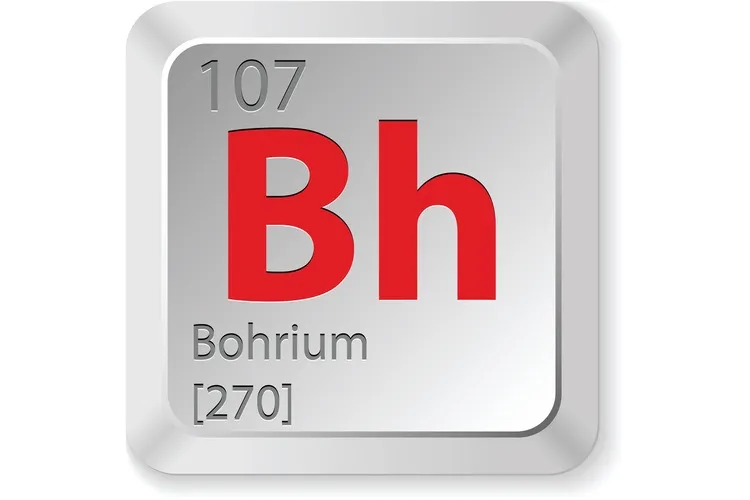
Atomic Number: 107 Atomic Symbol: Bh Atomic Weight: (270) Melting Point: Unknown Boiling Point: Unknown
Word Origin: Bohrium was named for Danish physicist Niels Bohr. For a time, it was known as nielsbohrium with the symbol Ns.
Discovery: Bohrium was first discovered by a team of scientists in Dubna, Russia, in 1976. The discovery was confirmed by Peter Armbruster, Gottfried Münzenber and their team working in Darmstadt, Germany, in 1981.
Properties of bohrium
Bohrium is a synthetic element about which little is known. It is presumed to be a solid metal, but since only a few atoms of it have been created, it is difficult to study. The German team identified six nuclei of the element. [See Periodic Table of the Elements]
There are 10 isotopes of bohrium with known half-lives. The most stable is 270Bh, which has a half-life of about one minute.
The atomic weight for manmade transuranium elements is based on the longest-lived isotope in the periodic table. These atomic weights should be considered provisional since a new isotope with a longer half-life could be produced in the future.
Get the world’s most fascinating discoveries delivered straight to your inbox.
Sources of bohrium
Bohrium is produced artificially and only small amounts have been made.
The Dubna team created it by bombarding bismuth-204 (204Bi) with heavy nuclei of chromium-54 (54Cr). A rapidly rotating cylinder, coated with a thin layer of bismuth, was used as a target and bombarded with a stream of chromium fired tangentially. This technique allowed the scientists to “glimpse” the new element for 0.002 seconds.
Uses of bohrium
Only a few atoms of bohrium have ever been made. Currently, it is only used in scientific study.
(Sources: Los Alamos National Laboratory, Jefferson Lab)
