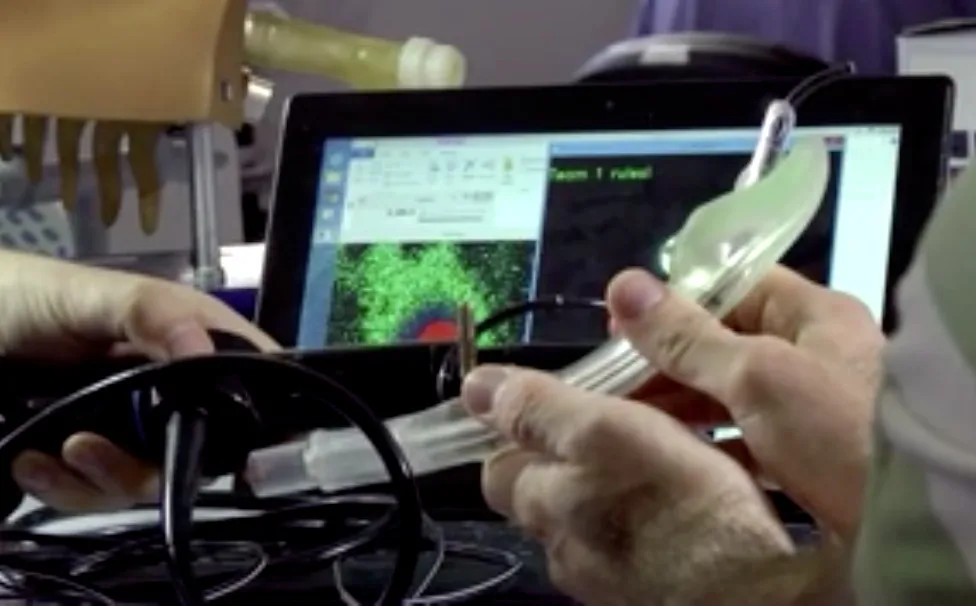
A robotic device that crawls into lungs could help deliver vital air to patients, researchers say.
To help anesthetized or critically ill patients breathe, flexible plastic tubes are placed into the lungs to maintain an open airway, a procedure known as intubation. Currently, intubation requires physicians to look down the throat, and choose between two very similar openings, one leading to the lungs, the other to the stomach.
Picking the wrong opening to intubate can lead to death. Moreover, intubation sometimes has to be performed in challenging situations that can make the procedure even more difficult, such as the battlefield, or with fluids such as blood obstructing the way.
A prototype of the device, called the GuideIN Tube, was successfully tested on cadavers at the Hadassah Medical Center in Jerusalem.
"Until our first attempt to test the device on cadavers at Hadassah Medical Center, we were not sure that the technology would actually work," researcher Itai Hayut, a physicist at Hebrew University in Jerusalem, told LiveScience.
To use the device, the physician first places a beacon of infrared light against the skin in the front of the patient's throat, illuminating the windpipe. Sensors on the device recognize the infrared light as where it should go, and the device automatically moves toward it. Wires on the device control its movements like a puppeteer, pulling it in the correct direction.
Sign up for the Live Science daily newsletter now
Get the world’s most fascinating discoveries delivered straight to your inbox.
A new device aims to make intubation procedures safer for patients.
(Image credit: The Hebrew University of Jerusalem)
One criticism of the device might come from experienced physicians, who say they have no problem performing intubation using existing methods. However, "the statistics regarding damaged vocal cords and broken teeth due to complications in performing intubation states otherwise, not to mention more severe damage," Hayut said.
"We really thought about the paramedic in the field," Hayut said in a statement. "We wanted something simple and compact that they could trust without fail."
Clinical trials may begin as soon as next year. The researchers noted that about 20 million intubation procedures are carried out every year in the United States alone. Difficult intubations, where a good view is limited, make up about 2.6 million procedures in the U.S. and cost an estimated $910 million annually.
"I strongly believe that GuideIN Tube represents the future of intubation," researcher Elchanan Fried, director of the general intensive care unit in Hadassah Medical Center in Jerusalem, said in a statement.
Hayut and his colleagues presented their findings at the Israel Advanced Technologies Industries-BioMed Conference in Tel Aviv in June.
Charles Q. Choi is a contributing writer for Live Science and Space.com. He covers all things human origins and astronomy as well as physics, animals and general science topics. Charles has a Master of Arts degree from the University of Missouri-Columbia, School of Journalism and a Bachelor of Arts degree from the University of South Florida. Charles has visited every continent on Earth, drinking rancid yak butter tea in Lhasa, snorkeling with sea lions in the Galapagos and even climbing an iceberg in Antarctica.