













Sequencing DNA from 'Insect Soup' May Aid Conservation

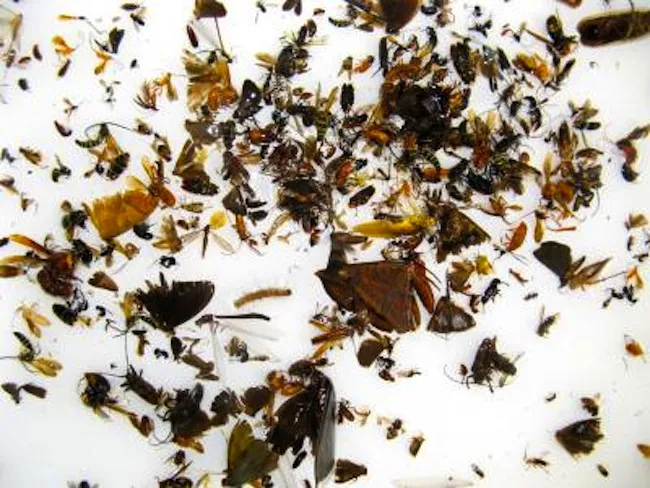
It may not sound very appetizing, but crushing up a variety of creepy crawlies and sequencing the DNA of the resulting "insect soup" may be an efficient way to catalog biodiversity and track conservation efforts around the world, according to a new study.
The process of identifying species from a single bulk sample — mashed up insects, for instance — is known as "metabarcoding." Researchers from the University of East Anglia in the United Kingdom say metabarcoding is much faster and just as reliable as compiling standard biodiversity databases through traditional but more labor-intensive means, like taking samples from individual insects.
Metabarcoding could enable scientists to effectively monitor endangered species or changing environments across different regions, countries and continents, the researchers say.
"Every living organism contains DNA, and even small fragments of that DNA can be used to identify species," study lead author Douglas Yu said in a statement. "We collected lots of insects and other creepy crawlies, ground them up into an 'insect soup,' and read the DNA using sequencers that are now cheap enough to use weekly or even daily." [Microscopic Monsters: Gallery of Ugly Bugs]
Traditional methods vs. metabarcoding
Yu and his colleagues compared their results with data sets collected in the U.K., China and Malaysia. The records in the traditionally compiled data sets identified more than 55,000 specimens, which took researchers 2,505 hours, Yu said.
"These kinds of data sets are the gold standard for biodiversity monitoring but are so expensive to compile that we cannot use them for regular monitoring," he explained. "Thus, conservation biologists and environmental managers are forced to work with little information."
Get the world’s most fascinating discoveries delivered straight to your inbox.
The scientists used metabarcoding to examine their mashed-up-insect soup. Yu said this process yielded the same biodiversity information as the more traditional data sets did. "They are also more comprehensive, many times quicker to produce, less reliant on taxonomic expertise, and they have the added advantage of being verifiable by third parties," he added.
Each "soup" concocted by Yu and his colleagues mixed together hundreds to thousands of specimens caught using insect traps. The researchers said these captured bugs are only a tiny fraction of their overall populations and, therefore, do not raise concerns about endangered species.
Staving off extinction
Demonstrating the reliability of metabarcoding could pave the way for its future use in shaping environmental-management decisions and policy objectives.
"If the environment changes for the better or for the worse, what lives in that environment changes as well," Yu said. "Insect soup becomes a sensitive thermometer for the state of nature. For instance, we showed that if the U.K. Forestry Commission ploughs up some of the grass-covered trackways that run between our endangered heathland habitats [in the lowlands of the U.K. that are home to some threatened or highly specialized plants and animals], populations of rare spiders, beetles and other creepy crawlies can reconnect along those trackways, helping to stave off extinction."
The researchers are working with the World Wildlife Fund and scientists at the University of Copenhagen in Denmark to use metabarcoding to study bloodsucking leeches, whose DNA may contain traces of endangered mammals that live in rainforests in Vietnam and Laos, Yu said.
"By creating a 'leech soup,' we can get a list of mammals and know more about whether park conservation is working," he said.
The detailed results of the study were published online Aug. 5 in the journal Ecology Letters.
Follow Denise Chow on Twitter @denisechow. Follow LiveScience @livescience, Facebook & Google+. Original article on LiveScience.com.

Denise Chow was the assistant managing editor at Live Science before moving to NBC News as a science reporter, where she focuses on general science and climate change. Before joining the Live Science team in 2013, she spent two years as a staff writer for Space.com, writing about rocket launches and covering NASA's final three space shuttle missions. A Canadian transplant, Denise has a bachelor's degree from the University of Toronto, and a master's degree in journalism from New York University.