













'A relationship that could horrify Darwin': Mindy Weisberger on the skin-crawling reality of insect zombification
Science writer Mindy Weisberger speaks to Live Science about the parasites that turn their hosts — whether ant, beetle or caterpillar — into zombie-like puppets that act against their own interests.


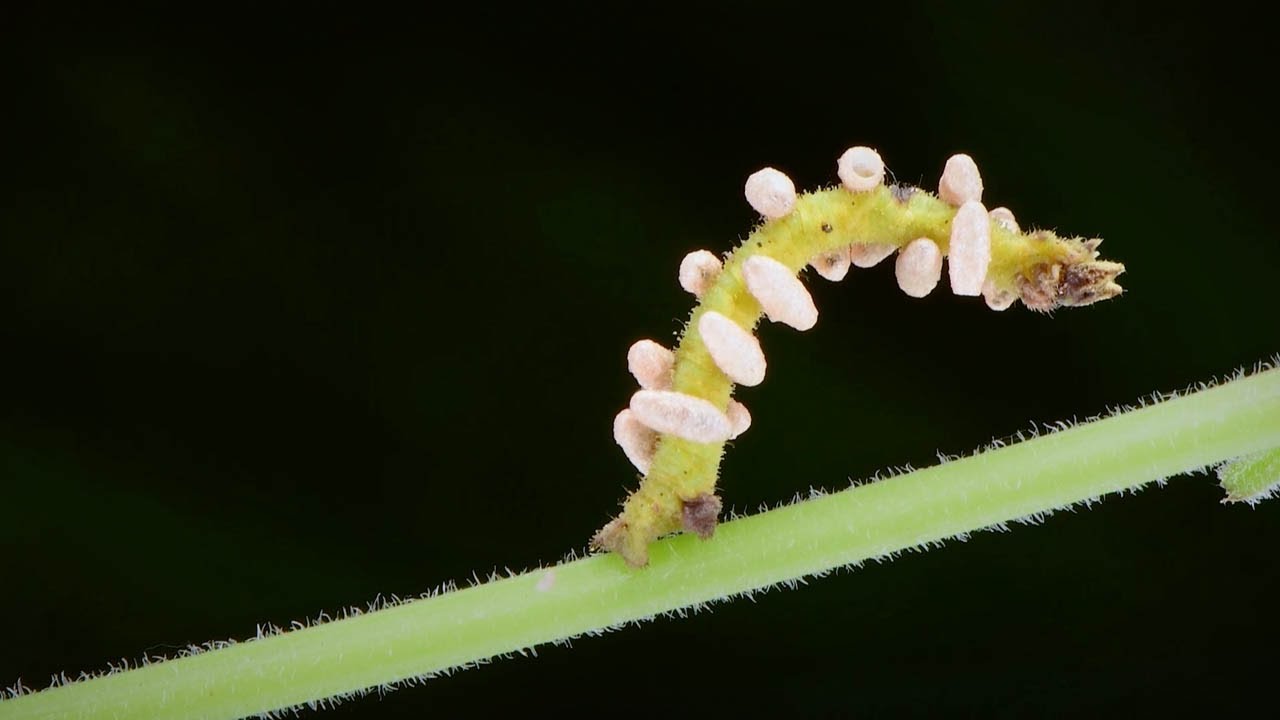
At this very moment, in a corner of your backyard, dozens of wasp larvae may be burrowing through the insides of a caterpillar. After chewing holes in its exoskeleton, these larvae build cocoons on the caterpillar's back so they can grow into adults while still feeding off their host.
Such parasitism is more common than you think. Some of the most blood-curling forms of parasitism can transform the host — whether ant, beetle or caterpillar — into a zombie-like puppet that acts according to the whims of the parasite.
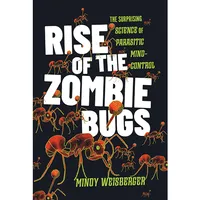
In her book "Rise of the Zombie Bugs" (Johns Hopkins University Press, 2025), science writer, media producer and former Live Science senior writer Mindy Weisberger shines a light on the sinister tactics used by parasites to manipulate other critters. Through captivating descriptions of the forms this mind control can take, Weisberger reveals that zombies are all around us — zombie insects, that is.
Live Science sat down with Weisberger to understand the damage zombifying parasites can inflict, how they evolved, and why they are reminiscent of zombies in pop culture.
Q: As a science writer and media producer, there are so many topics that you could have written about. Why did you choose to write about parasitic mind-control and zombie bugs?
Weisberger: Because they're fascinating — that's the short answer! I think it's because of the way that we humans think about autonomy and free will. It seems like the whole notion of someone who outwardly looks familiar but is being manipulated by some external force so that their behavior is not under their control is something uniquely terrifying.
Get the world’s most fascinating discoveries delivered straight to your inbox.
There are so many examples in the natural world of this type of behavior manipulation — where there are these parasites that not only infect and kill their hosts, but along the way actively change their behavior in ways that do not benefit the host at all. This book was a terrific opportunity to not only collect a lot of really interesting examples of behavior manipulation, but also to look at the deep history of these relationships and at some of the similarities across many different groups of organisms that do this — and also to see how scientists are piecing these stories together, and where the science is going.
Q: Could you tell me about the most skin-crawling example of behavior manipulation that you came across during your research?
Weisberger: The most horrible one, and also the one that I think people are most likely to see themselves because it's something that's commonly found in backyards in temperate climates worldwide, is caterpillars that are infected by Ichneumonid and Braconid wasps. These wasps lay their eggs inside caterpillars — and one caterpillar can be targeted by multiple wasps, so they can have dozens and dozens of these wasp larvae inside them. The larvae grow, and when they are ready to pupate, they chew their way through the skin of the caterpillar and they spin their cocoons on the caterpillars' backs.
Charles Darwin was so horrified by this that he wrote in a letter to a biologist friend that it made him question the existence of a benevolent God. If it's a relationship that could horrify Darwin, then that definitely makes it noteworthy. This is something that happens to caterpillars that are very common in gardens, so I think it's proof that you're probably a lot closer to a zombie than you think.
Q: Do you have a favorite zombifying parasite, and if so, could you tell me what its relationship with its host looks like?
There's another type of wasp, the jewel wasp (Ampulex compressa), that infects and manipulates cockroaches. It has a much more direct approach: It stings cockroaches directly in the brain and targets a very specific brain region that is related to locomotion. By doing so it delivers venom that makes the cockroach very docile, so it will walk when it's led, but it won't walk under its own power. After the wasp has stung the cockroach, the wasp will lead it back to its burrow and feed it alive to the wasp's young.
But cockroaches can actually deflect these attacks with kicks. The Catania Lab at Vanderbilt University filmed interactions between these wasps and roaches, and scientists found that cockroaches were very effective at repelling attacks by wasps. The wasp has to be in a very specific position, because it is targeting a very specific brain region, but the roaches were able to protect themselves.
Q: Do we know when some of these relationships evolved?
These relationships in some cases go back millions of years. In the case of the zombie-ant fungus (Ophiocordyceps unilateralis), there is a fossil from the Messel Pit in Germany that is 48 million years old. The zombie-ant fungus changes an ant's behavior by compelling it to leave the colony, climb a plant and bite down on a vein on the underside of a leaf. The ant dies there with its jaws locked in place, and then the fungus grows a stalk from behind the ant's head and a mass grows on the stalk that releases spores.
The fossil is of a leaf, and there are these marks along the veins of the leaf that are pretty identical to the marks that are left on leaves by zombie ants today. Scientists who found this fossil and who study the behavior of modern ants zombified by Ophiocordyceps say this fossil is indirect evidence that the zombifying relationship between Ophiocordyceps and ants is at least 40 million years old.
Q: How might a relationship like that have evolved — do scientists have any clues?
There was a paper in 2019 that looked into the potential origins of behavior manipulation by Ophiocordyceps. Scientists were able to trace all of the behavior-manipulating species in Ophiocordyceps to an ancestor that infected beetles but did not manipulate them. And what they hypothesized is that within the ecosystem where these beetles lived there were likely ants, so Ophiocordyceps made the jump from beetles to ants.
The difference between ants and beetles is that ants are social insects. They have suites of behaviors that evolved to preserve the health of the colony, which means that ants that are found to be infected with parasites will be destroyed by their nestmates. That does not work out so well if you're a parasite that needs to develop within your host, so with the move to ants there was now a selective pressure for the fungus to actively change its host's behavior, so that it would essentially self-isolate from its nestmates [by climbing plants and hooking onto leaves] at the opportune time.

Jewel wasps sting cockroaches in a region of their brain that controls locomotion, injecting venom that turns the cockroach into a zombie.
Q: How difficult is it to study these relationships and unpick the neurochemicals involved in changing a host's behavior?
Behavior is something that is controlled by so many complex interactions, and trying to pinpoint any one thing that shifts behavior dramatically is extremely complex. In some cases, it's especially tricky to study because of the nature of the organism.
For example in North America, within about a month, we are going to see an emergence of periodical cicacas in Brood XIV, which is absolutely spectacular. Periodical cicadas come out in cycles every 13 to 17 years. There's a fungus that parasitizes and manipulates the behavior of only periodical cicacas and it's called Massospora cicadina. If you are a researcher who is trying to understand how a relationship works between a parasite and its host, ideally you want to cultivate that in a lab. That is pretty much impossible when the organism that you want to study has a life cycle that keeps it underground for 13 to 17 years.
Q: Can you tell me more about the relationship between periodical cicadas and M. cicadina?
One thing scientists do know about how M. cicadina manipulates periodical cicacas is that it produces a type of amphetamine. This creates hyper-sexualized behavior in the cicadas. Once the fungus infects cicadas, it grows inside their bodies and produces this mass of fungal spores in the rear end of their abdomen. It also weakens the cicadas' exoskeleton, so that the back third of their shells drop off, leaving this exposed mass of spores. And then you have this amphetamine flooding the cicadas' little insect brains, so you have infected cicadas that are trying to mate with as many cicadas as possible, and thereby spreading the infection.
Q: In the book, you focus on parasites that infect and manipulate invertebrates — but are there examples of parasites that infect and alter the behavior of humans?
There are a couple of known pathogens that affect mammals and humans. Rabies is, I think, the most commonly recognized one. More recently, there's been a lot of attention turned toward the single-celled parasite Toxoplasma gondii.

A Brood X periodical cicada infected with the fungus Massospora cicadina. The cicada is missing its lower abdomen, and instead carries a mass of fungal spores that can infect other cicadas through contact.
T. gondii needs to be in cats to reproduce. In rodents that carry this parasite, studies show that it reduces their normal aversion to cat urine and makes them attracted to it. So it tweaks their behavior in a way that makes them more risk-taking around the predators that they would normally avoid, which makes them more likely to get eaten, which makes it more likely that the parasite is going to end up inside its definitive host.
There have been some studies that have shown that chimps and hyenas infected by T. gondii also display more boldness around felids that they would normally avoid. As far as humans go, we are rarely in a position where any parasite that we're carrying is going to end up being eaten by a cat. That said, some studies suggest that people carrying T. gondii can show signs of more aggressive behavior, more risk-taking behavior, in some cases more nurturing behavior. But because human behavior is very complex and there are many factors that shape human behavior, it's difficult to say with certainty if T. gondii is the one that is actually driving those behavioral changes.
Q: What keeps zombifying parasites in check? Why haven't we had a zombie bug apocalypse?
RELATED STORIES
These relationships don't evolve in a vacuum; they're part of larger ecosystems. No strategy for a parasite is going to be successful long-term if it's successful 100% of the time, because then you're going to run out of hosts. So, as much as I'm talking about all the success stories, obviously there are many failed attempts for any of these parasites. And the fact that insects are quite numerous, especially ants, also helps to balance out the distribution of infected versus uninfected. Because what we're seeing here is the result of millions upon millions of years of evolution, at some point some type of balance was achieved — which is not to say that that can't change.
Q: What's next for you in terms of writing? Have you got another book in the pipeline?
I'm looking to develop a version of this book for younger readers, because since I started writing my niece who was 7 at the time just had so many questions. I'm hoping for an opportunity to adapt it that way.
This interview has been condensed and lightly edited for length.
"Rise of the Zombie Bugs" sheds light on the fascinating — and nightmarish — world of behavior manipulation by parasites and pathogens. You can read an excerpt from the book here.
Zombies aren't just the stuff of nightmares. Explore the fascinating world of real-life insect zombification.

Sascha is a U.K.-based staff writer at Live Science. She holds a bachelor’s degree in biology from the University of Southampton in England and a master’s degree in science communication from Imperial College London. Her work has appeared in The Guardian and the health website Zoe. Besides writing, she enjoys playing tennis, bread-making and browsing second-hand shops for hidden gems.
You must confirm your public display name before commenting
Please logout and then login again, you will then be prompted to enter your display name.