













Kinky! Hawkmoths Rub Genitals to Ward Off Bats

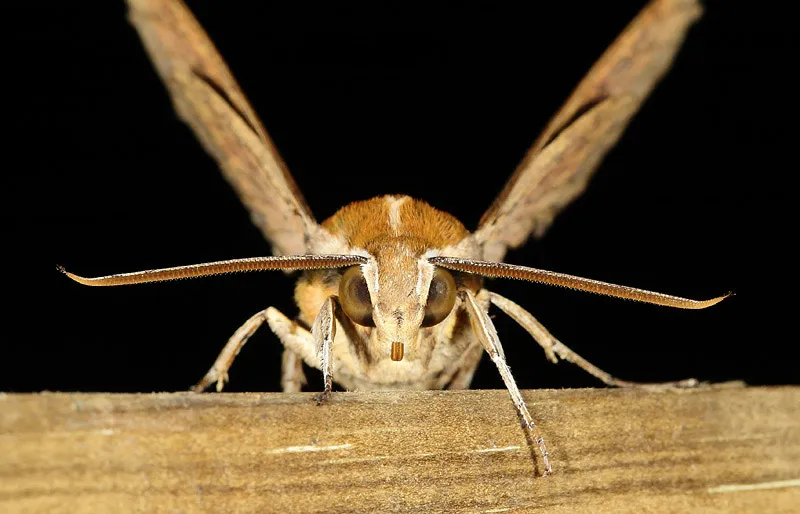
With perhaps the kinkiest alarm system in the animal kingdom, hawkmoths rub their genitals to create ultrasound bursts that might drive away bats, researchers say.
Moths, unlike their butterfly relatives, fly mostly during the night. This means they often share the skies with bats, which are similarly nocturnal.
Bats and moths have engaged in an arms race for nearly 65 million years as bats evolve ways to hunt down moths and moths evolve ways to escape bats. For instance, while bats essentially use sonar to scan the nighttime skies for moths and other insect prey using pulses of ultrasonic sound, insects have evolved bat-detecting ears sensitive to ultrasound at least 19 separate times in their past. [Ewwww! Photos of Bat-Eating Spiders]
Previously, behavioral ecologist Jesse Barber at Boise State University in Idaho and his colleagues had discovered tiger moths possess sound weapons they use to deter bats. By flexing structures on their midsections known as tymbals, they generate ultrasonic clicks that can apparently startle bats, warn bats the moths taste bad and even jam bat sonar.
Now Barber and his collaborators find hawkmoths may ward off bats with sounds generated by the rubbing of genitals.
"The fact that we've found another group of moths that makes sound back at bats means there could be more," Barber said. "The night sky is likely full of different insect groups responding to bats with their own ultrasonic sounds."
The scientists collected three closely related species of hawkmoths drawn to electric lights on the island of Borneo. They gently tethered the insects to plastic sticks using strings tied around their midsections.
Get the world’s most fascinating discoveries delivered straight to your inbox.
"To find these hawkmoths, we traveled to the other side of the world, the Old World tropics, carrying all the necessary technology — ultraviolet lights, ultrasonic microphones, ultrasonic speakers, computers, high-speed cameras — and despite occasional equipment failures due to high humidity and ungrounded electricity and having to move all around Borneo to find the best locations for moths, we were fortunate enough to uncover this amazing behavior," Barber told LiveScience.
When the researchers played bat sonar attack sequences at these moths, the insects responded with ultrasound bursts. The males generate these sounds by rubbing scales on their genitals against the rear ends of their bodies, much like how male crickets give off chirps by rubbing their wings together. Female hawkmoths apparently generate ultrasound in response to bat sonar as well, by pulling their genitals inward to rub scales on them together. [See Video of Hawkmoths Making Genital Sounds]
The fact that both male and females give off sounds with their genitals suggests these sounds may play a sexual role as well. For instance, a male hawkmoth was once detected sounding off near two females.
The role hawkmoth ultrasound bursts play remains unknown. The moths apparently do not taste bad to bats, so the sounds they make could instead be used to startle bats or jam their sonar, the researchers say. Future experiments could involve watching how bats and hawkmoths interact within special labs where they have plenty of space to fly, Barber said.
Barber and his colleague Akito Kawahara detailed their findings online July 3 in the journal Biology Letters.
Follow us @livescience, Facebook & Google+. Original article on LiveScience.com.
