














Smoke from Southeast Wildfires Drifts Over Ocean

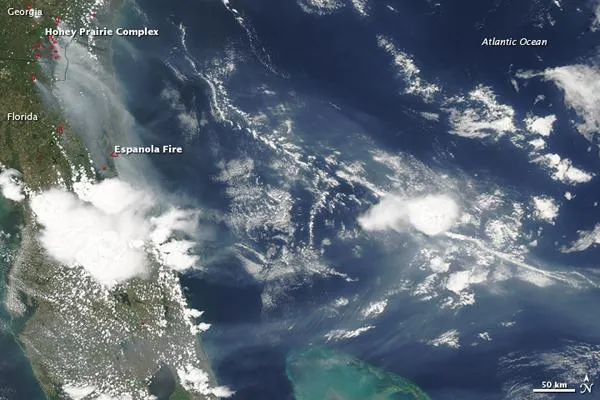
Smoke from fires in Georgia and Florida streamed eastward over the Atlantic Ocean on June 15, 2011. The Moderate Resolution Imaging Spectroradiometer (MODIS) on NASA's Aqua satellite captured this natural-color image the same day.
Red outlines indicate actively burning fires . The Honey Prairie Complex Fire produces most of the smoke, but significant smoke also arises from the Espanola Fire. Distinguishable from clouds by its darker color and less distinct margins, the smoke extends hundreds of kilometers east of the coast.
As of June 16, 2011, the Honey Prairie Complex had already burned 196,369 acres (79,468 hectares). Although it was 49 percent contained, it had the potential to keep growing. The Espanola Fire had consumed 4,306 acres (1,743 hectares) and was about 40 percent contained.
Smoke from Honey Prairie Complex Fire, along with smoke from the Wallow Fire in Arizona , affected air quality in the U.S. Southeast and Mississippi Valley in mid-June 2011, according to the U.S. Air Quality Smog Blog.
- Weather & Wildfire: What Fueled Arizona's Monster
- Wild Facts About the Huge Arizona Wildfires
- NASA Photos: Raging Arizona Wildfires Seen from Space
Get the world’s most fascinating discoveries delivered straight to your inbox.
