













Charcoal from Wildfires Found in Oceans

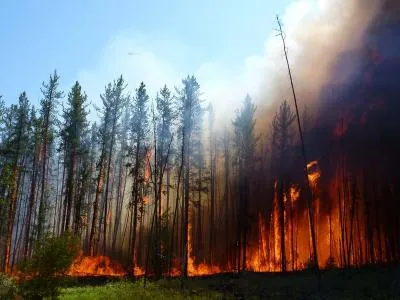
A survey of water samples from around the world has revealed that large amounts of charcoal from wildfires seep from soil into the planet's waterways, eventually reaching the oceans.
Each year, wildfires leave behind scorched remains, turning millions of acres of vegetation into charcoal. But, rather than remain in soil, new research suggests that charcoal deposits dissolve into river systems, contributing to the planet's global flow of carbon.
"Most scientists thought charcoal was resistant," Rudolf Jaffé, a researcher at Florida International University's Southeast Environmental Research Center in Miami, said in a news release. "They thought, once it is incorporated into the soils, it would stay there."
Jaffé and his colleagues analyzed 174 water samples from around the world, including the Amazon, Congo and Yangtze rivers, and determined that charcoal makes up roughly 10 percent of the organic carbon that is dissolved in the water.
"From a chemical perspective, no one really thought it dissolves, but it does," Jaffé said. "It doesn't accumulate like we had for a long time believed. Rather, it is transported into wetlands and rivers, eventually making its way to the oceans."
Based on previous scientific studies of the carbon chemistry in oceans, the researchers estimate that approximately 25 million tons of dissolved charcoal enter the sea each year.
These findings may help scientists more accurately gauge the planet's carbon budget, which involves calculating the climate effects based on known sources that either produce or remove carbon throughout the cycle.
Get the world’s most fascinating discoveries delivered straight to your inbox.
"To understand the oceans, we have to understand the processes on the land, from where the organic load enters the seas," study co-author Thorsten Dittmar, from the Max Planck Institute for Marine Microbiology in Germany, said in a statement.
The study authors say more research is needed to better understand charcoal's environmental impact, but these new findings have implications for the development of carbon sequestration techniques that aim to capture and store atmospheric carbon dioxide as a way to mitigate climate change.
Follow Denise Chow @denisechow. Follow LiveScience @livescience, Facebook & Google+. Original article on Live Science.

Denise Chow was the assistant managing editor at Live Science before moving to NBC News as a science reporter, where she focuses on general science and climate change. Before joining the Live Science team in 2013, she spent two years as a staff writer for Space.com, writing about rocket launches and covering NASA's final three space shuttle missions. A Canadian transplant, Denise has a bachelor's degree from the University of Toronto, and a master's degree in journalism from New York University.