













Ozone Hole Shrinks to Record Low

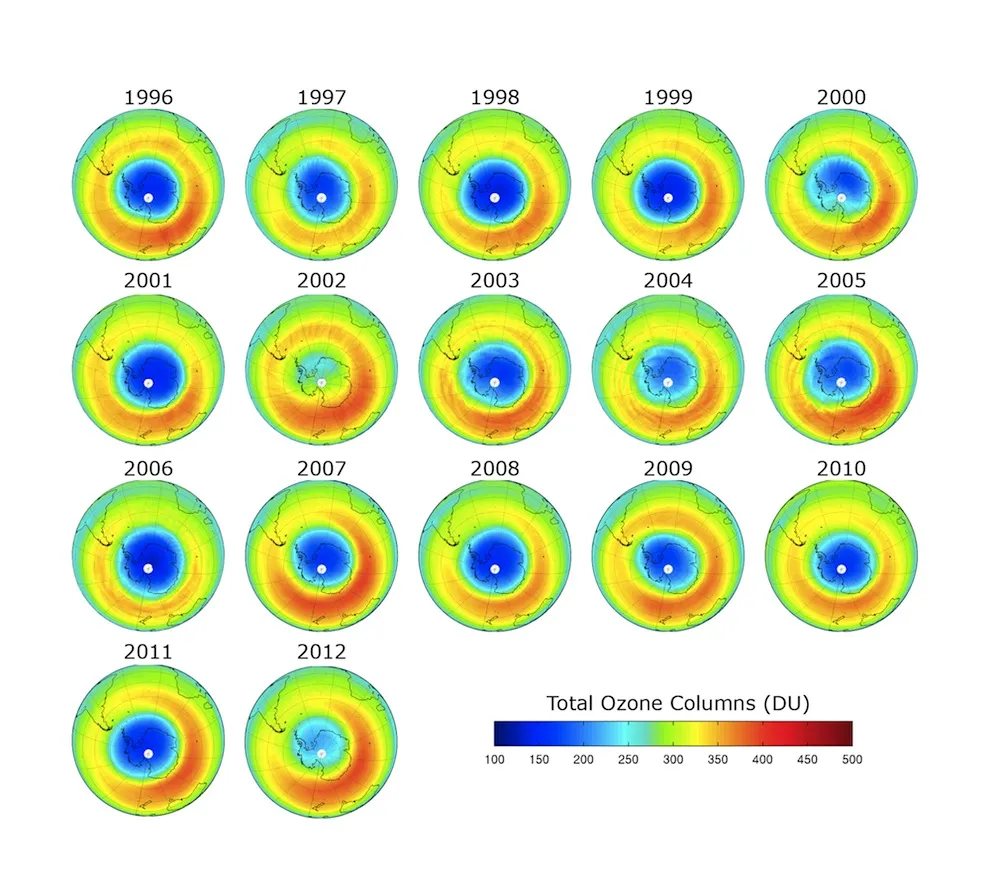
Good news from Antarctica: The hole in the ozone layer is shrinking, new measurements reveal.
Ozone is a molecule made of three oxygen atoms. It's relatively highly concentrated in a particular layer of the stratosphere about 12 miles to 19 miles (20 to 30 kilometers) above Earth's surface. This ozone layer prevents ultraviolet light from reaching Earth's surface — a good thing, given that UV light causes sunburn and skin cancer.
Ever since the early 1980s, though, a hole in this layer has developed over Antarctica during September to November, decreasing ozone concentration by as much as 70 percent. The cause is human-produced chlorofluorocarbons (CFCs), which were once heavily used in aerosols and refrigeration.
By international agreement, CFCs have been phased out of use. The policy has real effects, new satellite observations reveal. In 2012, the hole in the ozone layer over Antarctica was smaller than it has ever been in the last 10 years.
The new observations, announced by the European Space Agency (ESA) on Feb. 8, come from Europe's Met Op weather satellite, which has an instrument specifically designed to sense ozone concentrations. The findings suggest that the phase-out of CFCs is working, the ESA reports.
Antarctica is particularly vulnerable to ozone-depleting substances, because high winds cause a vortex of cold air to circulate over the continent. In the resulting frigid temperatures, CFCs are especially effective at depleting ozone. The result is that people in the Southern Hemisphere are at increased risk of exposure from UV radiation.
CFCs persist in the atmosphere for a long time, so it may take until the middle of the century for ozone concentrations to rebound to 1960s levels, the ESA reports. However, the hole in the ozone over Antarctica should completely close in the next few decades.
Get the world’s most fascinating discoveries delivered straight to your inbox.
Follow Stephanie Pappas on Twitter @sipappas or LiveScience @livescience. We're also on Facebook & Google+.

Stephanie Pappas is a contributing writer for Live Science, covering topics ranging from geoscience to archaeology to the human brain and behavior. She was previously a senior writer for Live Science but is now a freelancer based in Denver, Colorado, and regularly contributes to Scientific American and The Monitor, the monthly magazine of the American Psychological Association. Stephanie received a bachelor's degree in psychology from the University of South Carolina and a graduate certificate in science communication from the University of California, Santa Cruz.