















Terracotta Warriors: An Army for the Afterlife

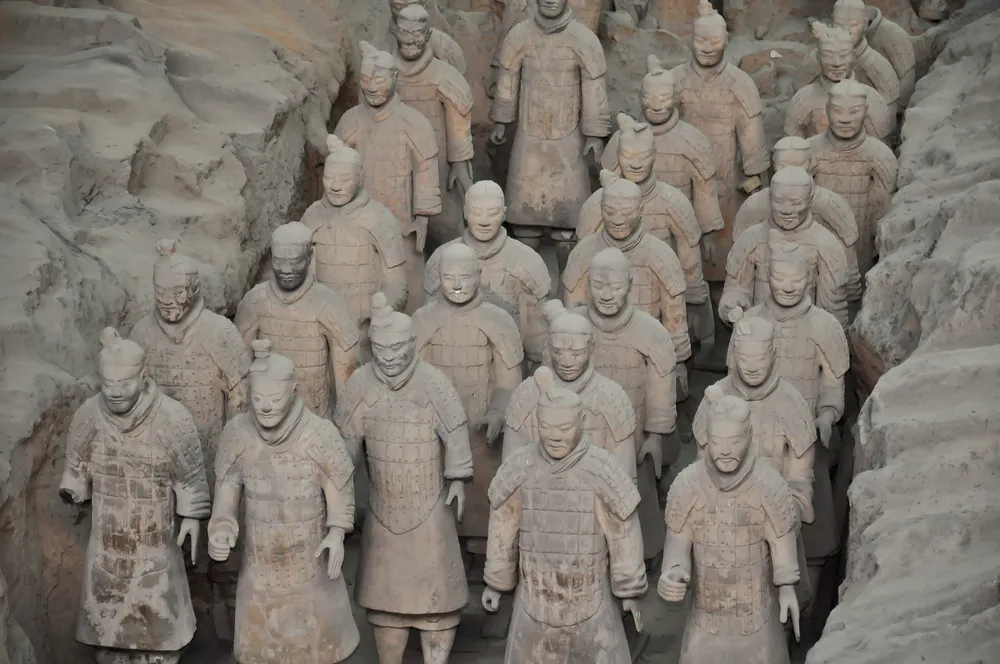
Chinese workers digging a well in 1974 made a startling discovery: thousands of life-size terracotta figures of an army prepared for battle. Now called the Terracotta Army or Terracotta Warriors, the figures are located in three pits near the city of Xi'an in China's Shaanxi province. After the warriors were discovered, the site became a museum and a UNESCO World Heritage Site in 1987.
The pits are situated less than one mile to the northeast of a pyramid-shaped mausoleum constructed for the first emperor of China, Qin Shi Huang (259 B.C. – 210 B.C.). According to UNESCO World Heritage Center, archaeologists suspect that the unexcavated tomb could contain an entire replica of the city of Xi'an, which the warriors guard. The three pits (a fourth pit was unfinished) contain an estimated 8,000 life-size terracotta figures of which about 2,000 have been excavated. The figures were created to serve the emperor in the afterlife and include a mix of chariots, cavalry, armored soldiers and archers. There are high-ranking officers (including nine generals found so far) and one of the pits, No. 3, actually served as a command post for the army and contains an honor guard and ornate chariot for the force's chief commander. All three pits are active archaeological sites and visitors can see excavations taking place. [Gallery: Ancient Chinese Warriors Protect Secret Tomb]
The details of the warriors are so intricate and individualized that it has been hypothesized that they were based on real soldiers who served in the emperor's army. Each warrior has uniquely styled hair and features; some have topknots while others have goatees; some have caps and loose tunics while others have armored vests and braided hair. They have different builds, expressions and postures. Another key feature is that the warriors were decorated in bright colors, which contributed to the individuation. New conservation techniques, performed on recently excavated figures, allow some of these patterns to be discerned. Every warrior contains a stamp of the name of the foreman in charge of his creation, so that mistakes could be tracked, according to the Field Museum.
Curiously, when the emperor created this army he had it face east, not toward the frontiers of his empire but rather toward the territories he had already taken. Why he did this is a mystery, it could be because of the topography around his mausoleum or it could because he felt the real threat came from the lands he had conquered.

The first emperor
His birth name was Ying Zheng and he was born at a time when China was divided into a number of warring states. One of these states, named Qin, was located in the western portion of ancient China and had been expanding for some time.
An army of clay warriors guards the tomb of China's first emperor, Qin Shi Huang, who died in 210 BC. The tomb is still under excavation near Xi'an, China.
When Zheng's father, King Zhuangxiang, died in 246 B.C., Zheng took the throne at the age of 13. Over the next three decades he initiated a series of military campaigns that would see Qin conquer the other states and unify China for the first time. After the unification was complete in 221 B.C., Zheng took on the title of Qin Shi Huang which means, in essence, the "First Emperor of Qin." After his death in 210 B.C., his dynasty quickly collapsed with a new group of rulers known as the "Han Dynasty" coming to power.
Get the world’s most fascinating discoveries delivered straight to your inbox.
According to the Field Museum, Qin Shi Huang spent a significant portion of his rule preparing for the afterlife, and even began construction of his mausoleum before he was coronated. It is estimated that the terracotta warriors themselves took more than 10 years to complete.
In this ensuing period, the emperor's terracotta army may not have been looked upon kindly. Archaeologist Yuan Zhongyi writes in his book "China's Terracotta Army and the First Emperor's Mausoleum" (Homa and Sekey, 2011) that pit two was "partially burnt down," possibly by a rebel army that arose shortly after the first emperor's death.
Another researcher, Chen Shen, curator of a massive Terracotta Warriors show that appeared recently in New York, notes that historical records are silent about the warriors. Sima Qian, a Han Dynasty historian who lived about a century after the first emperor's time, doesn't talk about the warriors despite covering 3,000 years of Chinese history in his "Shiji" (Records of the Grand Historian). That could be because he didn't want to highlight the first emperor's achievement.
"Because the historian served an emperor whose ancestors overthrew the First Emperor's brief dynasty, he had to be conscious of presenting the past in a way that would not distress his ruler with unflattering comparisons," Shen writes in his exhibition book "The Warrior Emperor and China's Terracotta Army" (Royal Ontario Museum Press, 2010).
Indeed while terracotta figures were made by later Chinese rulers, none of them attempted to produce a large army of life-sized figures ever again.
Pit One: Infantry and chariots
Pit One, the largest pit, is rectangular and covers 14,000 square meters (150,000 square feet) of space, the size of almost three football fields.
"The floor of the passage ways and the surrounding corridors is paved with grey bricks. The roof is supported by thick and sturdy wood blocks, one closely next to another, on which is covered with mats, and upon that loess [a sediment]," writes Zhongyi in his book.
The portions excavated so far are filled with warriors. A map that University of London researcher Lucas Nickel published in his book "First Emperor: China's Terracotta Army" (British Museum Press, 2007) illustrates their formation.
At the front of Pit One is a vanguard of un-armored standing archers, three rows deep, which Zhongyi writes were mainly equipped with bow and arrows. Behind them, separated by earthen mounds, are 11 straight lines of figures, many of them armored warriors who would have been equipped with melee weapons such as the halberd. Interspersed with these armored warriors are war chariots that were made of wood (now decayed) with four terracotta horses each. Each of these chariots has a driver (wearing extra-long armor for protection) along with two warriors armed with either melee weapons or bows.
Zhongyi writes that this arrangement of a fast-moving vanguard, equipped with long-range weapons, which in turn is followed by a heavier force, is not an accident. He points out that the ancient Chinese military strategist Sun Tzu wrote in his book the "Art of War" that the "the tip (vanguard) must be hard-hitting while the body must be overwhelming," a lesson the first emperor appears to have applied in the afterlife.

Pit Two: The cavalry
Pit Two is located just to the north of Pit One and is about half its size and roughly square (with a bulging area in the northeast where the force's vanguard is located).
Emperor Qin Shi Huang was buried with everything he needed for the afterlife, including an army complete with life-size clay horses.
Like Pit One, its vanguard is made up largely of archers, in this case mainly carrying crossbows (again the wooden part is decayed). The figures in the front rows are un-armored and standing up, while the ones behind are kneeling. Again this is no accident, as Zhongyi points out that it takes time for an archer to load a new bolt for his crossbow. By having one line firing, and another kneeling to reload, a steady stream of fire could be kept up on the enemy.
The main force of Pit Two, the part meant to overwhelm the enemy, includes about 80 war chariots. Each has two riders and a charioteer and there are also some armored troops, equipped with melee weapons, intermixed.
Newly introduced in Pit Two is a squadron of cavalry. Located in the northwest of the pit, the saddled horses are male, life-size and each carries a rider. Zhongyi notes the armor of the riders stops short of the waist, that way "the lap won't touch the horse when the rider is seated." The riders would have been equipped with both bows and melee weapons.
At the front of the horse squadron are six "assistant chariots," as Zhongyi calls them. They have a charioteer with only one warrior, the empty space reserved for an officer.
Pit Three: Command post
By far the smallest of the pits is Pit Three, used as a command post. It has an honor guard consisting of armored warriors holding long poles. At center is a grand command chariot manned by four warriors (including a charioteer). The "beautifully painted vehicle body was crowned by a round ornamented canopy indicating that this chariot had a special function," Lucas Nickel writes. "It may have been designed to carry the commander of the army."
The army commander is not included among the terracotta figures and researchers do not know his identity. One possibility is that the commander is no less than the emperor himself, who still lies buried in his tomb.
Non-military terracotta figures
Non-military terracotta figures have been discovered in other pits. Like the army, they were meant for the afterlife and include terracotta civil servants, equipped with knives and bamboo tablets for writing, and even a group of terracotta acrobats meant for entertainment.
"According to the way they [the acrobats] perform we speculate they are not indigenous to central China, but probably come from the south — probably the Burma area," said archaeologist Duan Qingbo, who was in charge of excavations at the Terracotta Army pits, in translated comments that appeared in "The Independent" (UK).
For the first emperor's afterlife, nothing was spared. He had a large army in proper military formation and even entertainment brought in from afar.
How were the warriors made?
For decades, archaeologists have pondered the techniques ancient artisans used to make thousands of individualized warriors in a relatively short period of time. According to National Geographic, some have suspected that a single artisan produced each warrior; others hold that the individualized faces were achieved by attaching a unique mix of pre-determined ears, noses, mouths, etc. to the heads, a la Mr. Potato Head. One recent theory suggests that they were inspired by Greek sculpture techniques they learned from travelers on the Silk Road, according to New Historian. Still others hypothesize that the warriors were created on an assembly line of convicts and conscripts. In this model, according to the Field Museum, workers used molds for the body parts and heads, adding individual flourishes before sending the sculpture into the kiln. At least 10 different head molds have been identified.
In 2014, a group of researchers at University College London analyzed 30 ears from the warriors to determine how different they were from each other. They theorized that if the warriors were supposed to portray real people, they should have distinct ears (forensic scientists can use ear-shapes to identify people, similarly to fingerprints). According to Smithsonian Magazine, no two ears analyzed were alike, though thousands more need to be assessed before archaeologists draw any specific conclusions. But it supports the theory that the warriors were based on a real army.
Mausoleum
The warriors are even more impressive when you consider that they are just one small part of Qin Shi Huang's mausoleum. Scientists have used remote sensing, core sampling and radar to discover that the tomb complex is almost 38 square miles (98 square kilometers). They suspect it contains a replica of the city of Xi'an, as well as its rivers and streams. In addition to clay inhabitants — warriors, acrobats, etc. — thousands of real people were also buried with their emperor. Many were craftsman and convicts who died building the mausoleum. Hundreds of concubines were also buried there, possibly to accompany their emperor to the afterlife, or possibly as part of an elaborate court intrigue, according to National Geographic.
Sima Qian's writings describe the contents of the tomb complex: "The tomb was filled with models of palaces, pavilions and offices as well as fine vessels, precious stones and rarities." Rivers and streams were made of mercury, hills and mountains of bronze, and precious stones represented the sun, moon, and stars. According to National Geographic, tests on the dirt at the tomb reveal high levels of mercury, supporting Sima Qian's description.
But we may never know for sure what lies beneath the tomb. Sima Qian warned that it was booby trapped, and modern archaeologists are kept away by the risk of damaging the site. Some artifacts could disintegrate rapidly if the tombs were opened.
Additional reporting by Live Science Contributor Jessie Szalay, who toured the site in 2016.
Additional resources

Owen Jarus is a regular contributor to Live Science who writes about archaeology and humans' past. He has also written for The Independent (UK), The Canadian Press (CP) and The Associated Press (AP), among others. Owen has a bachelor of arts degree from the University of Toronto and a journalism degree from Ryerson University.