













Mystery Molelike Mammal Survived Dino Extinction

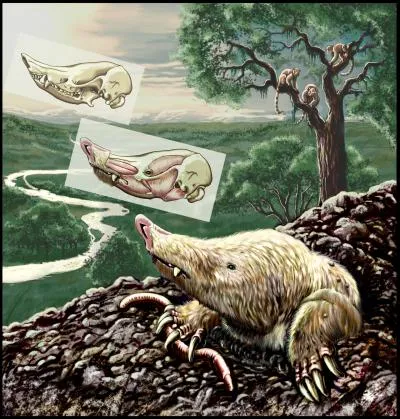
A molelike mammal nicknamed the "grave robber" survived the event that killed the dinosaurs, new research finds.
Necrolestes patagonensis, whose name translates in part to "grave robber," was among the mammals that lived through the dinosaur mass extinction. The new study finds that the creature lived 45 million years longer than paleontologists realized.
Necrolestes was first discovered in fossil form in the Patagonia region of South America in 1891, but little was known about the animal, study researcher John Wible, a mammalogist at the Carnegie Museum of Natural History, said in a statement.
"Necrolestes is one of those animals in the textbooks that would appear with a picture and a footnote, and the footnote would say 'we don't know what it is,'" Wible said.
For a century, researchers at different institutions gave Necrolestes their best shot, trying to place it accurately onto the mammal family tree. No one could agree. In stepped Wible and his team, including the University of Louisville's Guillermo Rougier.
"This project was a little daunting, because we had to contradict 100 years of interpretation," Rougier said in a statement.
Part of the confusion involved the animal's mismatched features, which included an upturned snout, compact body, and short, wide legs. All researchers could tell was that its body would have been perfect for digging. Triangular teeth suggested a diet of worms and other squirmy underground creepy-crawlies. [25 Amazing Ancient Beasts]
Get the world’s most fascinating discoveries delivered straight to your inbox.
In 2011, however, Rougier and his colleagues discovered a new South American extinct mammal, part of a now-extinct group that lived in the Late Cretaceous and early Paleocene, about 100 million years ago. The new fossil bore many similarities to the mysterious Necrolestes, including molars with just one root anchoring them to the jaw.
The find cements that both the new and old fossils are Necrolestes and proves that this group did not go extinct as early as believed. Paleontologists call discoveries like this "the Lazarus effect," after the Biblical character who came back from the dead. Once thought to have died with the dinosaurs, Necrolestes is now known to have survived 45 million years longer than its relatives, which mostly perished when the dinosaurs died.
Necrolestes' subterranean lifestyle may explain its lucky fate, the researchers reported Monday (Nov. 19) in the journal Proceedings of the National Academy of Sciences.
"There's no other mammal in the Tertiary of South America that even approaches its ability to dig, tunnel, and live in the ground," Wible said. "It must have been on the edges, in an ecological niche that allowed it to survive."
Follow Stephanie Pappas on Twitter @sipappas or LiveScience @livescience. We're also on Facebook & Google+.

Stephanie Pappas is a contributing writer for Live Science, covering topics ranging from geoscience to archaeology to the human brain and behavior. She was previously a senior writer for Live Science but is now a freelancer based in Denver, Colorado, and regularly contributes to Scientific American and The Monitor, the monthly magazine of the American Psychological Association. Stephanie received a bachelor's degree in psychology from the University of South Carolina and a graduate certificate in science communication from the University of California, Santa Cruz.