 Live Science Plus





You are now subscribed
Your newsletter sign-up was successful
Want to add more newsletters?

Delivered Daily
Daily Newsletter
Sign up for the latest discoveries, groundbreaking research and fascinating breakthroughs that impact you and the wider world direct to your inbox.

Once a week
Life's Little Mysteries
Feed your curiosity with an exclusive mystery every week, solved with science and delivered direct to your inbox before it's seen anywhere else.

Once a week
How It Works
Sign up to our free science & technology newsletter for your weekly fix of fascinating articles, quick quizzes, amazing images, and more

Delivered daily
Space.com Newsletter
Breaking space news, the latest updates on rocket launches, skywatching events and more!

Once a month
Watch This Space
Sign up to our monthly entertainment newsletter to keep up with all our coverage of the latest sci-fi and space movies, tv shows, games and books.

Once a week
Night Sky This Week
Discover this week's must-see night sky events, moon phases, and stunning astrophotos. Sign up for our skywatching newsletter and explore the universe with us!
Join the club
Get full access to premium articles, exclusive features and a growing list of member rewards.
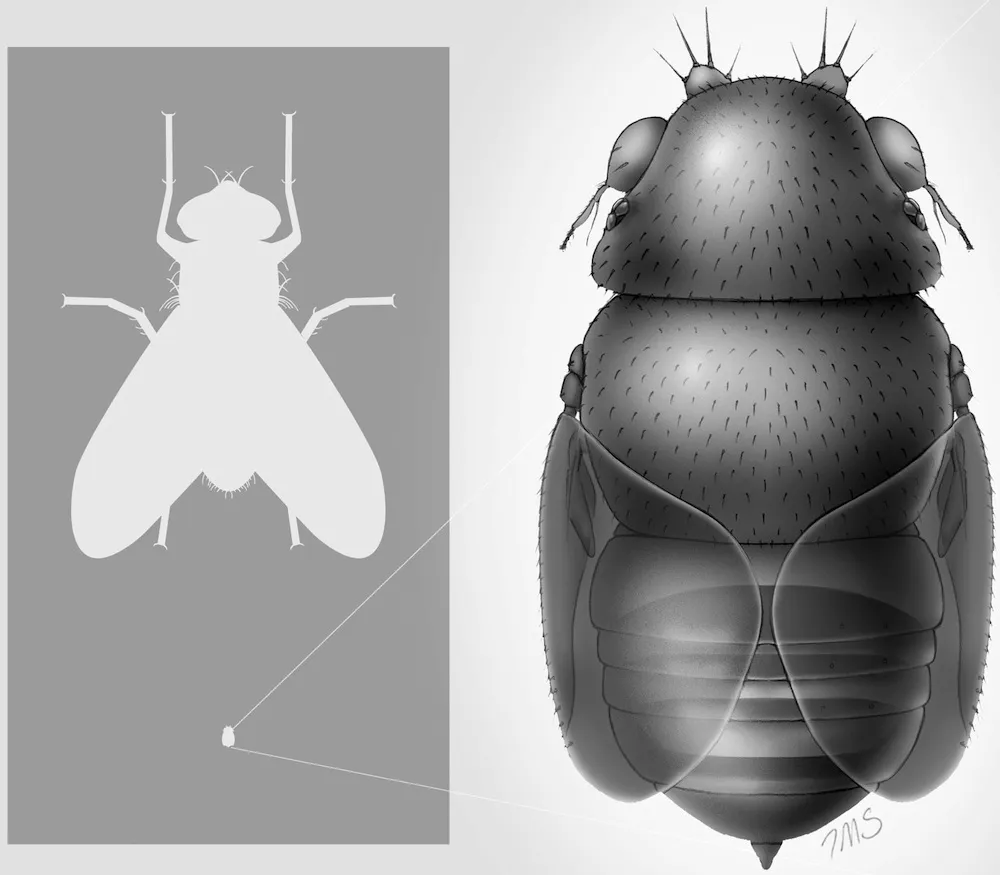
A new fly discovered in Thailand is the world's smallest. It is five times smaller than a fruit fly and tinier than a grain of salt (0.4 millimeters) in length — half the size of the smallest "no see-ums." It probably also feeds on tiny ants, likely decapitating them and using their head casings as its home.
"It's so small you can barely see it with the naked eye on a microscope slide. It's smaller than a flake of pepper," said Brian Brown, of the Natural History Museum of Los Angeles County, who identified the fly as a new species. "The housefly looks like a Godzilla fly beside it."
Thailand's tiny fly
The type specimen, a female, was picked up by the Thailand Inventory Group for Entomological Research in Kaeng Krachan National Park. The fly is the first of its kind discovered in Asia. [Microscopic Monsters: Gallery of Amazing Bugs]
It has smoky gray wings and the female they discovered has an egg-depositing organ that is pointed to make it easy to lay eggs inside another insect, as a parasitic fly would. While it's not the smallest insect (that title belongs a species of fairy wasp, coming in at 0.14 millimeters in length, about the size of a human egg cell), it is the world's smallest fly.
"When you get really small like that, the environment changes," Brown said. "The viscosity of air starts to become a problem and wind currents are major events. It's amazing how small something can be and still have all of its organs. This is a new frontier, and publishing this tiny fly is basically a challenge to other people to find something smaller," he said.
Feeding on ants
The researchers named the new fly Euryplatea nanaknihali. It comes from a group of 4,000 hump-backed flies called phorid flies. One genus of the fly, Pseudacteon, is known for its anti-ant behaviors, which include decapitation. They usually range from 0.04 inches to 0.12 inches (1 millimeter to 3 millimeters) in length, so they can only prey on larger ants.
The flies lay their eggs in the body of the ant; the eggs develop and migrate to the ant's head where they feed on the huge muscles used to open and close the ant's mouthparts. They eventually devour the ant's brain as well, causing it to wander aimlessly for two weeks. The head then falls off after the fly larva dissolve the membrane that keeps it attached.
The fly then takes up residence in the decapitated ant head for another two weeks, before hatching out as a full-grown adult. In this case, researchers think the fly parasitizes tiny acrobat ants, whose heads are about as large as the fly itself and grow to about 0.16 inches (4 millimeters) long.
They haven't been able to see this in action, but think it's likely in the newfound fly since the fly's closest relative decapitates ants in Equatorial Guinea.
Follow Jennifer Welsh on Twitter @microbelover or LiveScience @livescience. We're also on Facebook & Google+.

