














How to Spot Giant Asteroid Vesta in Night Sky This Week
With all the publicity on NASA's final space shuttle flight a few weeks ago, some people may have missed another cosmic milestone: On July 16, NASA's Dawn spacecraft entered orbit around the asteroid Vesta to spend the next year orbiting the space rock before heading off to an encounter with the dwarf planet Ceres.
Vesta is unusually bright among the asteroids because of its different mineral makeup. It is actually brighter than Pallas, the largest asteroid, and Ceres, the dwarf planet formerly classified as an asteroid. At 318 miles (512 kilometers) in diameter, Vesta is slightly smaller than Pallas, which is 326 miles (524 km). Both space rocks are much smaller than Ceres at 595 miles (957 km).
Did you know that you can see Vesta with your unaided eyes?
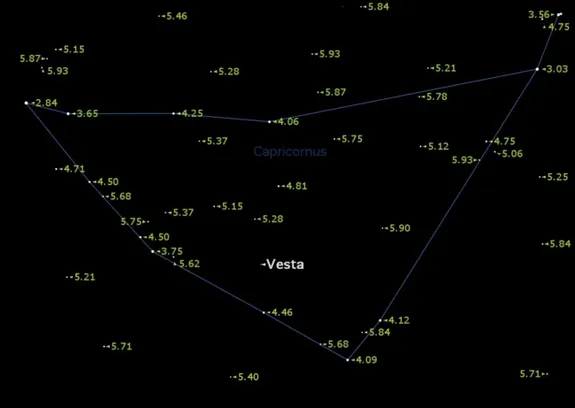
This week Vesta will be in opposition, its closest point toward Earth, and in an area of the sky with few stars, making it relatively easy to see. The sky map of Vesta available here shows where to look to spot the asteroid this week.
Strangely enough, being in an area bereft of stars can make this asteroid easier to see, because there are no bright stars nearby to confuse the viewer. However, it takes an experienced observer to spot the constellation in which it is located, Capricornus. [Close-Up Photos of Vesta]
How to spot Vesta
To see Vesta, you will need sharp eyes and a dark country sky.
Get the world’s most fascinating discoveries delivered straight to your inbox.
Most people will find a good pair of small binoculars a useful aid in locating the asteroid. Assuming you’re in the Northern Hemisphere, look towards the southern horizon around 1 a.m. local time. Bright Sagittarius will be off to your right, and due south will be the upside-down triangle of Capricornus.
As a whole, Capricornus is a constellation with few bright stars, but the stars that are visible form a very clearly marked triangle, with its brightest stars in its upper left and right corners.
The chart labels the stars with their magnitudes, their brightness measured on the upside-down scale which astronomers use, where the brightest stars are "1" and the faintest stars visible to the naked eye are "6."
Dark skies needed
Vesta is at the faint end of that scale at magnitude 5.6, but for the next week it will be located in a part of Capricornus which contains no stars anywhere near that bright, so Vesta will stand out against that dark area.
The skywatching chart mentioned earlier shows Vesta in its position at opposition on Friday, Aug. 5. It is moving from left to right in a line parallel to the lower right side of the Capricornus triangle.
Vesta moves about half the moon's diameter every 24 hours, so its movement will be obvious from one night to the next. In a telescope at high magnification, you can see it move over a few minutes watching.
This article was provided to LiveScience.com by Starry Night Education, the leader in space science curriculum solutions. Follow Starry Night on Twitter @StarryNightEdu.