













Developing a Light-based Cancer Detection Tool
This ScienceLives article was provided to LiveScience in partnership with the National Science Foundation.
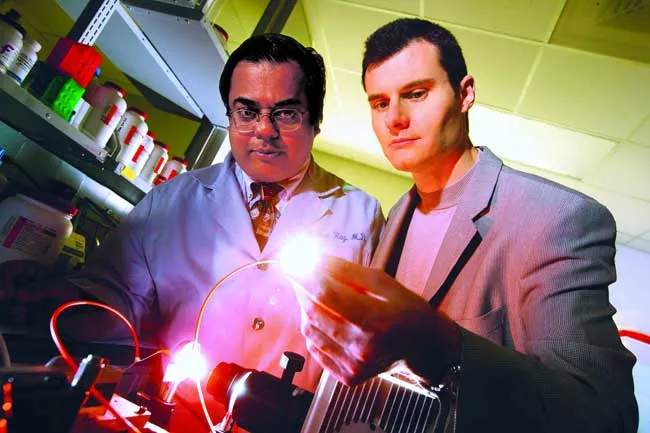
Occasionally, technologies emerge that revolutionize how medicine is practiced. The technology Northwestern University engineer Vadim Backman is helping develop may well fit that mold. Backman and his colleagues created a system that detects cancer—in the colon, lung, and even the pancreas—simply using reflected light. The technique is minimally invasive, requiring mere minutes of analysis on the outermost section of the colon (and no prior "cleansing"), a simple endoscopic procedure for detecting cancer of the pancreas, and as little as a CSI-friendly cheek swab for detecting lung cancer.
Backman works with a team of engineers and physicians from Northwestern University, NorthShore University Health System, and New York University, and they have already begun clinical trials. The technology is one of the latest developments in the field of biophotonics, a field that emerged in part from the efforts of biophotonics pioneer Leon Esterowitz, one of the developers of night-vision technology and medical lasers, and the NSF sponsor of Backman's work. See a video of Backman explaining his work here, and learn more about Backman's breakthroughs in a recent press release and an earlier webcast. Below, Backman answers the ScienceLives ten questions. Name: Vadim Backman Age: 37 Institution: Northwestern University Field of Study: Biomedical Engineering
What inspired you to choose this field of study? As an undergraduate majoring in physics I wanted to apply the principles of physics and engineering to help real people. Biomedical engineering was an excellent fit for me – I can still do engineering research while developing new technologies that may improve diagnosis and treatment of disease.
What is the best piece of advice you ever received? Never give up.
What was your first scientific experiment as a child? When I was six years old, I was trying to build a self-propelling machine based on expelling air. As it turned out, the device would break the law of energy conservation and, of course, did not work. But it took me almost the entire summer to learn that.
What is your favorite thing about being a researcher? The process of uncovering something new and unexpected. It is like watching a suspense movie all the time.
Get the world’s most fascinating discoveries delivered straight to your inbox.
What is the most important characteristic a researcher must demonstrate in order to be an effective researcher? Be able to think outside of the box.
What are the societal benefits of your research? I am developing a new technological platform for cancer screening by means of a simple and inexpensive test that anybody can benefit from.
Who has had the most influence on your thinking as a researcher? Great scientists I read about when I was a child, Einstein in particular.
What about your field or being a researcher do you think would surprise people the most? Many people think that researchers have an interesting, but quiet, no-stress job. In reality, it is very hard work with very long hours, lots of stress, and almost uninterrupted pressure from multiple deadlines. It is typically close to a 100 hour work week on a good week.
If you could only rescue one thing from your burning office or lab, what would it be? My laptop, definitely. It is not the hardware, it is the data that is so critical.
What music do you play most often in your lab or car? Italian opera – I am a big fan.
Below is a three-part video featuring Leon Esterowitz, Backman’s sponsor at NSF and a pioneer of medical laser and night vision technologies, describing the history of biophotonics and his own work on the Star Wars missile defense program and other efforts.
Editor's Note: This research was supported by the National Science Foundation (NSF), the federal agency charged with funding basic research and education across all fields of science and engineering. Any opinions, findings, and conclusions or recommendations expressed in this material are those of the author and do not necessarily reflect the views of the National Science Foundation. See the ScienceLives archive.