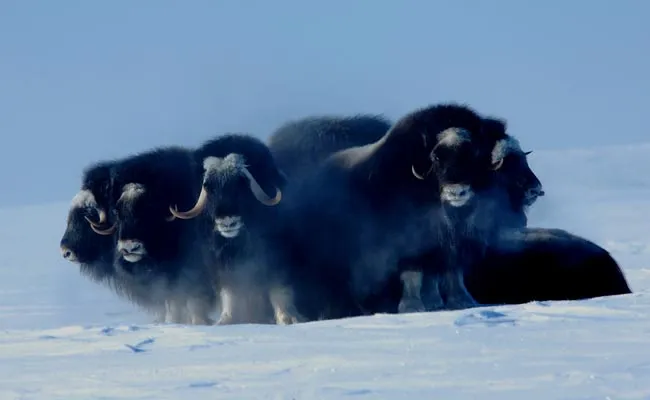
Creatures stranger and more ancient than Santa Claus inhabit the Arctic in winter. Musk oxen have long outlasted their Pleistocene Epoch counterparts, such as woolly mammoths and saber-toothed cats, in the wintery landscape of Alaska, northern Canada and Greenland.
"It's a little bit unclear why we have some species that survive and others that do not," said Joel Berger, Wildlife Conservation Society biologist and professor at the University of Montana. Survival was never guaranteed for musk oxen, either.
They disappeared from Russia and Northern Europe 20,000 years ago, and around 1880 the last musk ox was spotted in Alaska, where hunting was the likely culprit in their disappearance, Berger said. About 50 years later, musk oxen from Greenland were re-introduced to Alaska, where they remain.
Now Berger and his colleagues are trying to figure out what factors are causing musk oxen to thrive in some areas while only holding stable or declining in others.
Musk oxen are stocky, about 4 feet (1.2 meters) high at the shoulder for females and 5 feet (1.5 m) for males, with droopy-looking horns and double-layered wool, the soft inner layer of which is called qiviut. They are more closely related to sheep and goats than to oxen, according to the Alaska Department of Fish and Game.
They live in groups and appear to have a complex social structure; however, the details aren't yet understood, Berger said.
Their winter survival strategy is similar to that of a hibernating bear, although the musk oxen remain aboveground, he said. Bears become inactive and live off their body fat in the winter months; the musk oxen also use their stored fat for energy and keep activity to a minimum.
Sign up for the Live Science daily newsletter now
Get the world’s most fascinating discoveries delivered straight to your inbox.
As part of research conducted with colleague Layne Adams, a biologist with the U.S. Geological Survey, Berger has watched musk oxen in the winter, and "they just stand there," he said.
Not all populations have had the same success since being re-introduced, however. A group of about 400 musk oxen in the Arctic National Wildlife Refuge has declined to fewer than 30 since the 1990s. Meanwhile, a population at the Bering Land Bridge, the point in Alaska closest to Siberia, has grown, and another group of musk oxen, in Cape Thompson, Alaska, has stabilized.
Berger and Adams are in the process of studying variations in musk oxen mothers' ability to produce calves, and mothers' and calves' survival between the latter two sites. So far, they have seen some differences, but nothing extreme, he said.
Wynne was a reporter at The Stamford Advocate. She has interned at Discover magazine and has freelanced for The New York Times and Scientific American's web site. She has a masters in journalism from Columbia University and a bachelor's degree in biology from the University of Utah.