













Musk Ox Decline Is Not Our Fault

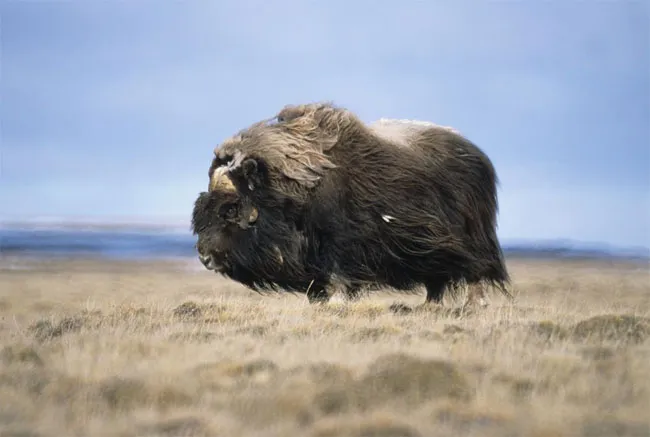
Humans have played a role in the extinction of many animals over the years, but when it comes to the musk ox — an Arctic mammal that started to decline around 12,000 years ago — we might be off the hook, at least for the downturns that took place long ago, a new study says.
"We found that, although human and musk ox populations overlapped in many regions across the globe, humans probably were not responsible for the decline and eventual extinction of musk oxen across much of their former range," said study author Beth Shapiro of Penn State University.
The study is the first to use ancient musk ox DNA collected across the animal's former stomping grounds to test for human impacts on the population, she said.
Not really oxen
Musk oxen are stocky, hooved animals with a thick coat of hair and curved horns. Although they look similar to oxen, they are actually more closely related to mountain goats and sheep than they are to cattle. The males, whose strong musky odor gave rise to the species name, stand about 4.4 feet (1.4 meters) tall and weigh about 750 pounds (340 kilograms).
These mammals were once plentiful across the entire Northern Hemisphere, but they now exist almost solely in Greenland and number only about 80,000 to 125,000 individuals.
Musk oxen were just one of several species to experience a decline at the end of the Pleistocene (an epoch from 2.58 million to 12,000 years ago), a period marked by both rapid environmental change and the spread of humans into new areas. Mammoths and woolly rhinoceroses went extinct at the end of this epoch.
Get the world’s most fascinating discoveries delivered straight to your inbox.
On the other hand, horses, bison and caribou survived into the present day.
"The reasons for these drastically different survival patterns have been debated widely, with some scientists claiming that the extinctions were due largely to human hunting," Shapiro said. "Musk oxen provide a unique opportunity to study this question, because they suffered from a decline in their population that coincided with the Pleistocene extinctions, yet they still exist today."
Climate vs. hunting
Shapiro and her colleagues collected musk ox bones and other remains from animals that lived during different times, as early as 60,000 years ago, and compared DNA from these samples with musk oxen alive today. They used statistical methods to study how the genetic diversity of the populations changed through time.
The results show the species' genetic diversity increased and decreased frequently over the past 60,000 years, indicating fluctuation in the species' population size.
The genetic diversity did not appear to be affected by the arrival of humans into the animal's range, the researchers say. In fact, both humans and the musk ox arrived and expanded simultaneously in Greenland.
These results point to climate change as a more likely possibility for the species decline.
Past climate vulnerability indicates that current global warming could affect the musk oxen's survival in the near future. "There's a lot in the news about the plight of polar bears, but musk ox may be similarly at risk," said study team member Tom Gilbert of the University of Copenhagen.
The results are published this week in the journal Proceedings of the National Academy of Sciences.
- Image Gallery: The World's Biggest Beasts
- Ancient Creatures Survived Arctic Winters
- Global Warming Likely Cause of Worst Mass Extinction Ever
