













Taking Over the World With My Bear Hands
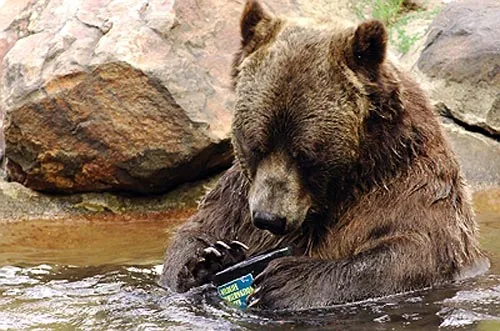
Sometimes, while I'm waiting for the death ray to warm up, I find myself staring at my soft pink hands and wondering – would I strike more fear in the masses if my innocent-looking mitts were replaced with, say, the paws of a grizzly bear?
It's a question every human being asks him- or herself at some point, I'm sure. But if I can weasel my way into the new Hand Transplantation Program at the University of California, Los Angeles, I might be able to turn my idle daydreaming into bloodcurdling reality. Which is just the way I like my reality.
The UCLA Hand Transplantation Program, launched on July 26, is recruiting amputee patients for a clinical trial of current hand transplant procedures, in an effort to move the surgery out of the shadowy experimental fringes of science and into the surgical mainstream. Of course, my proposed bear-to-human transplant would put the surgery back into those shadowy fringes, but that doesn't bother me.
Hand transplantation is an involved procedure, drawing on all the complicated parts of transplantation surgery, plastic surgery and orthopedic surgery. Hands sourced from dead patients must be painstakingly attached to their new bodies, the bones grafted together, muscles, nerves, and blood vessels joined, and the skin stitched up in a process that can take from eight to 12 hours. The proud owner of the secondhand limb then needs to undergo extensive physical therapy and take immunosuppressant drugs for the remainder of the hand's life, to prevent their body from rejecting it.
Now if the surgery weren't so complicated, I'd just do it on my own, in the privacy of my laboratory. But since transplants are no cakewalk, I'll need the surgeons at UCLA to give me a hand.
While hand transplantation is still experimental, it isn't exactly new; the procedure has been practiced since 1998, and there are at least 11 hands in the United States today that have traded bodies over the course of their lives. Worldwide, more than 40 people use different hands than the ones they were born with.
But most of these trades have been sorely lacking in imagination: Not only do surgeons look for donor hands that match their patient's size and skin tone, they even limit themselves to hands of the same species. With any luck, I can talk the doctors at UCLA out of their ridiculous conventions. They could at least stray so far as a gorilla's hand instead of a boring old human hand.
Get the world’s most fascinating discoveries delivered straight to your inbox.
Unfortunately for me, the program has guidelines about who gets new hands; patients need to undergo strict psychological evaluations to make sure they're of sound mind for the surgery. That could be a problem for me as a mad scientist since, by definition, my mind is anything but sound.
- More Mad Scientist: How Moles Could Tunnel into Fort Knox
- Bionic Humans: Top 10 Technologies
- Top 10 Mad Scientists
Mad scientist Eric Schaffer has one index finger on the "fire death ray!" button and his other index finger on the exciting pulse of scientific research. His accounts of diabolical machinations, as well as research breakthroughs, appear regularly on LiveScience.