













MagBeam Propulsion: To Mars And Back In 90 Days
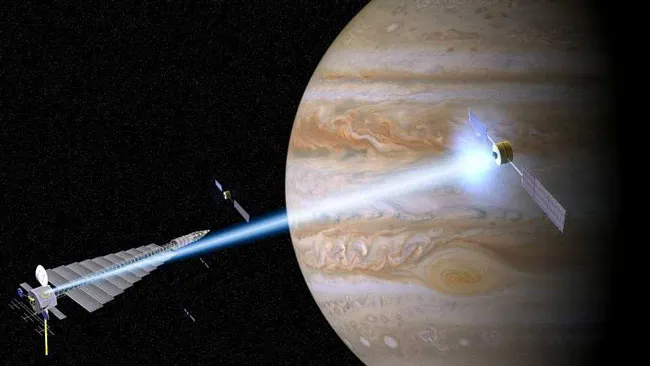
Magnetized-beam plasma propulsion, or MagBeam propulsion, could cut the time required for long journeys around the solar system from years to weeks. How can it do this? People usually think of a spacecraft as a ship with both payload and power source. The MagBeam system separates these two logical units; the power source stays in one place (for example, in permanent orbit around the Earth). Spacecraft are pushed to other parts of the solar system; the plasma beam also offers the potential for greater acceleration.
The idea of separating the spacecraft and its payload from its constant power source was first explored in science fiction in the excellent 1974 novel Mote in God's Eye , by Larry Niven and Jerry Pournelle . In the book, a battery of laser cannon were used to accelerate a small ship with a light sail to a significant fraction of the speed of light. The original idea for a laser-based propulsion system, where the power source sits in one place and powers a distant spacecraft, is credited to Robert L. Forward and dates from 1961.
The MagBeam propulsion system is being developed at the University of Washington; earth and space sciences professor Robert Winglee is leading the project.
"We're trying to get to Mars and back in 90 days," Winglee said. "Our philosophy is that, if it's going to take two-and-a-half years, the chances of a successful mission are pretty low."
MagBeam propulsion offers significant advantages over conventional rockets:
- One power source could be used to power multiple craft (serially, not at the same time).
- The power source could use solar energy, resulting in additional cost savings.
- Plasma propellants are accelerated to speeds an order of magnitude greater than those achieved by chemical rocket propellants, resulting in higher spacecraft velocities - at least 26,000 miles per hour.
A round trip to Mars would take 2 1/2 years using current technology. If the trip time could be shortened, many other difficulties (like the quantity of consumables and the psychological effects on the astronauts) could be greatly eased.
The system requires a power source at each end of a journey; one to accelerate the spacecraft at the start and another at the destination, to decelerate it. The spacecraft simply coasts during the journey from planet to planet; the astronauts would therefore experience weightlessness for most of the trip. Once MagBeam power sources were placed at destinations around the solar system, the system could be operated using solar power alone.
Get the world’s most fascinating discoveries delivered straight to your inbox.
So when can we expect a MagBeam test mission? According to Dr. Winglee, within 5 years if funding remains consistent. Residents of Seattle can attend the NASA Advanced Concepts Institute meeting early this week to learn more.
(This Science Fiction in the News story used with permission from Technovelgy.com - where science meets fiction .)