
 Live Science Plus


Robot Claims to be Sick
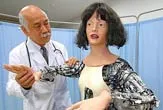
A robotic "sick patient" has been created by researchers at Gifu University's Graduate School of Medicine. They claim that this is the first robotic female patient that is able to both respond verbally to questions about how it feels, as well as move its body in ways that exhibit the symptoms of disease (see photo).
The intent is to provide students with an opportunity to have the closest thing possible to hands-on experience with rare medical conditions. For example, when suffering from myasthenia gravis--an often misdiagnosed neuromuscular disease leading to muscle weakness and fatigue--the robot tells the doctor its eyelids are heavy, and it changes its facial expression, slowly relaxes its shoulders and hunches forward. "It was difficult to get the shoulder joints and shoulder blades to move like a human," says researcher Yuzo Takahashi. "In the future, we want to program the robot with more symptoms and create a very realistic learning tool." This robot, which may seem a bit farfetched (after all, what's wrong with learning from real patients?), could nevertheless serve a real need. Medical students in a teaching hospital rotate quickly through each specialty; they only see those conditions that are present in the patients who happen to be in the hospital at that time. A versatile patient robot could model a much wider range of conditions than a small hospital might see in a month. On the other hand, physicians would point out that each patient "presents" differently; there is a range for Parkinson's, ALS and so forth. Perhaps the roboticists who created the "sick patient" robot could also program in a variety of sets of symptoms for each disease. Robots are making many contributions to the field of medicine: Beetle-Sized Robot Roams Your Body The robot is designed to enter the body through a small incision. First Powered Robotic Ankle Prosthesis MIT Media Lab director Hugh Herr, himself a double-amputee, demonstrated the world's first powered robotic ankle. Stroke Rehabilitation By Howard, The Robotic Hand A robotic therapy device that may help people regain normal strength and use of their hands following a stroke. Via Pink Tentacle. (This Science Fiction in the News story used with permission from Technovelgy.com - where science meets fiction.)
Get the world’s most fascinating discoveries delivered straight to your inbox.