Get the world’s most fascinating discoveries delivered straight to your inbox.
You are now subscribed
Your newsletter sign-up was successful
Want to add more newsletters?
Join the club
Get full access to premium articles, exclusive features and a growing list of member rewards.
An account already exists for this email address, please log in.
Colossal X-class solar flare erupts from 'rule-breaking' sunspot — and Earth is in the firing line
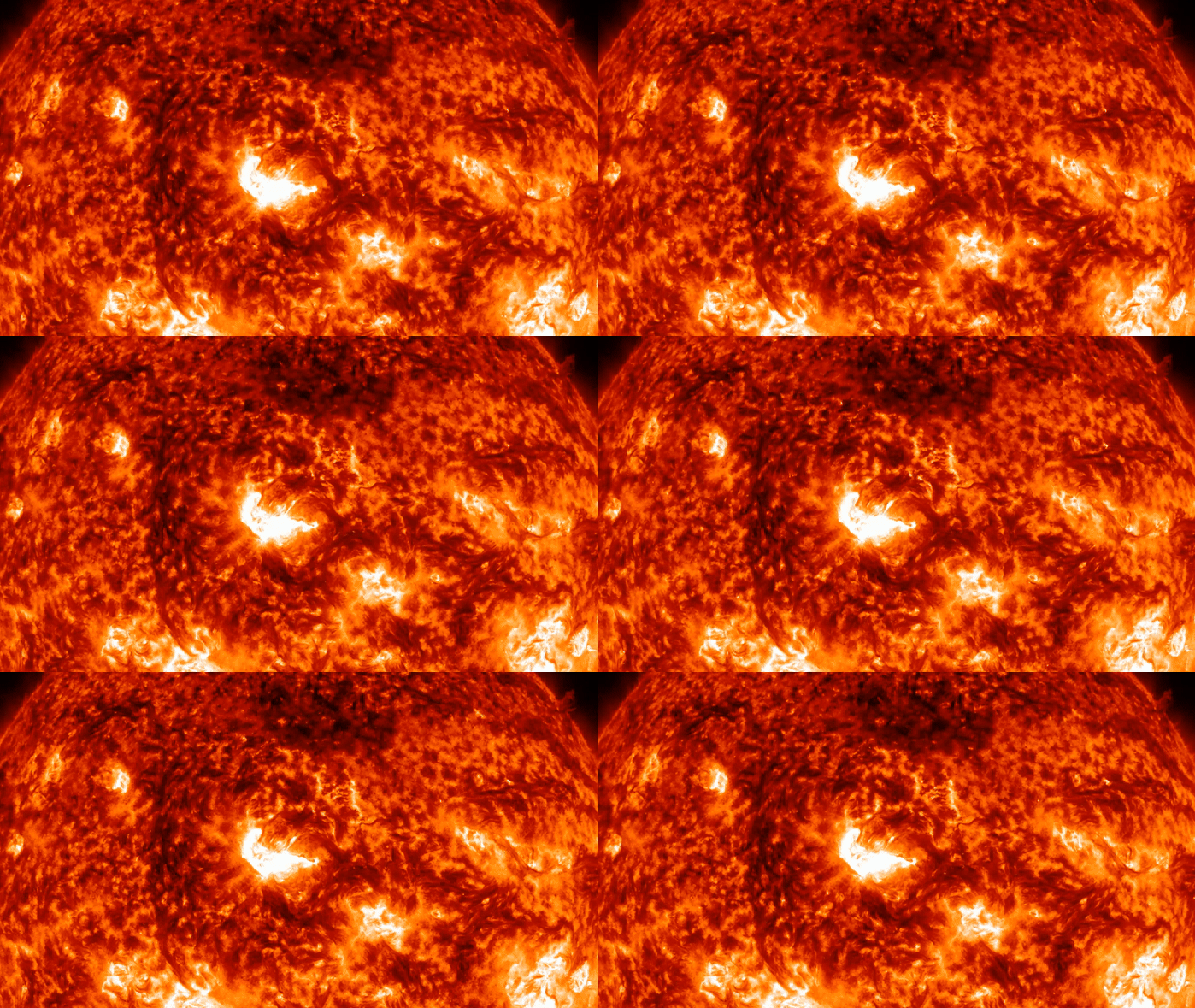
A 'rule-breaking' sunspot has fired off an extremely powerful X-class solar flare, launching a CME toward Earth that could bring vibrant weekend auroras.
The active sun is kicking into overdrive and we could be in for yet more dazzling auroras.
In the early morning hours of Aug. 14, the sun unleashed the most powerful class of solar flare, in a potent X-class eruption. The solar flare peaked at 2:40 a.m. EDT (0640 GMT) and caused shortwave radio blackouts over the sunlit portion of Earth at the time of the eruption, Asia and the Indian Ocean.
What makes this X-class solar flare particularly interesting is that it erupted from 'rule-breaking' sunspot AR3784 which had already garnered the attention of solar scientists and aurora chasers due to its strange polarity.
The sunspot's polarity breaks a hundred-year-old rule, Hale's Law, whereby sunspots in the Northern Hemisphere should be polarized -+. Instead, sunspot AR3784 is polarized ±, a whole 90-degree twist, according to Spaceweather.com.
It's not the first sunspot to break the rule, according to spaceweather.com, it happens approximately 3% of the time. However, a majority of "rule-breakers" show a "reversed polarity" of +- instead of -+, but AR3784 lies somewhere between the two.
An image of the sun produced using NASA's SDO HMI Magnetogram instrument displays positive fields colored green and blue with negative fields appearing yellow and red.
(Image credit: NASA's Solar Dynamics Observatory, SDO/HMI Magnetogram, graphic produced and labeled in Canva by Daisy Dobrijevic)
Experts at Spaceweather.com suggested that the "magnetic underpinnings of this sunspot are corkscrewing in an unusual way. If opposite magnetic polarities get twisted together too tightly, there could be an X-class solar flare." Lo and behold the sunspot did just that.
Sign up for the Live Science daily newsletter now
Get the world’s most fascinating discoveries delivered straight to your inbox.
Solar flares are eruptions on the sun's surface that release intense bursts of electromagnetic radiation. These flares occur when built-up magnetic energy in the solar atmosphere is suddenly released. They are classified by size into different categories, with X-class flares being the most powerful. M-class flares are 10 times less intense than X-class, followed by C-class flares, which are 10 times weaker than M-class. B-class flares are 10 times weaker than C-class, and A-class flares, which are 10 times weaker than B-class, have no significant effects on Earth. Within each class, numbers from 1 to 10 (and beyond for X-class) indicate the relative strength of the flare.
Powerful solar flares like the one released on Aug. 14 can often be accompanied by a coronal mass ejection — a large plume of plasma and magnetic field from the sun. It has since been confirmed that yesterday's X-flare hurled off a faint CME directly toward Earth.
The exact timing of when the CME will arrive is uncertain with NOAA's model suggesting an arrival date of Aug. 18 while NASA's model leans closer to Aug. 17.
Aurora hunters cross your fingers and charge those cameras! (If you hope to snap a photo of the northern lights, check out our guide on where and how to photograph auroras.)
CMEs carry electrically charged particles known as ions, and when these collide with Earth's magnetosphere, they can trigger geomagnetic storms. During these storms, the ions interact with gases in Earth's atmosphere, releasing energy in the form of light. This phenomenon is recognized as the northern lights, or aurora borealis, in the Northern Hemisphere, and as the southern lights, or aurora australis, in the Southern Hemisphere.
It wasn't just a CME that accompanied the X-flare but also a strong radio blackout. The shortwave radio blackouts detected over Asia and the Indian Ocean resulted from the intense burst of X-rays and extreme ultraviolet radiation emitted during the X-flare.
map showing a large red region which depicts the highest degraded frequency, the area lies over Asia and the Indian Ocean.
(Image credit: NOAA Space Weather Prediction Center)
Radiation from solar flares reaches Earth at the speed of light and ionizes the upper atmosphere upon arrival. This ionization creates a denser environment for high-frequency shortwave radio signals that facilitate long-distance communication to travel through.
As these radio waves pass through ionized (electrically charged) layers, they lose energy due to increased collisions with electrons, which can weaken or entirely absorb the radio signals.
Daisy Dobrijevic joined Space.com in February 2022 as a reference writer having previously worked for our sister publication All About Space magazine as a staff writer. Before joining us, Daisy completed an editorial internship with the BBC Sky at Night Magazine and worked at the National Space Centre in Leicester, U.K., where she enjoyed communicating space science to the public. In 2021, Daisy completed a PhD in plant physiology and also holds a Master's in Environmental Science, she is currently based in Nottingham, U.K.