













Monkey Math Mirrors Our Own
If you show someone a mouse and a cat and ask which is smaller, they'll quickly reply, "the mouse." Ask which is bigger, and it takes most people slightly longer to respond.
Conversely, if the two animals are large, such as a cow and an elephant, the typical person will be quicker at saying the elephant is larger than saying the cow is smaller.
Put another way: We can identify the smallest of two small things more quickly than the bigger. And we can identify the biggest of two big things more quickly than the smaller.
This rule, known to scientists from actual tests on people, is known as "semantic congruity," and it also holds true for comparing numbers and distances.
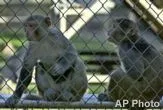
Until now, scientists thought the rule was rooted in our language abilities. But in a recent study by researchers at Duke University, a group of monkeys have shown a similar ability to tell the difference between large and small groups of dots.
Researchers showed macaque monkeys two arrays of randomized numbers of dots on a computer touch screen. Instead of asking the monkeys to choose the larger or smaller array of dots, the researchers gave cues by changing the color of the background behind the dots.
If the background was blue, the monkeys were supposed to touch the larger array. If it was red, they were to choose the smaller one. If they did a good job, they were rewarded with a sip of a sweet drink.
Get the world’s most fascinating discoveries delivered straight to your inbox.
"Clearly, even though their capability has nothing to do with language, it is nevertheless semantic in that the red and blue color cues carry meaning for the monkeys," said study co-author Jessica Cantlon. "Our results showed a very large semantic congruity effect. For example, when the number pair was small, such as two versus three, the monkeys were much faster at choosing the smaller compared to the larger of the pair."
This finding is the most recent in a series of discoveries that indicate our primate cousins display human-like characteristics. Monkeys like to gamble and enjoy looking at other monkeys' bottoms. Chimpanzees have been found to crack under social pressures.
"This is another piece of the puzzle showing us that the comparison mechanism that the monkeys use is, as far as we can tell, the same mechanism that humans are using," said study co-author Elizabeth Brannon.
This work was detailed online this week in the Proceedings of the National Academies of Science.