 Live Science Plus





You are now subscribed
Your newsletter sign-up was successful
Want to add more newsletters?

Delivered Daily
Daily Newsletter
Sign up for the latest discoveries, groundbreaking research and fascinating breakthroughs that impact you and the wider world direct to your inbox.

Once a week
Life's Little Mysteries
Feed your curiosity with an exclusive mystery every week, solved with science and delivered direct to your inbox before it's seen anywhere else.

Once a week
How It Works
Sign up to our free science & technology newsletter for your weekly fix of fascinating articles, quick quizzes, amazing images, and more

Delivered daily
Space.com Newsletter
Breaking space news, the latest updates on rocket launches, skywatching events and more!

Once a month
Watch This Space
Sign up to our monthly entertainment newsletter to keep up with all our coverage of the latest sci-fi and space movies, tv shows, games and books.

Once a week
Night Sky This Week
Discover this week's must-see night sky events, moon phases, and stunning astrophotos. Sign up for our skywatching newsletter and explore the universe with us!
Join the club
Get full access to premium articles, exclusive features and a growing list of member rewards.
Scientists have discovered the fastest bite in the world, one so explosive it can be used to send the Latin American ant that performs it flying through the air to escape predators.
These powerful jaws could serve as inspirations for the propulsion systems of miniature robots, "for instance for rescue operations," researcher Andrew Suarez, an ecologist and entomologist at the University of Illinois at Urbana-Champaign, told LiveScience.
ANT VIDEOS: Bite / High Jump / Long Jump
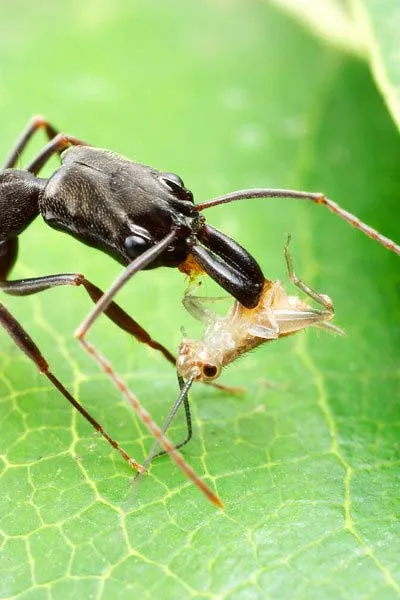
The researchers collected trap-jaw ants from Costa Rica.
Suarez distinctly remembered the first time he and fellow researcher Brian Fisher at the California Academy of Sciences in San Francisco dug up a trap-jaw ant colony "and had them shooting all over the place like popcorn—many of which landed on us and started stinging."
Suarez and Fisher, along with University of California at Berkeley researchers Sheila Patek and Joseph Baio, found the ant's jaws accelerate at 100,000 times the force of gravity. This means they can snap shut 2,300 times faster than a blink of the eye to reach speeds up to 145 mph, exerting forces 300 to 500 times the ant's body weight.
| Ants in Action |
| The mandibles of the trap-jaw ant close at speeds up to 145 mph, the fastest predatory strike in the animal kingdom. |
"Until recently, cameras were simply not fast enough to capture the movement of the mandibles," Suarez said. He and his colleagues had to use high-speed video cameras capable of taking up to 250,000 frames per second to film the ant jaws, roughly 10,000 faster than speeds movies are usually shot at.
Olympic feats
Falcons can dive as fast as 300 mph, but they rely on gravity and start from great heights. Aside from getting a gravity assist or other help, these snapping ant jaws are by far the fastest-moving body parts in the animal kingdom. The scientists reported their findings online Aug. 21 via the Proceedings of the National Academy of Sciences.
Experiments revealed the ants could use their jaws to snap at prey, strike at intruders or flee from predators.
In attacks against intruders, dubbed "bouncer defenses," the ants slam their mandibles against their targets—in experiments, thin strips of plastic or metal—presumably to injure them or bounce them away. Coincidentally, this can also catapult the ants up to 15 inches away. This distance, translated for a 5-foot-6-inch tall person, roughly equates to a record-shattering Olympic long jump of 132 feet.
When the researchers introduced predators such as spiders, the trap-jaw ants at times used so-called "escape jumps," directing their jaws toward the ground, launching themselves up to 3 inches in the air. For our 5-foot-6-inch Olympian, that's 44 feet. The world record in the high jump is just slightly over 8 feet.
Suarez is now working with colleagues to see if this jaw-powered propulsion the ants use could find use in engineering.
"It's just another example of looking towards nature and evolution to think of innovative solutions," he said.
All About Ants
- ANT VIDEOS: Bite / High Jump / Long Jump
- Ants More Aggressive When in Gangs
- Why Ants Rule the World
- Ant Gallery
Related Stories

