













Evidence Found for Ancient Supersized Sperm
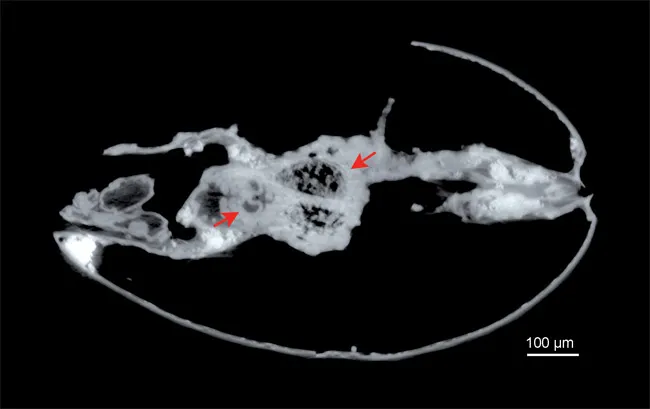
The fossilized remains of a tiny 100 million-year-old crustacean reveal evidence of what to her at least would have been giant sperm, measuring perhaps as long as her body. While the sperm itself was not preserved, 3-D images of the female's specialized receptacles indicate she had just finished having sex and that they were filled with sperm that has since degraded. (The oldest direct evidence of sperm comes from a springtail living some 40 million years ago, according to the researchers.) Called Harbinia micropapillosa, the tiny organism now found to bear evidence of degraded sperm was also an ostracod, crustaceans ranging in size from smaller than a poppy seed to as large as a meatball. The organisms are still around on Earth today and are equipped with up to eight pairs of appendages along their bivalve bodies. They are known for their supersized sperm relative to their body size, reaching a record-breaking 10 body lengths, or 0.2 inches (6 millimeters), in Propontocypris monstrosa. The males are likewise well-endowed, having correspondingly large copulatory organs to cope with their sperm, said lead researcher Renate Matzke-Karasz of Ludwig Maximilians University in Munich, Germany. (When sperm length reaches that of the organism's body, it can arguably be called "giant," Matzke-Karasz said.) Matzke-Karasz and her colleagues used holotomography, a type of 3-D scanning method, to look at the reproductive organs of specimens of H. micropapillosa (male and female remains), along with those of a living relative called Eucypris virens. Living ostracods like E. virens have reproductive organs separated into two systems located on both sides of the body. The males have two sperm pumps and two copulatory organs (aka penises), while females have two vaginal openings connected to long ducts that end in semen receptacles. The researchers found that three specimens of male H. micropapillosa contained hollow tubes at the back of the body, which were likely sperm pumps. The two female specimens showed paired cavities that corresponded with seminal receptacles, which are only known from ostracods reproducing with giant sperm. "The receptacles must have been filled with sperm in order to be preserved as two cavities," the researchers write. Empty receptacles are folded up inside the body and only take on their distinctive shape and size after sperm gets transferred into them. And if the ancient ostracods copulated like their modern counterparts, it would've been arduous. "The copulation itself takes a long time. They have to find each other, and during the act the female has to actively 'agree,' because otherwise she simply closes her carapace," Matzke-Karasz told LiveScience. "The copulation when it starts seems to be energetically costly because it can last up to one hour." The new research, detailed in the June 19 issue of the journal Science, shows ostracods were already reproducing with giant sperm well into the Mesozoic Era even though sperm and its associated organs can be energetically draining to organisms. "Now we can show that in spite of the costs, it must be a successful way to reproduce, since it 'survived' for such a long time," Matzke-Karasz said.
- Why Are 250 Million Sperm Cells Released During Sex?
- Rapid Evolution Gives Sperm the Advantage
- Animal Sex: No Stinking Rules
Get the world’s most fascinating discoveries delivered straight to your inbox.
Jeanna Bryner is managing editor of Scientific American. Previously she was editor in chief of Live Science and, prior to that, an editor at Scholastic's Science World magazine. Bryner has an English degree from Salisbury University, a master's degree in biogeochemistry and environmental sciences from the University of Maryland and a graduate science journalism degree from New York University. She has worked as a biologist in Florida, where she monitored wetlands and did field surveys for endangered species, including the gorgeous Florida Scrub Jay. She also received an ocean sciences journalism fellowship from the Woods Hole Oceanographic Institution. She is a firm believer that science is for everyone and that just about everything can be viewed through the lens of science.