 Live Science Plus





You are now subscribed
Your newsletter sign-up was successful
Want to add more newsletters?

Delivered Daily
Daily Newsletter
Sign up for the latest discoveries, groundbreaking research and fascinating breakthroughs that impact you and the wider world direct to your inbox.

Once a week
Life's Little Mysteries
Feed your curiosity with an exclusive mystery every week, solved with science and delivered direct to your inbox before it's seen anywhere else.

Once a week
How It Works
Sign up to our free science & technology newsletter for your weekly fix of fascinating articles, quick quizzes, amazing images, and more

Delivered daily
Space.com Newsletter
Breaking space news, the latest updates on rocket launches, skywatching events and more!
Once a month
Watch This Space
Sign up to our monthly entertainment newsletter to keep up with all our coverage of the latest sci-fi and space movies, tv shows, games and books.
Once a week
Night Sky This Week
Discover this week's must-see night sky events, moon phases, and stunning astrophotos. Sign up for our skywatching newsletter and explore the universe with us!
Join the club
Get full access to premium articles, exclusive features and a growing list of member rewards.
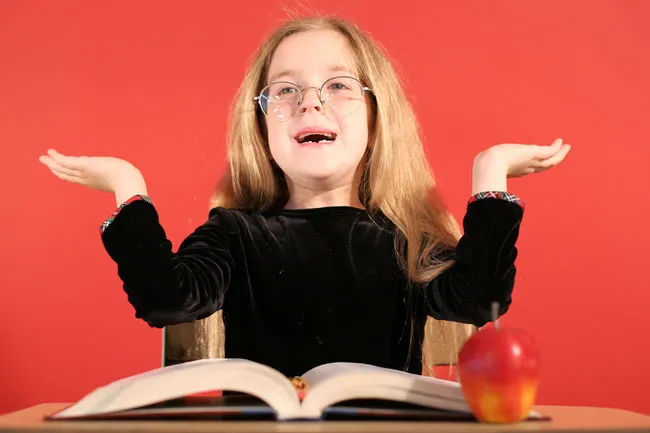
The difference between success and failure in school could be as simple as the flick of a wrist.
Children taught to gesture with their hands as they learn new concepts perform far better at solving similar problems weeks later than children who don't gesture, a new study finds.
Previous studies have shown that people who spontaneously gesture as they learn tend to remember new concepts better, but it has been unclear whether gesturing simply accompanies the process of learning or if it actually facilitates the process. Susan Wagner Cook, a University of Rochester psychologist, along with colleagues at the University of Chicago decided to test whether children who tend not to gesture on their own—but who are taught to gesture while learning a new concept—comprehend and remember the concept better than kids who are not taught to gesture.
Solve this
They split 84 third- and fourth-grade students into three groups and taught each of them how to solve math problems they were initially unable to solve correctly.
One group of the kids was taught to speak through the problems aloud as they solved them, such as by saying, "I want to make one side equal the other side." A second group was taught to speak through the problems aloud like the first group, but they were also taught to gesture in a specific way to convey the same idea. The third group was taught to gesture without speaking.
After this instruction, Cook's team tested the students to see which groups were able to solve similar problems by themselves. They found that all three groups performed comparably, many of the students having learned how to solve the problems correctly.
After four weeks, the students were asked to solve the same types of problems again in a classroom setting, without any further instruction. Those who were taught to gesture and speak through the problems remembered 92 percent of what they had previously learned, and those who gestured without speaking remembered 80 percent.
By contrast, the non-gesturing students remembered only 33 percent of what they had learned.
"When we want to convey a new concept to children, it certainly won't hurt to use our hands, or to get them to use theirs," Cook told LiveScience. "Gestures may be less precise than speech, but that may be precisely what learners need."
Why it works
Cook says it's not clear yet exactly why gesturing helps children remember what they have learned, but it could be that moving the body somehow helps the brain create stronger memories.
"Gestures engage the body, the mind and the environment, all at the same time," Cook said. "I think that all of these aspects, as well as the simultaneity, are probably part of the reason we see the effects of gesturing that we observed."
Cook, whose study will be published in the journal Cognition, hopes to design additional experiments to tease out exactly what gesturing does for memory , and she also wants to find ways to incorporate gesturing into the classroom. This "could certainly have profound implications, especially since gesture is free and readily available," she said.
- All About Memory
- Top 10 Mysteries of the Mind
- 10 Things You Didn't Know About You
