Live Science Plus





You are now subscribed
Your newsletter sign-up was successful
Want to add more newsletters?

Delivered Daily
Daily Newsletter
Sign up for the latest discoveries, groundbreaking research and fascinating breakthroughs that impact you and the wider world direct to your inbox.

Once a week
Life's Little Mysteries
Feed your curiosity with an exclusive mystery every week, solved with science and delivered direct to your inbox before it's seen anywhere else.

Once a week
How It Works
Sign up to our free science & technology newsletter for your weekly fix of fascinating articles, quick quizzes, amazing images, and more

Delivered daily
Space.com Newsletter
Breaking space news, the latest updates on rocket launches, skywatching events and more!

Once a month
Watch This Space
Sign up to our monthly entertainment newsletter to keep up with all our coverage of the latest sci-fi and space movies, tv shows, games and books.

Once a week
Night Sky This Week
Discover this week's must-see night sky events, moon phases, and stunning astrophotos. Sign up for our skywatching newsletter and explore the universe with us!
Join the club
Get full access to premium articles, exclusive features and a growing list of member rewards.
About 36 million years ago, a shark the length of two upright pianos chipped and lost its three-pronged tooth, possibly while crunching on a bony fish, a new study finds.
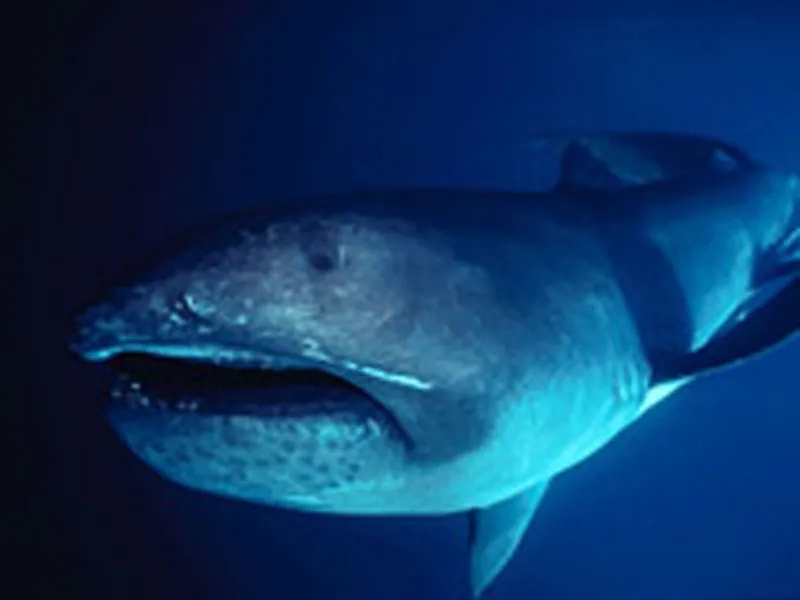
Based on that tooth, paleontologists have been able to name a previously unknown ancient species of megamouth shark, one that's related to the modern but rarely seen megamouth shark, Megachasma pelagios, the researchers said.
The newfound species, called Megachasma alisonae, is the oldest megamouth shark on record, and pushes back the existence of megamouth sharks by 13 million years, said the study's lead researcher Kenshu Shimada, a paleobiologist at DePaul University in Chicago. [In Photos: Seeing Sharks Up Close]
The distinct shape of the ancient tooth — which looks like a pitchfork with a prominent middle point and two side cusps — indicates that M. alisonae ate small fish, likely "by impaling them on the taller centrally placed crown," said study co-author David Ward, a retired research associate in the Department of Earth Sciences at the Natural History Museum in London, in the United Kingdom.
"It has been speculated that [the two side cusps] help shred the fish when the shark thrashes its head around, allowing the fish to be freed from the teeth and swallowed," Ward added.
The shape of the tooth suggests that M. alisonae had a different diet than the modern M. pelagios, a so-called filter feeder that gulps in water and feeds on plankton as it swims, and has teeth with one large main cusp and two tiny side cusps, Shimada said.
Single tooth
Ward and his colleagues discovered the tooth in 1988 after sieving through about 3,530 lbs. (1,600 kilograms) of sediment from the banks of eastern Denmark, along the North Sea. They found multiple shark teeth, but one stuck out.
"Most of the teeth that we got in the sample had shapes that were very similar to modern sharks and rays," Ward told Live Science. "This particular thing didn't fit into any of those categories."

Ward never formally published a study on the tooth, but he connected with Shimada at the Society of Vertebrate Paleontology meeting in 2015. Just the year before, Shimada and his colleagues had published a study in the Journal of Vertebrate Paleontology identifying the newfound but extinct megamouth shark Megachasma applegatei, which lived about 23 million years ago.
If there was evidence of an earlier megamouth shark, he wanted to see it, Shimada said.
The two scientists began working together, and wrote a study describing the ancient tooth from Denmark. A reviewer, however, encouraged them to declare that the tooth belonged to a newfound species, and so they named it after Ward's wife, Alison, who helped find the specimen.
Ward worried that this honor might be taken the wrong way, so in the acknowledgements he wrote, "We should also clarify that Alison Ward, after whom the new species is named, has no bearing to the etymology of the genus name Megachasma ('big mouth')." [7 Unanswered Questions About Sharks]
Megamouth history
The tooth of M. alisonae is small — just 0.15 inches tall by 0.17 inches wide (4 by 4.5 millimeters) — but it helped Shimada and Ward piece together clues about the shark. For instance, a toothy analysis revealed that the shark likely measured between 4.2 feet and 11.5 feet (1.3 and 3.5 meters) long, Shimada said.
Moreover, small chips in the tooth's enamel (called enameloid in sharks) on the main cusp, as well as the two side cups, suggests that M. alisonae ate large zooplankton and small fish with hard skeletal elements, Ward said.
The dental specimen's location also suggests that megamouth sharks may have originated near Europe, possibly in the North Sea or the Arctic Ocean, the researchers said.
However, it's unclear whether M. alisonae had the same behavior as the modern M. pelagios, which spends the daytime in waters at least 540 feet (165 m) deep, and then migrates up to shallow waters at night, following the plankton, Shimada said. Still, the location of the tooth suggests the ancient shark lived in relatively deep, open marine waters, the researchers said in the study.
In addition, M. alisonae was smaller than M. pelagios, which at 18 feet (5.5 m) is about the length of almost four upright pianos. The modern shark is also thought to have blue bioluminescent lips, which it likely uses to lure prey toward its mouth, Ward said.
A pre-print version of the study is available in the journal Acta Palaeontologica Polonica. The research was also presented on Oct. 27 at the 2016 Society of Vertebrate Paleontology meeting in Salt Lake City.
Original article on Live Science.