It's quick and easy to access Live Science Plus, simply enter your email below. We'll send you a confirmation and sign you up for our daily newsletter, keeping you up to date with the latest science news.
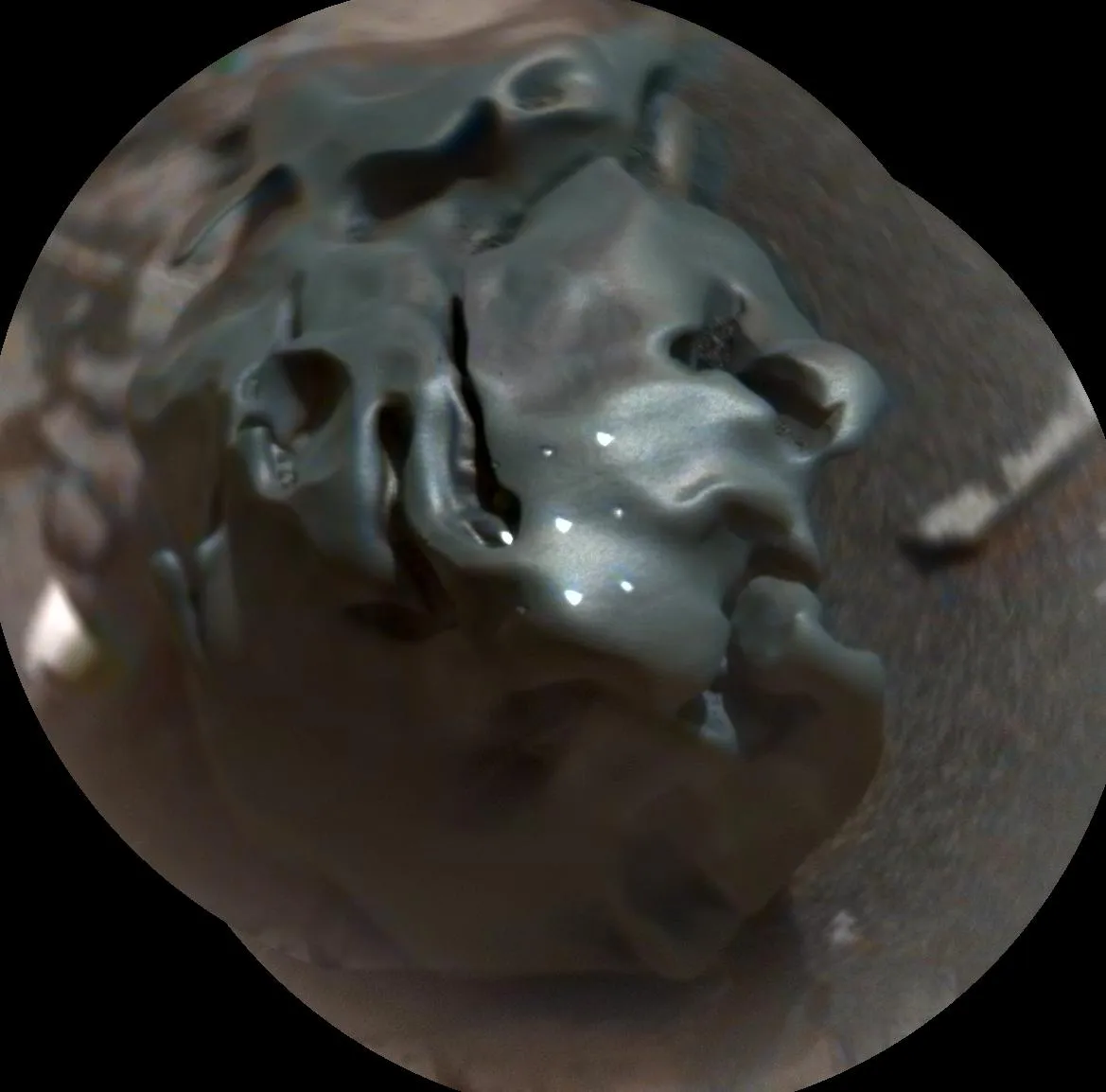
NASA's Mars rover Curiosity stumbled upon a dark grey, golf-ball-size object last week that looks nothing like the typical red-orange rocks that are normally seen on Mars.
To figure out exactly what this weird rock is and where it came from, Curiosity used its on-board rock-zapping laser to analyze the rock's chemical composition. This test revealed that it is an iron-nickel meteorite that fell from the Martian sky. Curiosity's science team dubbed the newfound meteorite "Egg Rock."
These types of meteorites have been discovered on both Earth and Mars in the past, but this is the first time that Curiosity's laser-firing spectrometer, the "ChemCam," has been used to study such a rock. [Here's What a Mars Meteorite on Earth Looks Like (Photos)]
This strange rock is made up of iron, nickel, phosphorous and a few other trace elements, which led scientists to conclude that it is a meteorite that is non-native to the Red Planet. These types of meteorites come from the molten cores of asteroids.
NASA's Mars Science Lab, also known as the Curiosity rover, spotted this strange, dark object on the Martian surface. The rover's Mast Camera (Mastcam) took this photo of the golf ball-sized meteor on Oct. 30, 2016. Further inspection with Curiosity's Chemistry and Camera (ChemCam) instrument revealed that the rock is an iron-nickel meteorite.
(Image credit: NASA/JPL-Caltech/MSSS)
Scientists working with Curiosity (the rover is the centerpiece of NASA's $2.5 billion Mars Science Laboratory (MSL) mission) first noticed Egg Rock on Oct. 30 in photos taken by the rover's Mast Camera, known as Mastcam.
"The dark, smooth and lustrous aspect of this target, and its sort of spherical shape attracted the attention of some MSL scientists when we received the Mastcam images at the new location," ChemCam team member Pierre-Yves Meslin said in the same statement.
Curiosity came across the meteorite in an area called the Murray formation in lower Mount Sharp. The rover will continue to explore this area as a part of its extended mission, which is focused on learning how Mars' environment changed over time, and whether the environment could have possibly harbored life in the past.
Sign up for the Live Science daily newsletter now
Get the world’s most fascinating discoveries delivered straight to your inbox.
Hanneke Weitering is an editor at Liv Science's sister site Space.com with 10 years of experience in science journalism. She has previously written for Scholastic Classroom Magazines, MedPage Today and The Joint Institute for Computational Sciences at Oak Ridge National Laboratory. After studying physics at the University of Tennessee in her hometown of Knoxville, she earned her graduate degree in Science, Health and Environmental Reporting (SHERP) from New York University. Hanneke joined the Space.com team in 2016 as a staff writer and producer, covering topics including spaceflight and astronomy.

 Live Science Plus