













Scientists Untangle Chemistry of Frankincense to Develop 'Perfume'

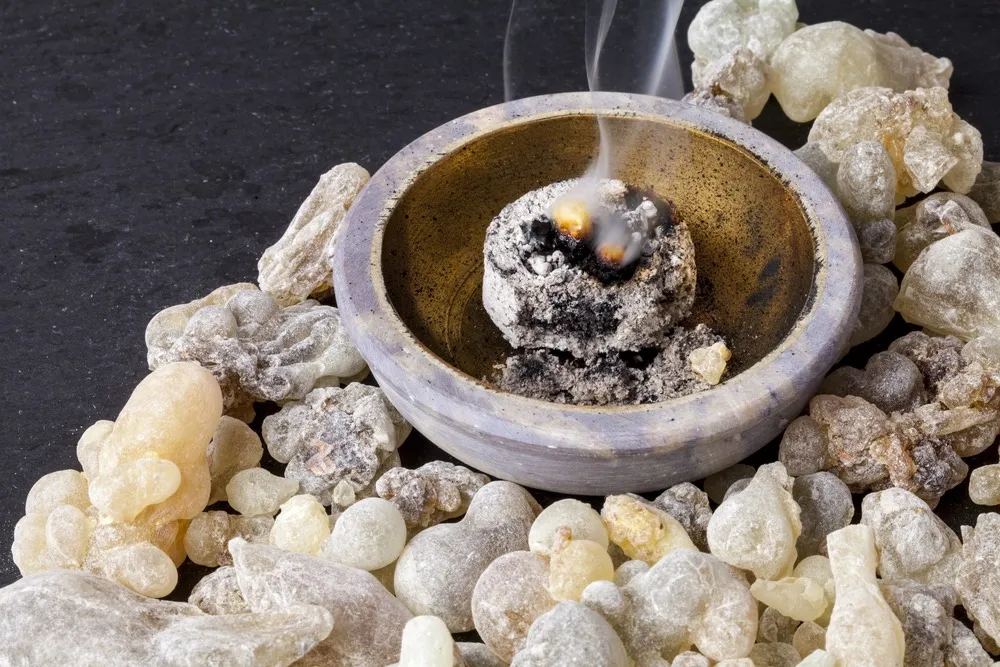
Two never-before-seen molecules are responsible for the "old church" scent of frankincense, one of the gifts given to baby Jesus and a well-known incense "flavor."
Researchers distilled the odor-creating molecules of the ancient perfume to find the two new compounds, now dubbed olibanic acids.
"They are contained in extremely low amounts" — less than 100 parts per million in the essential oil for the most potent molecule, study leader Nicolas Baldovini, a chemist at the Institute de Chimie de Nice in France, wrote in an email to Live Science. "Therefore, their isolation is very difficult."
Mystery molecules
Frankincense may well be the oldest fragrance used by humans, Baldovini said. The scent comes from the resin of gum trees of the genus Boswellia, and it was burned as incense in ancient Mesopotamia and Egypt. The oldest archaeological evidence for frankincense use dates back to the late fourth millennium B.C. Frankincense is also mentioned repeatedly in the Bible: The Queen of Sheba brings it to King Solomon, and the three Magi gift some of it to baby Jesus. [The Holy Land: 7 Amazing Archaeological Finds]
"As for many natural aromatic raw materials, the nature of its key odorants was still poorly understood," Baldovini said, adding that he had personal reasons to want to study frankincense. "I really love its odor," he said.
Baldovini and his colleagues painstakingly broke down the essential oil of frankincense into its constituent parts through a multistep process of extraction and distillation. They used human sniff testers to determine which fractions of frankincense were responsible for its smell.
Synthesized frankincense
In this process, the researchers identified a particularly interesting "odor zone" that smelled of the "typical balsamic, old church-like endnote of frankincense," they wrote online Oct. 4 in the journal Angewandte Chemie: International Edition. Further analysis revealed the relevant molecules to be one (+)-trans- and one (+)-cis-2- octylcyclopropyl-1-carboxylic acid. In chemistry, "trans" and "cis" indicate a mirror-image molecule. The structure is the same in each, but they are arranged in opposite directions.
Get the world’s most fascinating discoveries delivered straight to your inbox.
It was a bit surprising to find that previously unknown molecules explained frankincense's distinctive smell, Baldovini said. He and his colleagues were able to synthesize synthetic versions of the molecules, which could be used by the perfume industry.
"We patented the use of these compounds for fragrance formulation," Baldovini said.
Original article on Live Science.

Stephanie Pappas is a contributing writer for Live Science, covering topics ranging from geoscience to archaeology to the human brain and behavior. She was previously a senior writer for Live Science but is now a freelancer based in Denver, Colorado, and regularly contributes to Scientific American and The Monitor, the monthly magazine of the American Psychological Association. Stephanie received a bachelor's degree in psychology from the University of South Carolina and a graduate certificate in science communication from the University of California, Santa Cruz.